
Quick Navigation
- The short answer: when to add copepods to a new tank
- When to add copepods to a new tank: never during the cycle
- How to know it is time to add copepods to a new tank
- Phytoplankton first, copepods days later
- Why the fishless window is the answer to when to add copepods to a new tank
- How many copepods to add to a new tank
- Your stocking list decides when to add copepods to a new tank
- How to add copepods to a new tank on the day they arrive
- Give your copepods a safe place to breed
- Feeding after you add copepods to a new tank
- Switch off the UV when you add copepods to a new tank
- A week by week plan: when to add copepods to a new tank and what comes next
- Missed the window on when to add copepods to a new tank?
- Five mistakes people make on when to add copepods to a new tank
- Growing your own copepods alongside the tank
- FAQs
If you are standing in front of a freshly cycled tank wondering when to add copepods to a new tank, you are asking the right question at exactly the right moment. Most people ask it too late, after the fish are already in, and spend the next year trying to build a pod population against a tank full of mouths. You still have the choice, and the answer you pick now will shape how your reef feeds itself for years.
I have been culturing live copepods, phytoplankton and rotifers here in Wales since 2008, and in 18+ years the question I answer most often from new marine keepers is some version of "is it time yet?" Just this week I had an email from someone on his very first marine tank, still mid-cycle, asking how much to order and how often to feed. My first piece of advice was not to order anything yet. This post is the longer version of that conversation, written so you can get the timing right without guesswork.
The short answer: when to add copepods to a new tank
Add copepods once ammonia and nitrite have both read zero and held there, after your post-cycle water change, and before your first fish. Start phytoplankton a day or two beforehand so there is food waiting. That window, between a finished cycle and a first fish, is the single best opportunity you will ever get to establish a pod population, because there is nothing in the tank eating them.
That is the whole answer on when to add copepods to a new tank, but the detail matters, because each part of it exists for a reason. Get one part wrong and you either kill the pods you paid for or you build a population that never gets off the ground. The rest of this post explains the why, and then gives you a schedule you can follow.
When to add copepods to a new tank: never during the cycle
This is the mistake I see most often, and it usually comes from a good place. People reason that copepods are part of the natural biology of a reef, so adding them early must help. It does not. Copepods are not nitrifying bacteria. They do not process ammonia, they do not shorten your cycle, and they cannot survive the ammonia and nitrite spikes that a cycling tank goes through.
Tigriopus californicus, the harpacticoid species we culture, is a tough animal. It tolerates swings in temperature and salinity that would finish off many other species. What it cannot tolerate is free ammonia and nitrite at cycling levels. Add a bottle during the spike and most of it dies within days, and every dead copepod becomes extra organic load for the bacteria you are trying to establish. You have paid to slow your own cycle down.
The same applies to phytoplankton. Live phyto in a tank with no animals to eat it and no stable bacterial population just breaks down and feeds the nuisance algae you are about to fight in the ugly stage. So the rule is simple: no live foods of any kind until the test kit says the cycle is done. If you want the full picture on getting to that point, my guide on how to cycle a marine aquarium covers every route, dry rock, live rock and no rock.
Live Copepods
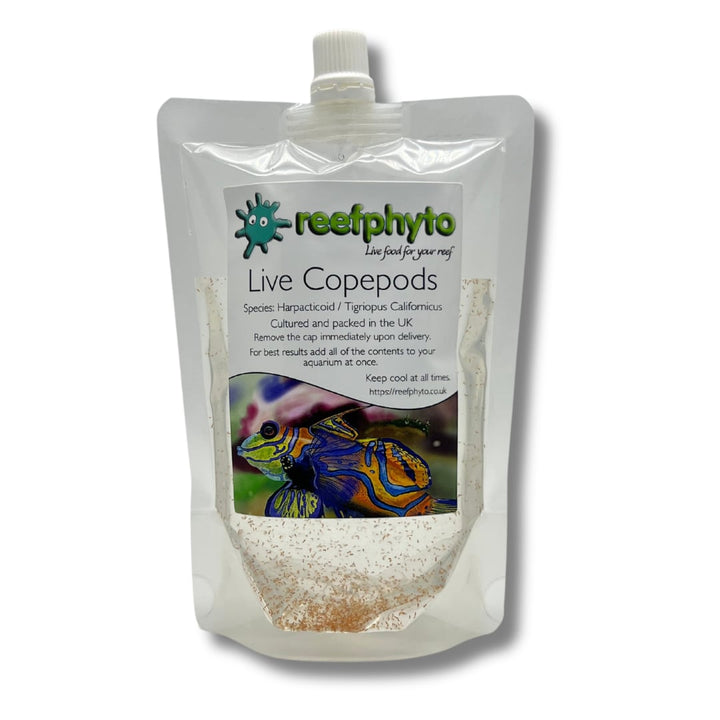
£11.99
Live Copepods UK: Tigriopus californicus, Cultured Fresh in Wales by Reefphyto Your reef looks right on paper. Clean water, stable parameters, good equipment. But something is still off. Your fish are pale, your mandarin is wasting, your corals are feeding… read more
How to know it is time to add copepods to a new tank
"Finished cycling" gets used loosely, so here is what I mean by it. Ammonia reads zero. Nitrite reads zero. Both hold at zero for at least 24 hours after you have dosed your ammonia source, which proves the bacteria can process a full day's load. You then do a large water change to bring nitrate down, because a fresh cycle usually leaves plenty behind.
Once those boxes are ticked, you know exactly when to add copepods to a new tank: now. You do not need to wait for coralline algae, a full diatom bloom or a particular number of weeks. In fact, a thin brown diatom film on the sand and rock is a good sign rather than a problem, because harpacticoid copepods graze biofilm and that film is part of what they will live on while they settle in.
Two quick checks before you order. Make sure your salinity is where it will stay, around 1.025 to 1.026, because we culture at reef salinity and you want the pods to arrive into water that matches. And if you run UV, plan to switch it off for the first few weeks, which I explain further down.
Phytoplankton first, copepods days later
When you add copepods to a new tank, phytoplankton should already be going in, leading by a day or two. Think of it as stocking the larder before the guests arrive. Copepods poured into a sterile tank with nothing to eat will graze biofilm for a while, but they breed far faster when there is suspended microalgae available from day one.
5 Species Phytoplankton is the one I would start with in a new tank. It is a blend of five microalgae spanning roughly 1 to 20 microns, which covers everything from copepod nauplii and bacteria up to adult pods and the first filter feeders you add later. In a new, lightly stocked tank, dose 1ml per 27 litres daily. Once you are moderately stocked move to 1ml per 18 litres, and heavily stocked reefs with lots of filter feeders sit at 1ml per 9 litres. If you would like to try a small amount first, the Phyto Shot is a ready-to-use pouch with no commitment.
Dose it in the evening or under reduced lighting, into a high-flow area, and switch your skimmer off for an hour or two so it has time to be eaten before it gets pulled out. There is more on this in my post on phytoplankton dosing in a reef tank.
Why the fishless window is the answer to when to add copepods to a new tank
Every copepod population in a reef tank lives in a balance between how fast it breeds and how fast it gets eaten. In an established tank with a pair of clowns, a wrasse and a goby, predation starts the moment the pods leave the bottle. Many are eaten before they reach the rockwork, and the survivors spend their lives hiding rather than breeding.
This is why when to add copepods to a new tank matters so much: in a fishless tank, that pressure is zero. The pods spread through the rock, move into the sand bed, find their way into the sump and start breeding immediately. Tigriopus californicus goes from egg to breeding adult in a matter of weeks at reef temperatures, and each female carries several broods of eggs over her life. Over six to eight weeks of consistent phytoplankton feeding, a single introduction becomes a standing population spread through the whole system, including places no fish can reach.
That is why deciding when to add copepods to a new tank is really a decision about whether your pods start with a head start or a handicap. The same bottle of copepods is worth far more in an empty tank than it will ever be once fish are in. Most people do it the other way round and then wonder why the population never takes.
How many copepods to add to a new tank
The amount depends on your total system volume, including the sump, and on what you plan to keep. These are the introduction amounts I recommend for Live Copepods in a new tank:
| System volume (including sump) | Introduction amount | Monthly top-up for the first 2 to 3 months |
|---|---|---|
| Nano, under 60 litres | 100ml | 100ml |
| 60 to 200 litres | 250 to 500ml | 100 to 250ml |
| 200 to 400 litres | 500ml | 250ml |
| 400 litres and above | 500 to 1000ml | 250 to 500ml |
Knowing when to add copepods to a new tank is half the job; the amount is the other half. Go to the top of the band if your stocking list includes sand sifters or obligate pod eaters, which I cover in the next section. The monthly top-ups are not about replacing pods that died. They add fresh genetics and extra breeding adults while the population is still building, which gets you to a self-sustaining level faster. For a deeper look at quantities, see how many copepods should I add to my tank.
If you are on a nano, the Pod-Shot is a concentrated single-dose pouch that suits smaller systems well.
Your stocking list decides when to add copepods to a new tank
This is the part people rarely think about when deciding when to add copepods to a new tank, and it changes the answer more than tank size does. Before you order, write down every fish and invertebrate you plan to keep over the next couple of years, not just the first few.
Some animals live or die on copepod density. The mandarin dragonet is the famous one, but scooter blennies, leopard wrasse, pipefish and many dragonets fall into the same group. If any of these are on your list, the fishless window is not optional. Seed heavily, keep the top-ups going, and give the population a minimum of three months, ideally longer, before the obligate feeder goes in. My mandarin dragonet care guide explains why the six-month die-off is so common and how to avoid it.
Other animals do not need pods to survive but still put heavy pressure on them. Sand sifters are the big one. A diamond watchman goby strains mouthfuls of sand all day, and a sand sifting starfish works the substrate continuously from below. In a 230 litre system, the two together will strip sand bed fauna faster than it replaces itself. If sand sifters are on your list, go up a size at introduction and give the pods somewhere to breed out of reach.
If your list is clowns, a royal gramma, a couple of blennies and a cleaner shrimp, none of which rely on pods, you can take a lighter approach. Copepods are still worth adding for the natural grazing, detritus processing and food for corals, but you are not racing a clock.
How to add copepods to a new tank on the day they arrive
Once you have decided when to add copepods to a new tank, plan the delivery for a day you are home. Copepods travel well, but they do best when they go in the day they arrive. Float the bottle for fifteen to twenty minutes to match temperature. Because we culture at reef salinity, you do not need a long drip acclimation for salinity, although a small splash of tank water into the bottle does no harm.
Where you pour them matters more than people think. In a tank with a sump, the refugium or a quiet sump chamber is ideal, because the pods can settle into rubble and macroalgae before they get pulled into the display. In an all-in-one or a tank with no sump, turn the lights off, turn the flow down, and pour them slowly onto the base of the rockwork with a feeding syringe or straight from the bottle.
Switch the skimmer off for an hour or two and leave any filter socks out for the evening. Do it at lights-out if you can, because harpacticoid copepods are most active in darkness and will head for cover in the rock naturally. If you are building a refugium for the first time, my guide on how to set up a refugium for copepods is worth reading first.
Give your copepods a safe place to breed
If you add copepods to a new tank built on dry rock, there is very little structure for pods to hide and breed in. Live rock is full of crevices built up over years, but dry rock is comparatively smooth, and a bare sump chamber has nothing at all. That is fine while the tank is fishless, but the moment fish go in, pods out in the open become food rather than breeders.
That is the reason we designed the PodHide, a copepod shelter 3D printed here in Wales from reef-safe PETG. You seed it through the holes, sit it in the sump or on the rockwork, and it gives the pods a protected space to complete their breeding cycle while their offspring drift out into the tank. For nanos and smaller sumps, there is the PodHide Nano, and the PodHide and Copepod Bundle is the cheapest way to get the shelter and the pods together. It is not essential, but in a new tank heading for sand sifters or a mandarin, it earns its place. I wrote about the idea behind it in the copepod breeding shelter.
Reefphyto PodHide – Reef Tank Copepod Shelter & Breeding Station

£28.95
Reefphyto PodHide: Reef Tank Copepod Shelter & Breeding Station You added copepods three weeks ago. The mandarin hunted well for a few days. The wrasse picked through the rockwork with obvious interest. Then the activity slowed, the hunting behaviour became… read more
Feeding after you add copepods to a new tank
Copepods are not a daily purchase. They are an initial seed plus monthly top-ups. Phytoplankton is the daily part, and it is the part people skip. Without a food source going in, the population will grow to whatever the biofilm can support and then stall, which in a new tank with little life is not very much.
So once you add copepods to a new tank, the routine is phyto every day, at the light rate while the tank is lightly stocked, stepping up as you add livestock. For a 230 litre system at 1ml per 27 litres, that is roughly 8 to 9ml a day. Once you reach a medium stocking level at 1ml per 18 litres, it becomes around 13ml a day. Our phytoplankton keeps refrigerated for six weeks from delivery, so buy the size you will actually use in that time rather than the biggest bottle.
If you would rather feed a PodHide or refugium directly, Copepod Feed is a four-species microalgae blend designed for that job. Reef Juice is another option once corals start going in, dosed at 5ml per 100 litres one to two times weekly alongside your daily phyto.
Switch off the UV when you add copepods to a new tank
If your new system has a UV steriliser, turn it off while the pods establish, and ideally while the phyto is being dosed. Copepod nauplii, the tiny larval stage, drift in the water column and pass through the UV unit along with everything else. Phytoplankton does the same. Running UV during the establishment phase is like seeding a lawn and then mowing it daily. I covered this properly in UV steriliser in a reef tank: is it eating your pods?
A week by week plan: when to add copepods to a new tank and what comes next
Here is how I would sequence a new system from the end of the cycle to the first fish, if copepods matter to your plans.
| Timing | What to do |
|---|---|
| Cycle complete | Ammonia and nitrite at zero for 24 hours. Large water change. UV off. |
| Day 1 | Start 5 Species Phytoplankton at 1ml per 27 litres daily, evenings, skimmer off for an hour or two. |
| Day 2 to 3 | Add Live Copepods at lights-out into the refugium, sump or base of the rockwork. Seed a PodHide if using one. |
| Weeks 1 to 4 | Daily phyto. Clean-up crew can go in. Check the glass with a torch after dark from week three. |
| Week 4 | First copepod top-up. First hardy fish can go in if pods are visible at night. |
| Weeks 6 to 8 | Population should be carrying itself. Second top-up. Continue stocking slowly. |
| Month 3 onwards | Final top-up. Obligate pod eaters only once the population is clearly established. |
None of this is set in stone. If you have a big refugium full of chaeto and live rock rubble, you will get there faster. If you are on dry rock with no sump, give it longer. The torch test is your guide: after lights-out, a healthy population shows as small white or orange specks moving on the glass and rock. If you see none after four weeks of feeding, something is limiting them and it is worth getting in touch.
Missed the window on when to add copepods to a new tank?
If you are reading this after the fish went in, do not worry, you have not missed out entirely. You can still build a population, it just takes more effort. Add copepods at lights-out, target the sump or refugium rather than the display, use a shelter so they have somewhere to breed, and keep the phytoplankton going daily. Expect to top up more often in the first few months. My post on how often to add copepods to a reef tank covers this in more detail.
The principle is the same either way. Knowing when to add copepods to a new tank is really about giving them the best possible start. An empty tank gives them that for free. A stocked tank means you have to create it with shelter, food and timing.
Five mistakes people make on when to add copepods to a new tank
The first is getting when to add copepods to a new tank wrong and adding them during the cycle. The second is adding copepods with no food plan, so the population peaks on biofilm and then fades. The third is pouring them into the display in the middle of the day with the pumps on full, where most get chopped up in the return pump or swept into a filter sock before they ever reach the rock. The fourth is running UV and a skimmer on full from day one. And the fifth, the costly one, is adding a mandarin or another obligate feeder within the first few weeks because "the tank has pods". It may have pods, but it does not yet have enough of them to feed a fish that eats all day.
Avoid those five and you are already ahead of most new reef tanks. When to add copepods to a new tank is not complicated. It just rewards patience in a hobby that tempts us to rush.
Growing your own copepods alongside the tank
Whatever you decide about when to add copepods to a new tank, if you are planning a mandarin or another pod-dependent fish, a home culture running alongside the tank gives you a reserve you control. A Copepod Culture Kit fed on Copepod Feed will supply regular harvests into the display, which is far more reliable than waiting for the tank to produce enough on its own. Many of my customers start a culture during the cycle, while they are waiting, so it is producing by the time the tank is ready. My guide on how to successfully culture copepods takes you through it step by step, and a copepod sieve makes harvesting cleaner.
If you are unsure what to order for your system, tell me your total water volume and your stocking plan and I will tell you exactly what I would do. Knowing when to add copepods to a new tank is one decision, but getting the amount and the food right alongside it is what turns a bottle of pods into a population that lasts.
If you have questions about when to add copepods to a new tank, get in touch. I answer every message personally.
Darren
Founder, Reefphyto Ltd - Wales, UK - Est. 2008