Quick Navigation
- What a UV Steriliser in a Reef Tank Actually Does
- What a UV Steriliser in a Reef Tank Does Not Do
- Does a UV Steriliser Kill Copepods?
- How Quickly Your Dosed Phytoplankton Reaches the Bulb
- Should a UV Steriliser in a Reef Tank Run Continuously or Only During an Outbreak?
- Simple Habits for Using a UV Steriliser in a Reef Tank With Live Foods
- Seeding Pods After Running a UV Steriliser in a Reef Tank
- Getting the Balance Right
- FAQs
You have dosed your phytoplankton, the water has that faint green tint for a moment, and then you glance at the sump and see the blue glow of your UV steriliser humming away. It is a question I am asked almost every week: is running a UV steriliser in a reef tank quietly undoing all the good work you have just done with your live foods? The honest answer is that it can, but only for certain organisms, at certain times, and there are a few very simple habits that fix it.
I have been culturing copepods, phytoplankton and rotifers here in Wales for 18+ years, and I have spent a lot of that time talking reef keepers through exactly this problem. What prompted this post is an article Reef2Reef published on Monday, UV Sterilizers in Reef Tanks: What They Actually Do and Don't Do. It is a balanced, neutral piece, and it says plainly that running UV continuously at high flow "can also reduce beneficial free-floating organisms, including some phytoplankton and copepod larvae, which matters if you're trying to maintain a pod population or feed filter feeders." I agree with that, and I want to take it a step further with the practical side: which life stages are actually at risk, which ones are not, and how to get the best from both your UV and your live foods.
What a UV Steriliser in a Reef Tank Actually Does
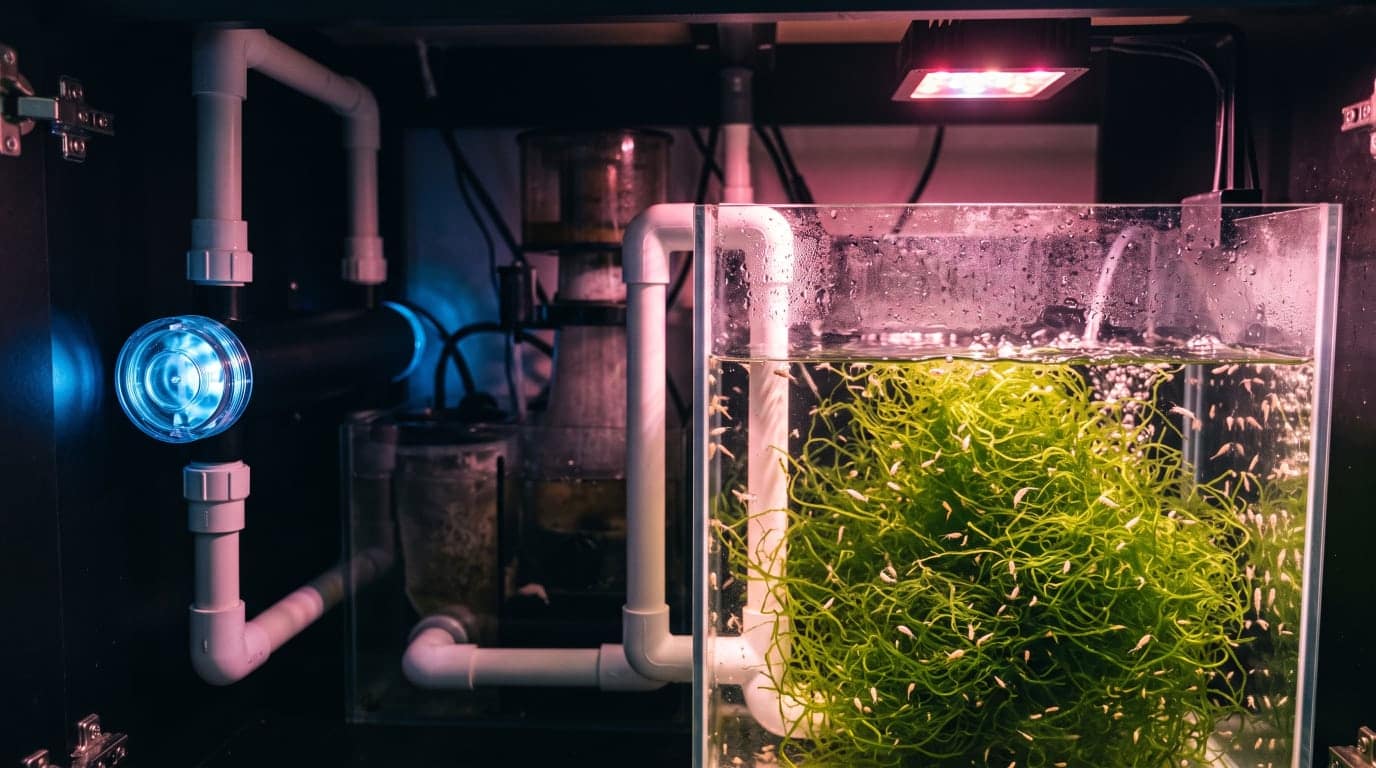
A UV steriliser is a simple piece of kit. Water is pumped through a chamber that houses a UV-C lamp, usually inside a quartz sleeve, and the light at around 254 nanometres damages the DNA of anything small enough and exposed long enough as it passes. Free-floating bacteria, single-celled algae, algae spores and the free-swimming stages of parasites such as the theront stage of marine whitespot are all affected. They either die outright or can no longer reproduce.
The key point, and the one most people miss, is that a UV steriliser in a reef tank only treats the water that physically passes through it. It has no effect on anything living on your rock, in your sand bed, on the glass or tucked away in your refugium. It is a contact treatment for the water column, and nothing more.
The second point is dwell time. How long the water spends in front of the lamp matters far more than the wattage printed on the box. Push water through too quickly and the dose each organism receives drops, so the unit becomes less effective at killing pathogens. Slow the flow down and the dose rises, which makes it much better at controlling parasites and algae, but also much better at killing anything else small and free-floating that happens to be carried through. That trade-off is the heart of this whole topic.
5 Species Phytoplankton

£6.99
5 Species Phytoplankton Blend: Build a Thriving Marine Ecosystem Your corals are open, your fish are healthy, and your parameters are clean. But something about the tank feels thin. The microfauna community never quite established. Your copepod population does not… read more
Where UV Earns Its Place
Used well, a UV steriliser in a reef tank is a very useful tool. It clears green water from a free-floating algae bloom, often within a few days. It reduces bacterial counts in the water column, which some keepers find helpful in heavily stocked fish systems. It lowers the number of free-swimming parasite stages, which reduces the chance of reinfection during an outbreak. It also gives that crystal clear water many of us like. I have no issue with anyone running one. I just want you to run it knowing what it is touching.
What a UV Steriliser in a Reef Tank Does Not Do
It is worth being clear here, because UV is sometimes sold as a cure-all. UV will not cure an established whitespot or velvet infection, because the parasites attached to your fish never pass through the unit. It will not remove ammonia, nitrate or phosphate, as these are dissolved nutrients rather than organisms. It will not fix nuisance algae growing on your rock, such as hair algae or cyano mats, because those are attached rather than floating. And it will not replace quarantine. If anything, a UV can give a false sense of security while a problem is building on the fish themselves.
A UV steriliser in a reef tank also will not wipe out your copepod population. I say this because I regularly get worried messages from people who have just read a forum thread and are convinced their UV has killed every pod in the tank. That is very rarely the case, and understanding why is the key to getting the balance right.
Does a UV Steriliser Kill Copepods?
The short answer is that a UV steriliser in a reef tank affects the free-floating fraction of your live food, not the whole population. To make sense of that, you need to think about where each organism spends its life and how small it is.
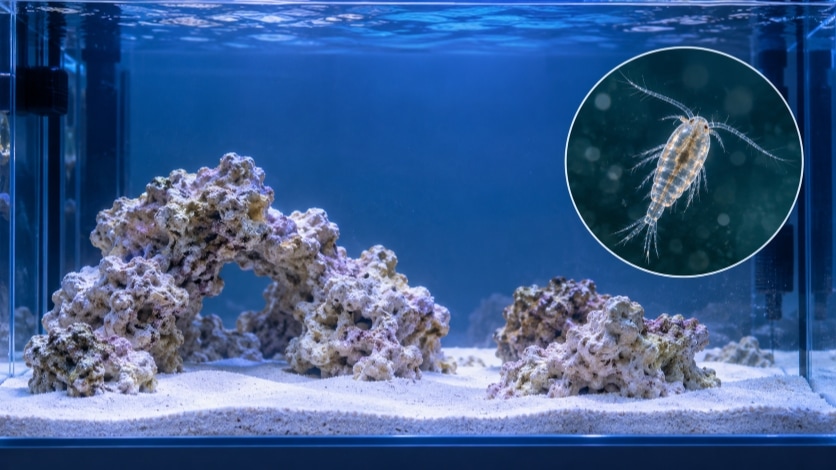
Adult Live Copepods such as Tigriopus californicus are harpacticoid pods. They are 1 to 3mm long and spend most of their time crawling over rock, glass, macroalgae and sand. They do swim, particularly at night, but they are not permanent residents of the water column. An adult that gets pulled into a return pump is far more likely to be harmed by the impeller than by the UV itself, and the vast majority of adults never make that journey at all. Your breeding population in the rockwork and refugium is largely out of reach.
The story changes with the young. Copepod nauplii, the larval stage that hatches from the egg sacs, are tiny, well under a fifth of a millimetre, and they drift. Many of them end up in the water column, get carried into the sump and pass straight through whatever is running there. At that size and with little protection, a slow flow UV will damage a proportion of them. This is exactly what the Reef2Reef article means by copepod larvae. It is not your adults at risk, it is the next generation, and over weeks that can slow down how quickly a pod population recovers from grazing by a mandarin or a wrasse.
Phytoplankton is the most exposed of all. Nannochloropsis cells are only 2 to 4 microns across, and every cell you dose lives entirely in the water column. A single cell has no shelter, no shell to speak of and nowhere to hide. Rotifers sit in the middle. Brachionus plicatilis is 90 to 360 microns and swims constantly in open water, so it spends a lot more time in the flow than an adult copepod does.
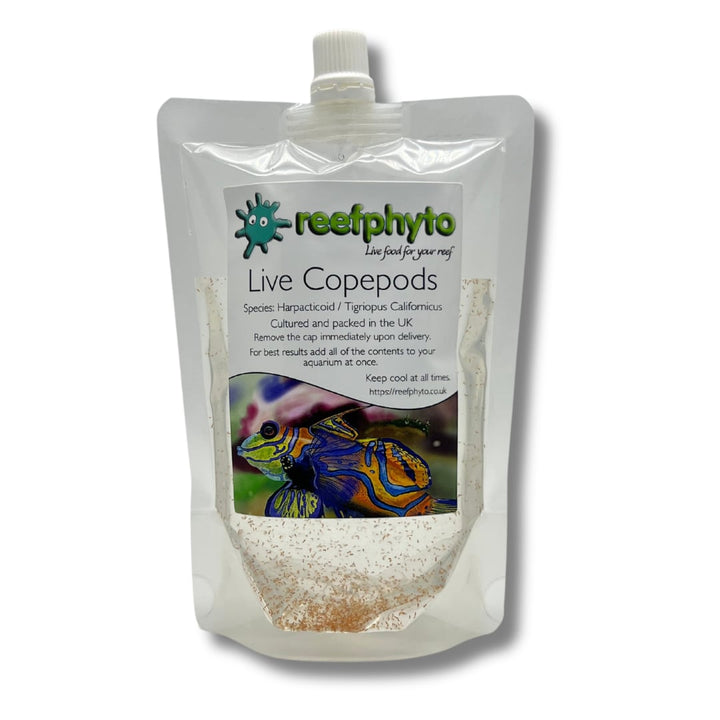
Live Copepods
£11.99
Live Copepods UK: Tigriopus californicus, Cultured Fresh in Wales by Reefphyto Your reef looks right on paper. Clean water, stable parameters, good equipment. But something is still off. Your fish are pale, your mandarin is wasting, your corals are feeding… read more
Life Stage Risk at a Glance
| Organism and life stage | Where it lives | Approximate size | Exposure to UV |
|---|---|---|---|
| Adult harpacticoid copepods | Rock, glass, sand, macroalgae, refugium | 1 to 3mm | Low |
| Copepod egg sacs | Carried by females on surfaces | Attached to adult | Low |
| Copepod nauplii (larvae) | Drift in the water column | Under 0.2mm | Moderate to high |
| Rotifers | Open water, swimming constantly | 90 to 360 microns | Moderate to high |
| Live phytoplankton | Entirely in the water column | 2 to 20 microns | High |
| Coral and invertebrate larvae, filter feeder food | Water column | Varies | High |
If you take one thing away from that table, let it be this. The adults in your rock and refugium are your pod bank, and they are largely safe. What a UV steriliser in a reef tank competes with is the food you have just added to the water and the youngest pods drifting through it.
How Quickly Your Dosed Phytoplankton Reaches the Bulb
This is the part I find most people have never worked out, and it is worth doing the maths for your own system. Suppose you have a 400 litre system and your UV is fed by a pump pushing 800 litres per hour. That means the equivalent of your entire water volume passes through the UV twice every hour. Mixing is never perfect, but within a couple of hours, most of what you dosed has had at least one trip past the lamp.
Now think about why you are dosing phytoplankton in the first place, and what a UV steriliser in a reef tank does to that effort. You want those live cells in the water long enough for your copepods, rotifers, clams, feather dusters, sponges and non-photosynthetic corals to find them. If a large proportion of them are killed within the first hour or two, you lose much of the point of feeding live. Dead cells are not useless, some will still be eaten, but they break down more quickly and add to your nutrient load rather than feeding your pods. That is the real cost of leaving a UV steriliser in a reef tank running straight through a feed.
The same logic applies to your Live Rotifers and Live Zooplankton. Rotifers are an excellent food for small-mouthed fish and filter feeders precisely because they stay in open water, and that same behaviour makes them easy prey for your UV if it is running during a feed.
Should a UV Steriliser in a Reef Tank Run Continuously or Only During an Outbreak?
There is no single right answer here, and I would be wary of anyone who tells you otherwise. It depends on what your tank is built around, and what you want a UV steriliser in a reef tank to do for you.
If you keep a fish-heavy system with no mandarins, no dedicated filter feeders and no interest in building a pod population, running a UV steriliser in a reef tank continuously is a perfectly reasonable choice. You get clearer water and fewer free-floating pathogens, and the loss of some phytoplankton and nauplii does not really affect what you are trying to achieve.
If your tank depends on a thriving natural food web, the picture is different. Mandarin dragonets, scooter blennies, many wrasses, pipefish and seahorses all rely heavily on a steady supply of copepods. Tanks with gorgonians, sponges, clams and non-photosynthetic corals rely on fine particulate and live plankton. In those systems, a UV that runs day and night at slow flow is working against the very thing you are trying to build. I have spoken with keepers who have struggled for months to get a pod population established in a mandarin tank, only to find that switching their UV to an outbreak-only role made a clear difference.
A sensible middle ground that works for many people is to treat UV as a tool you reach for, rather than something that runs by default. Switch it on to deal with a green water bloom, to support a parasite outbreak alongside proper treatment, or while you are stabilising a newly stocked tank. Once the problem is under control, switch it back off or put it on a timer. You still have the kit ready when you need it, and your food web gets to do its job the rest of the time.
Match the Approach to Your Tank
| Your setup | Suggested UV approach |
|---|---|
| Fish-only or fish-heavy, no pod reliant species | Continuous running is reasonable |
| Mixed reef, dosing phytoplankton weekly | Run as normal, switch off for a few hours after each feed |
| Mandarin, scooter blenny or pipefish tank | Outbreak-only use, or a timer that avoids feeding and night hours |
| Filter feeder, clam or NPS coral system | Outbreak-only use |
| New tank being seeded with pods | Keep off for the first few weeks after seeding |
| Active parasite or green water problem | Run continuously at the flow the manufacturer recommends until resolved |
Simple Habits for Using a UV Steriliser in a Reef Tank With Live Foods
The good news is that you do not have to choose between UV and live food. A handful of small habits will let you have both, and none of them cost anything.
Switch the UV Off for a Few Hours After Dosing
This is the easiest and most effective change you can make if you run a UV steriliser in a reef tank and feed live foods. When you dose phytoplankton, rotifers or pods, turn the UV off and leave it off for a few hours, then switch it back on. Most keepers find three to four hours is a good window. Many controllers and smart plugs make this a one-tap job, or you can simply build it into your feeding routine. If you run a protein skimmer, it is worth pausing that for the same period too, because a skimmer will happily remove phytoplankton from the water as well.
For phytoplankton, follow the dosing rates carefully so you are not overfeeding while the UV is off. With 5 Species Phytoplankton, that is 1ml per 27L for light feeding, 1ml per 18L for medium and 1ml per 9L for heavy. Live Reef Flourish is 1 to 4 drops per 80L daily, Reef Flourish Super Concentrate is 1 to 4 drops per 265L daily, and Reef Juice is 5ml per 100L, one to two times weekly. My phytoplankton dosing guide goes into much more detail on how much to use and why.
Dose at Lights Out
Copepods and many filter feeders are most active after dark. Adding your live foods in the evening, then switching the UV off overnight, lines everything up nicely. Your pods get a long, undisturbed feeding window, nauplii can settle, and you can put the UV back on in the morning. If you use a timer, setting it to run during the day and rest at night is a simple way to automate this.
Dose Straight Into the Refugium
If you have a refugium, it is the best place to add both phytoplankton and pods. Flow through a refugium is usually gentle, there is plenty of macroalgae for pods to settle into, and the food reaches your breeding population before it reaches the sump pump or the UV. Pods that establish there will then trickle into the display over time. If you do not have one yet, my guide to setting up a refugium for copepods walks through the whole process.
If you add copepods to the display instead, target them. Use a Feeding Syringe to place them directly onto the rockwork with the return and wavemakers paused for ten to fifteen minutes, so they can grip the rock rather than being swept straight into the overflow.
Give Your Pods Somewhere to Breed
Because adult pods are the ones that survive UV exposure best, the more safe habitat they have, the more resilient your population becomes. A PodHide gives copepods a protected space in the display where fish cannot reach them and flow cannot sweep them away, and females can release nauplii close to shelter. For smaller systems there is the PodHide Nano, and the PodHide and Copepod Bundle gets you started with both at once. I explain the thinking behind this in why pods disappear from reef tanks.
Reefphyto PodHide & Copepod Bundle

£36.84
£40.94
Live Copepods & PodHide Bundle You keep adding copepods to your tank and they disappear within days. Your mandarin is still hunting, your wrasses are still patrolling, and the population never seems to get ahead of the predation. You are… read more
Look After the UV Itself
This one is less obvious. A UV lamp loses much of its UV-C output within six to twelve months, even though it still glows blue. A tired lamp is less effective against pathogens, which tempts people to slow the flow down to compensate, and slow flow through a working lamp is exactly the setting that is harshest on nauplii and phytoplankton. A UV steriliser in a reef tank that is maintained properly is also kinder to your live foods. Replace the lamp on schedule, keep the quartz sleeve clean, and run the flow rate your manufacturer recommends for the job you actually need it to do.
Seeding Pods After Running a UV Steriliser in a Reef Tank
If you have been running UV continuously for months and want to rebuild your pod population, or you have just finished a treatment period, the approach is simple. Switch the UV off, or set it to outbreak-only, and give the system a few weeks of calm. Add a good dose of Live Copepods at lights out, ideally into the refugium or a PodHide, and follow up with a second addition a couple of weeks later. Pod-Shot is a convenient concentrated option if you want to target a specific area of the rockwork.
Support that population with regular phytoplankton, dosed with the UV off, because pods that are well fed breed faster and produce more nauplii. Once you can see pods moving on the glass at night, your UV steriliser in a reef tank can return to its normal role without setting you back. If you keep a mandarin and want a steady supply without having to remember reorders, the Mandarin Food Pack Subscription delivers pods and phyto on a regular schedule. For a deeper look at why pods matter so much, see why live copepods benefit your reef tank.
New tanks deserve a special mention. If you are just finishing the cycling process, it is tempting to switch everything on at once. I would hold off on running the UV for the first few weeks after seeding pods and phytoplankton, so that a breeding population can establish before anything is competing with it.
Getting the Balance Right
A UV steriliser in a reef tank is neither a villain nor a miracle. It does a specific job on the water that passes through it, and it does that job well. The organisms it affects most are the ones that drift: phytoplankton, rotifers, and the youngest copepods. The adults living in your rock, sand and refugium are largely untouched, and that is where your pod population really lives.
For most reef keepers, the fix is not to throw the UV away but to use it with a little thought. Switch it off for a few hours after feeding, dose at lights out, put your live foods into the refugium or a PodHide, and consider saving UV for the times you really need it. Do that and your UV steriliser in a reef tank and your live foods can work side by side, rather than against each other.
If you have questions about running a UV steriliser in a reef tank alongside live foods, get in touch. I answer every message personally.
Darren
Founder, Reefphyto Ltd - Wales, UK - Est. 2008