
Quick Navigation
- Why Copepods Vanish So Quickly in a Reef Tank
- What a Copepod Breeding Shelter Actually Does
- Where to Place a Copepod Breeding Shelter
- What to Seed It With
- Feeding the Population: Phytoplankton Is the Fuel
- Copepod Breeding Shelter Compared to Other Approaches
- Realistic Expectations and Long-Term Results
- Getting Started With a Copepod Breeding Shelter
- FAQs
If you have ever added live copepods to your reef tank only to watch the population vanish within a week or two, a copepod breeding shelter is the piece of the puzzle you have been missing. It is one of the most common frustrations I hear from reef keepers, and it almost always comes down to the same thing. The pods are not failing. They are simply being eaten faster than they can reproduce.
I am Darren, and I have spent more than 18 years culturing live marine food at Reefphyto here in Wales. I have lost count of how many keepers have told me the same story. They buy a healthy pouch of pods, pour them in with good intentions, watch the mandarin or wrasse hunt happily for a few days, and then the activity quietly fades. Within a fortnight the tank looks exactly as it did before. The money has gone, the fish is hungry again, and the keeper is left wondering what they did wrong. In most cases, the answer is that nothing was done wrong at all. The tank was just missing a safe place for the pods to settle and breed.
Why Copepods Vanish So Quickly in a Reef Tank
To understand why a copepod breeding shelter works, it helps to understand the problem it solves. A reef tank is, from a copepod's point of view, a hunting ground with very few hiding places. Open sand, bare glass, and high-flow areas all expose pods to predators. Fish like mandarins, scooter blennies, six line wrasses, anthias, and even small gobies are relentless. A single mandarin can consume hundreds of copepods every day. Corals and filter feeders take their share too, picking pods straight out of the water column.
None of that is a problem in itself. A reef tank is supposed to have a working food web. The trouble starts when consumption outpaces reproduction. Copepods breed well, but they need somewhere protected to do it. A gravid female carrying eggs is vulnerable. Newly hatched nauplii are tiny and slow. If every life stage is exposed to a hungry mandarin from the moment it appears, the population never gets the chance to compound. You are effectively pouring pods into a tank that eats them at the same speed you add them.
This is why so many keepers end up re-seeding their tank every few weeks. It feels like maintenance, but it is really just replacing losses. The pods are doing their job. They are reproducing. The reproduction is simply happening in full view of the predators, so the offspring are eaten before they ever contribute to a self-sustaining population. The fix is not more pods. The fix is protection.
What a Copepod Breeding Shelter Actually Does
A copepod breeding shelter is a structure that gives pods somewhere predators cannot reach. The principle is simple. If copepods can shelter, feed, and breed in a space too small or too enclosed for fish to access, their offspring survive long enough to mature. Those mature pods then breed in turn. Instead of a population that constantly resets to zero, you get one that compounds. The shelter becomes a steady, self-renewing source that drip-feeds live food back into the tank.
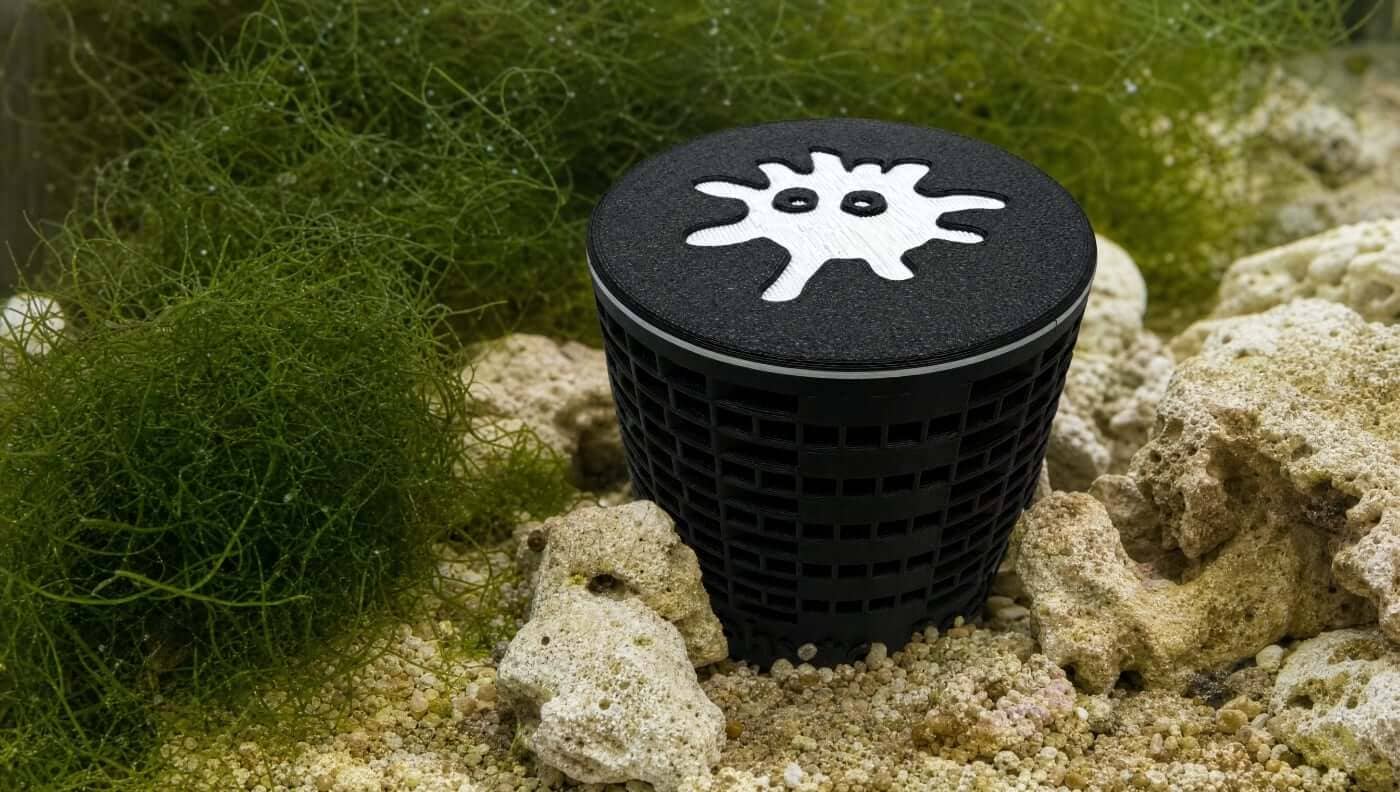
This is exactly the role the PodHide was designed to fill. I developed it after years of watching customers fight the same losing battle. The PodHide is a 3D printed copepod shelter and breeding station, produced in-house at our Welsh facility from reef-safe PETG. It is a compact unit, 85mm tall and 80mm wide, covered in multiple holes that lead into a network of internal chambers. The interior surfaces are deliberately rough and textured, because copepods do not just hide on smooth walls. They cling, graze, and lay eggs against surfaces with grip.
The holes are the key feature. They are large enough for copepods of every life stage to move freely in and out, but far too small for a mandarin or wrasse to follow. A pod inside a PodHide can feed on biofilm, find a mate, carry eggs to term, and release nauplii into a sheltered space. When those young pods are ready, they leave through the holes and enter the tank as food. The predators get a constant supply. The breeding stock stays protected. That is the whole idea behind a proper copepod breeding shelter, and it is the difference between a population that survives and one that simply gets consumed.
Reefphyto PodHide – Reef Tank Copepod Shelter & Breeding Station

£28.95
Reefphyto PodHide: Reef Tank Copepod Shelter & Breeding Station You added copepods three weeks ago. The mandarin hunted well for a few days. The wrasse picked through the rockwork with obvious interest. Then the activity slowed, the hunting behaviour became… read more
Built to Sit Where You Need It
The PodHide has four stability feet on the base. This sounds like a small detail, but it matters in practice. A copepod breeding shelter is no use if it tips over or drifts in the current every time you do a water change. The four feet let it sit securely on the glass, on a sump shelf, or pushed gently into a sand bed without rolling or moving. It stays exactly where you place it, which means the pod population inside it stays stable too.
PETG was chosen deliberately. It is a tough, inert plastic that holds up to long-term saltwater immersion without leaching or degrading. There is nothing in a PodHide that will affect your water chemistry. It is a permanent fixture you can leave in place for the life of the tank.
Where to Place a Copepod Breeding Shelter
Placement makes a real difference to how well a copepod breeding shelter performs. The single most important rule is to choose a low-flow area. Copepods are not strong swimmers, and a unit sitting directly in a powerhead stream will struggle to hold a settled population. You want a calm spot where pods can come and go on their own terms rather than being blasted out.
If you run a sump with a refugium section, that is the ideal home for a PodHide. The refugium is already a low-predation zone, and adding a dedicated shelter on top of the macroalgae and rubble multiplies the protected breeding space. The pods produced there travel back to the display through the return pump, feeding the tank continuously. If you would like a full walkthrough of building that kind of system, my guide on how to set up a refugium for copepods covers every component in detail.
Not every reef keeper has a sump, and that is fine. A copepod breeding shelter works in the display tank too. Tuck it into a quiet corner behind the rockwork, low down where flow is gentle, ideally somewhere shaded. The pods will use it as a base and the predators will patrol the open water around it. For nano and pico tanks where space is tight, the smaller PodHide Nano is scaled to fit inside compact systems without dominating the aquascape. Whichever version suits your tank, the goal is the same. Give the pods a stronghold, and let the tank feed off the surplus.
How to Seed the Shelter With Copepods
Seeding a copepod breeding shelter properly gets the population established faster. Rinse the unit in tank water or RO water before its first use to clear any dust. Then, before you place it in the tank, turn it on its side and use a turkey baster or pipette to squirt your copepods directly into the holes. This puts the pods inside the protected chambers from the very start, rather than relying on them finding their own way in.
Once seeded, lower the PodHide gently into position. Try not to invert it again, as that can flush out the pods you just added. From that point the shelter does the work. Give the population a few weeks to settle and breed before you expect to see a noticeable difference in the tank. A copepod breeding shelter is a long game. It is not an overnight fix, but it is a permanent one.
Reefphyto PodHide & Copepod Bundle

£36.84
£40.94
Live Copepods & PodHide Bundle You keep adding copepods to your tank and they disappear within days. Your mandarin is still hunting, your wrasses are still patrolling, and the population never seems to get ahead of the predation. You are… read more
What to Seed It With
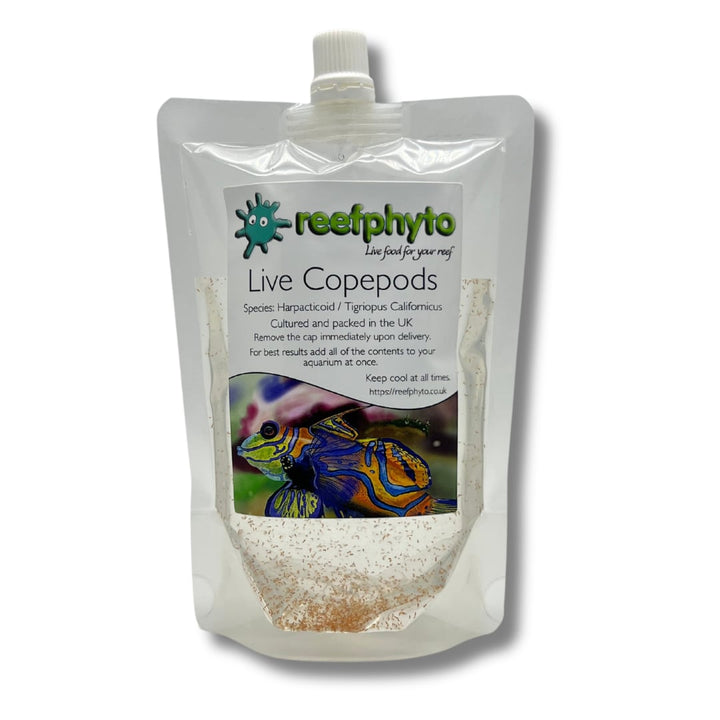
A shelter is only as good as the pods you put in it. I always recommend starting with a proper culture-grade population rather than a quick top-up. Our Live Copepods are Tigriopus californicus, a hardy harpacticoid species that is ideally suited to life inside a copepod breeding shelter. Harpacticoids are benthic by nature, meaning they prefer to crawl and cling to surfaces rather than swim in open water. That behaviour is exactly what makes them thrive inside the textured chambers of a PodHide.
For keepers who want to seed the shelter and have the breeding stock ready to go in one purchase, the PodHide and Copepod Bundle pairs the shelter with a live copepod culture at a saving over buying them separately. It is the most straightforward way to get a copepod breeding shelter working from day one. If your tank already has a refugium running and you simply want to reinforce it, a standalone pouch of Live Copepods seeded into a fresh PodHide does the same job.
Once the shelter is established, you can keep the wider population topped up with a ready-to-pour pouch like Pod-Shot whenever a hungry mandarin is grazing harder than usual. For a broader food web that adds rotifers alongside copepods, our Live Zooplankton blend covers a wider particle size range in a single addition, and the Zooplankton Multipack brings copepods, rotifers, and phytoplankton together for keepers building a complete live food system.
Feeding the Population: Phytoplankton Is the Fuel
A copepod breeding shelter protects your pods, but protection alone does not feed them. Copepods need food to breed, and their natural food is phytoplankton. A well-fed population reproduces faster, which means more surviving offspring leaving the shelter and entering the tank. If you want your copepod breeding shelter to perform at its best, regular phytoplankton dosing is not optional.
Our 5 Species Phytoplankton blend is what I recommend for this. It combines five microalgae species to give pods a varied, nutritionally complete diet. For a typical reef tank, dose 1ml per 27 litres for light feeding, 1ml per 18 litres for medium feeding, or 1ml per 9 litres for heavy feeding, added daily. If you are running a refugium with a PodHide inside it, dosing toward the heavier end keeps both the macroalgae and the copepod population well supplied. You can read more about why this matters in my article on how phytoplankton impacts your reef.
The relationship is straightforward. Phytoplankton feeds the copepods, the copepod breeding shelter protects them while they reproduce, and the tank harvests the surplus. Get all three working together and the constant re-seeding stops.
Copepod Breeding Shelter Compared to Other Approaches
Reef keepers try several strategies to keep a copepod population alive. It is worth seeing how a dedicated copepod breeding shelter compares to the alternatives, because each approach addresses the problem differently.
| Approach | How It Works | Main Limitation |
|---|---|---|
| Re-seeding regularly | Add a fresh pouch of pods every few weeks | Ongoing cost, never builds a self-sustaining population |
| Refugium with macroalgae | Chaeto and rubble provide some shelter and grazing surface | Open structure still allows predator access in places |
| Live rock and rubble in the display | Natural crevices give pods limited hiding space | Predators learn the rockwork and hunt the crevices |
| Copepod breeding shelter (PodHide) | Enclosed chambers with predator-proof holes and textured surfaces | Needs seeding and a few weeks to establish |
The clearest takeaway is that a copepod breeding shelter is not a competitor to a refugium. It is a multiplier. A refugium gives pods a low-predation zone, and a PodHide placed inside it adds a genuinely predator-proof core where the breeding stock is fully secure. The two together produce far more live food than either does alone. For keepers without a sump, the shelter delivers much of the same protected breeding benefit directly inside the display tank.
Live Copepods
£11.99
Live Copepods UK: Tigriopus californicus, Cultured Fresh in Wales by Reefphyto Your reef looks right on paper. Clean water, stable parameters, good equipment. But something is still off. Your fish are pale, your mandarin is wasting, your corals are feeding… read more
Realistic Expectations and Long-Term Results
I want to be honest about what a copepod breeding shelter will and will not do, because I would rather you bought one knowing exactly what to expect. It will not flood your tank with pods overnight. It will not stop a mandarin from being a mandarin. What it will do, given a few weeks and a fed population, is shift your tank from a system that consumes pods to a system that produces them.
The change is gradual and easy to miss day to day. You stop noticing the mandarin hunting frantically. The fish looks rounder and calmer. You realise it has been two months since you last bought a pouch of pods. The refugium has visible movement when you shine a torch into it after lights out. These are the signs that a copepod breeding shelter is doing its job. It is quiet, steady progress rather than a dramatic event, and that is precisely what a stable reef wants.
For keepers with copepod-dependent fish, this matters enormously. A mandarin dragonet is an obligate live feeder, and a reliable in-tank pod supply is the single biggest factor in keeping one healthy long-term. If that is your situation, my guide on mandarin dragonet care goes deeper into building the kind of population a mandarin needs, and a copepod breeding shelter is central to that strategy. The same logic applies to scooter blennies, leopard wrasses, and any other pod hunter that struggles on prepared foods alone.
Getting Started With a Copepod Breeding Shelter
If you have been stuck in the re-seeding cycle, a copepod breeding shelter is the way out. Start with a PodHide, seed it with a live copepod culture, place it in a low-flow spot in your sump or display, and feed the population with phytoplankton. Give it time. Within a couple of months you should see the difference, and from then on the shelter keeps working without ongoing cost.
It is a small piece of 3D printed plastic, but it changes the fundamental dynamic of your tank. Instead of fighting a losing battle against predation, you are working with it. The pods breed in safety, the surplus feeds the tank, and the population sustains itself. That is what a reef ecosystem is supposed to do, and a copepod breeding shelter is often the one component that makes it finally click into place.
If you have questions about choosing or using a copepod breeding shelter, get in touch. I answer every message personally.
Darren
Founder, Reefphyto Ltd - Wales, UK - Est. 2008