5 Species Phytoplankton Blend: Build a Thriving Marine Ecosystem
Your corals are open, your fish are healthy, and your parameters are clean. But something about the tank feels thin. The microfauna community never quite established. Your copepod population does not hold its numbers the way you hoped. The biological depth you imagined when you started the tank has not materialised.
The part of the food chain most reef systems are missing is the part nobody can see. Phytoplankton is the nutritional foundation every marine ecosystem is built on. Without it, copepods decline, filter feeders starve quietly, and corals are deprived of the planktonic particles they evolved to capture. Most reef keepers never dose it. The ones who do notice the difference in the biology of their tank within weeks.
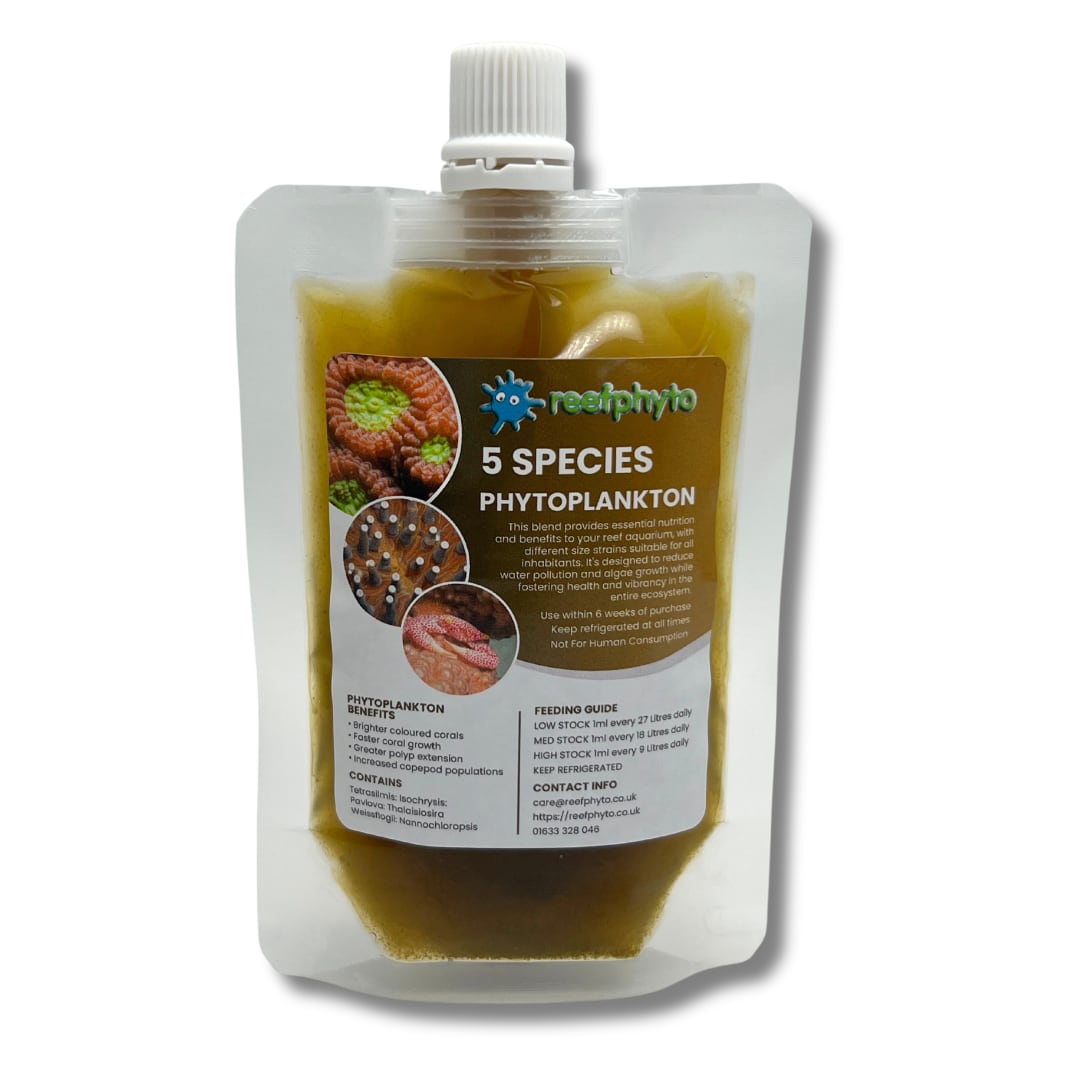
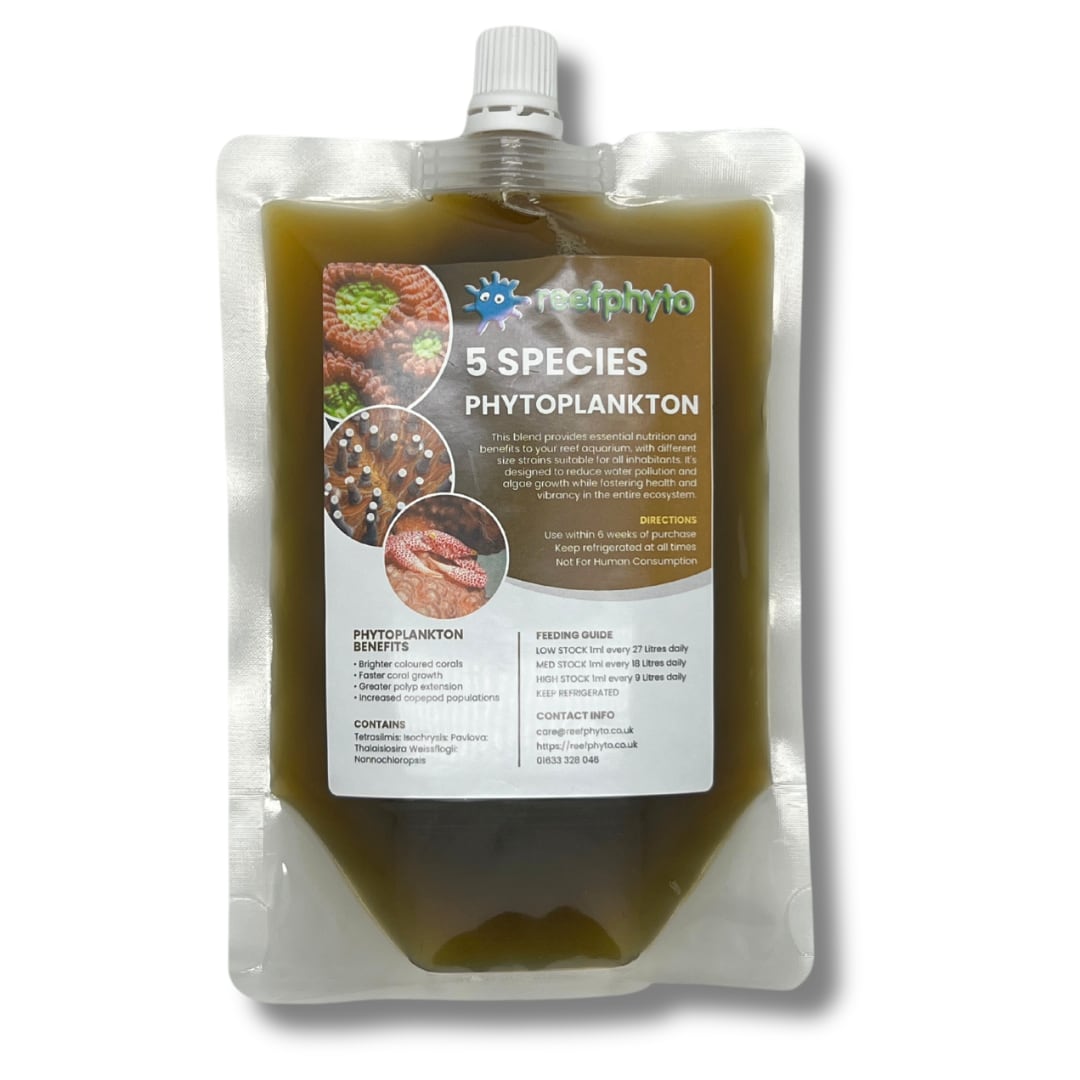
Reefphyto's 5 Species Phytoplankton is a blend of Nannochloropsis oculata, Tetraselmis, Isochrysis, Pavlova, and Thalassiosira weissflogii, cultured fresh as a high-density culture, covering particle sizes from 1 to 20 microns. Dose at 1ml per 27 litres daily for lightly stocked systems, 1ml per 18 litres for medium-stocked tanks, and 1ml per 9 litres for heavily stocked reefs with high coral and filter feeder density.
Over weeks of regular dosing, the change accumulates. Copepod populations strengthen because their food source is consistently present. Corals extend further and hold deeper colour. Filter feeders become more visible and active. The tank develops the kind of living density that makes it feel less like a display and more like a piece of real ocean.
Not sure how much to dose for your tank size? Our dosing calculator works it out for you. Enter your total water volume, select your product, and get the exact daily dose in seconds. No guesswork, no searching through instructions.
Reefphyto has been culturing phytoplankton from our specialist facility in Wales since 2008. Every batch is produced fresh, dispatched at peak cell density, and available in sizes from 100ml to 5000ml to suit any system. Darren is available personally if you want guidance on integrating this into your existing feeding routine.
If your corals are not extending fully and your invertebrates are not thriving despite clean water, adding phytoplankton is the right decision.
5 Species Phytoplankton UK: Feed the Foundation of Your Reef Ecosystem
Most reef keepers feed from the top down. Fish get fed. Corals receive target feeding. But the microscopic base of the marine food chain, the phytoplankton that sustains every copepod, every filter feeder, every coral polyp, and every invertebrate in a healthy reef, is routinely absent from captive systems entirely. Reefphyto's 5 Species Phytoplankton is a, freshly cultured blend of five complementary microalgae species, produced at our specialist facility in Wales and dispatched as a high-density culture. It is the nutritional foundation your reef food web has been missing.
Why Single-Species Phytoplankton Is Not Enough
Most phytoplankton products contain a single microalgae species, typically Nannochloropsis. Nannochloropsis is a solid phytoplankton choice. It is robust, easy to culture, and has a strong EPA fatty acid profile, but it does not represent what a wild reef system provides. In the ocean, phytoplankton communities are extraordinarily diverse, with different species offering different fatty acid profiles, amino acid compositions, cell sizes, and nutritional properties. The organisms that consume phytoplankton in the wild have evolved to utilise that diversity. A single-species product addresses some of their nutritional needs but not all.
A five-species blend provides the range of cell sizes, lipid profiles, and nutritional compounds that a diverse marine community requires. Organisms that cannot efficiently process Nannochloropsis may respond well to Isochrysis or Tetraselmis. Filter feeders that prefer larger particles find Thalassiosira weissflogii far more accessible than the smallest microalgae. Corals and invertebrates sensitive to specific fatty acid ratios benefit from the broader profile that five complementary species provide together.
The Five Species and Why Each One Matters
Nannochloropsis oculata: The EPA Powerhouse
Nannochloropsis oculata is one of the most studied and widely used marine microalgae in aquaculture. At 1 to 5 microns, it is among the smallest species in the blend and accessible to the finest filter feeders and coral polyps. Its exceptional EPA content makes it one of the most nutritionally dense phytoplankton species available, and its cell wall properties support efficient digestion by a broad range of marine invertebrates. It also excels at nutrient uptake, absorbing ammonia, nitrites, nitrates, and phosphates from the water column as it grows, which provides a measurable water quality benefit in systems where it is dosed regularly.
Tetraselmis: Lipids, Amino Acids, and Copepod Enrichment
Tetraselmis is a larger flagellated green microalgae measuring approximately 10 to 14 microns. It is exceptionally rich in lipids and amino acids, making it a highly regarded species for copepod and rotifer enrichment. Copepods that feed on Tetraselmis produce nauplii with a significantly richer nutritional profile than those fed on a single-species diet, which translates directly into better outcomes when those copepods are consumed by your fish. For reef keepers running a home copepod culture, regular addition of a Tetraselmis-containing phytoplankton blend to the culture vessel measurably improves the nutritional quality of every copepod harvested.
Isochrysis: DHA and Bivalve Nutrition
Isochrysis is a small golden-brown microalgae measuring 4 to 6 microns with an exceptionally high DHA content. DHA is the omega-3 fatty acid most critical for neurological development and visual acuity in marine larvae, making Isochrysis an essential component in any serious marine breeding programme. In a mixed reef, it provides DHA to filter-feeding bivalves, tube worms, and any organisms consuming zooplankton that have themselves been enriched on Isochrysis. It is widely regarded as one of the most important single species in marine aquaculture phytoplankton programmes.
Pavlova: Growth Support for Sensitive Filter Feeders
Pavlova is a 4 to 6 micron haptophyte microalgae with a balanced fatty acid profile that has shown particular benefit for sensitive filter feeders and slow-growing invertebrates. Its combination of EPA, DHA, and sterols supports tissue growth and health in organisms that struggle to thrive on simpler phytoplankton diets alone. For reef keepers maintaining fan corals, feather duster worms, Christmas tree worms, and similar filter feeding organisms, Pavlova provides a nutritional range that single-species products frequently cannot match.
Thalassiosira weissflogii: Feeding Larger Filter Feeders and Benthic Invertebrates
Thalassiosira weissflogii is a diatom measuring 5 to 20 microns, making it the largest species in the blend and the most accessible for organisms that cannot efficiently process smaller microalgae cells. Clams, oysters, scallops, and larger benthic invertebrates respond particularly well to diatom-based diets. The silica cell wall of Thalassiosira also makes it resistant to rapid degradation in the water column, meaning it remains available to slow-moving filter feeders for longer after dosing. For mixed reef systems containing larger filter feeding invertebrates alongside corals and microfauna, including a diatom in the phytoplankton blend makes a meaningful practical difference.
What Phytoplankton Does for Your Reef Over Time
The effects of regular phytoplankton dosing are cumulative rather than immediate. Unlike introducing live copepods, where the hunting response from your fish is often visible within minutes, phytoplankton works through the food web over days and weeks. Understanding what to look for and when helps set realistic expectations and confirms that the dosing programme is working.
In the first one to two weeks, coral polyp extension typically improves as the organisms detect planktonic particles in the water column. Filter feeders become more active and more visibly extended. Any copepod population in the refugium begins to show improved density as their primary food source becomes consistently available.
Between weeks two and six, copepod populations in a well-fed refugium strengthen noticeably. Coral pigmentation begins to deepen as the animals access the specific fatty acids and compounds present in a diverse phytoplankton blend. Microfauna diversity in the substrate and rock work increases as the base of the food chain becomes reliably present.
Over three months of consistent dosing, the cumulative effect on tank biology is significant. Tanks that are dosed regularly with phytoplankton sustain healthier copepod populations, show stronger coral growth and colouration, and exhibit the kind of visible microbial and microfauna activity that distinguishes a truly thriving reef from one that is merely maintained.
Phytoplankton and Dinoflagellate Control
One of the less discussed benefits of regular phytoplankton dosing is its effect on dinoflagellate outbreaks. Dinoflagellates thrive in systems with unstable nutrient chemistry, low biodiversity, and limited biological competition. A five-species phytoplankton blend addresses all three of these factors simultaneously.
By absorbing excess ammonia, nitrites, nitrates, phosphates, and silicates from the water column, the phytoplankton reduces the nutrient concentrations that dinoflagellates depend on to dominate. By increasing planktonic biodiversity in the water column, it creates biological competition that dinoflagellates struggle to outcompete. By sustaining copepod and zooplankton populations that naturally graze on nuisance biofilms, it introduces a biological control mechanism that chemical interventions cannot replicate.
For reef keepers dealing with persistent or recurring dinoflagellate problems, integrating regular phytoplankton dosing alongside other management strategies is one of the most ecologically sound approaches available. It does not treat the symptom, it addresses the biological conditions that allow the problem to develop.
How to Dose the 5 Species Phytoplankton
Dose directly into a high-flow area of the tank to distribute cells quickly through the water column. Turn off your protein skimmer for one to two hours after dosing to prevent the phytoplankton from being immediately removed before it can be consumed. Dose in the evening or under reduced lighting where possible. Phytoplankton cells are consumed most efficiently when they are not rapidly degraded by intense light.
As a general guide, low-stocked systems benefit from approximately 1ml per 27 litres daily, medium-stocked systems from 1ml per 18 litres, and heavily stocked systems with high filter feeder and coral density from 1ml per 9 litres. These are starting points. Adjust based on how quickly the product clears from your water column and how your tank responds over the first few weeks.
Store refrigerated and use within six weeks of delivery. Shake gently before each use to redistribute settled cells. The product is non-culturable. It is a blended multi-species product not designed for home propagation. For reef keepers who want to grow their own single-species phytoplankton at home, our Nannochloropsis Starter Culture provides a culturable monoculture designed for that purpose.
Choosing the Right Size
The 5 Species Phytoplankton is available in six sizes from 100ml to 5000ml. For smaller systems or keepers new to phytoplankton dosing, 100ml or 250ml provides an accessible starting point that allows you to establish a dosing routine and observe your tank's response before committing to larger volumes. For systems over 300 litres dosing daily, 500ml or 1000ml offers better value and a more practical order frequency. Public aquariums, fish breeders, and keepers running copepod culture programmes at scale will find the 2500ml and 5000ml formats most practical.
Frequently Asked Questions About the 5 Species Phytoplankton
Can I dose this if I already use Nannochloropsis?
Yes, and in most cases it is an upgrade. The five-species blend provides Nannochloropsis as 20% of the composition alongside four complementary species that cover nutritional gaps and particle sizes that single-species Nannochloropsis cannot address. Switching from a single-species product to a five-species blend broadens the range of organisms you are feeding and the nutritional value of every dose.
Will it cloud my water?
At the recommended dosing rates, the 5 Species Phytoplankton should not cause visible cloudiness in a well-established system. Freshly dosed phytoplankton may give the water a very slight green tint immediately after addition, which typically clears within a few hours as the cells are consumed by filter feeders, corals, and microfauna. If cloudiness persists, reduce the dose and allow your tank's filter feeding community to adjust over a few weeks before increasing again.
Is this suitable for feeding copepod cultures?
Yes. The five-species blend is an excellent copepod culture feed, providing greater nutritional diversity than single-species products and supporting faster population growth and richer nauplius quality. It can be used directly in a home culture vessel at a rate sufficient to maintain a light green tint in the culture water. Our specialist Copepod Feed is formulated specifically for culture use and provides a concentrated alternative for dedicated culture programmes.
How does this interact with my protein skimmer?
Phytoplankton cells are removed by protein skimmers, which is why turning off your skimmer for one to two hours after dosing is recommended. In tanks with heavy skimming, dosing in the evening when the skimmer can be paused overnight gives the cells the best opportunity to be consumed before removal. Over time, the improved microfauna and filter feeder activity that results from regular phytoplankton dosing typically reduces the skimmate load rather than increasing it.
Can I use this in a FOWLR tank without corals?
Yes. While the coral-feeding benefits are the most visually obvious effect of phytoplankton dosing, a fish-only with live rock system also benefits significantly. The phytoplankton sustains copepod populations in the live rock and substrate, supports microfauna diversity, improves the nutritional quality of any live food fed to the fish, and contributes to the nutrient export that keeps the system chemically stable.
Complete the Food Web
The 5 Species Phytoplankton works most powerfully as part of a complete food routine. Paired with live copepods, it sustains the refugium population that feeds your fish. Combined with live rotifers, it provides the nutritional enrichment that makes every rotifer dose more valuable. For keepers who want to introduce the whole food web in a single first order, the Zooplankton Live Food Mix includes a phytoplankton Reef Shot alongside copepod and rotifer pouches. For those ready to commit to a full multi-species feeding programme, the Zooplankton Multipack provides all three at full culture volumes together.

 Roll over image to zoom in
Click on image to zoom
Roll over image to zoom in
Click on image to zoom



 Cultured in Wales, shipped live.