Brine Shrimp Eggs 90% Hatch Rate: Premium Nutrition for Your Aquarium
Your fish are spawning, or you are attempting to raise fry for the first time, and the question of what to feed them in those first critical days is suddenly the only thing that matters. The wrong answer at that stage is not a minor setback. It is the difference between a successful hatch and losing everything you worked for.
Most fish fry cannot accept anything that does not move. Their hunting instinct is triggered by motion, and their mouths are too small for anything but the finest live food. In that window between hatching and weaning, newly hatched brine shrimp nauplii are one of the very few foods small enough, nutritious enough, and alive enough to do the job reliably for both marine and freshwater species.
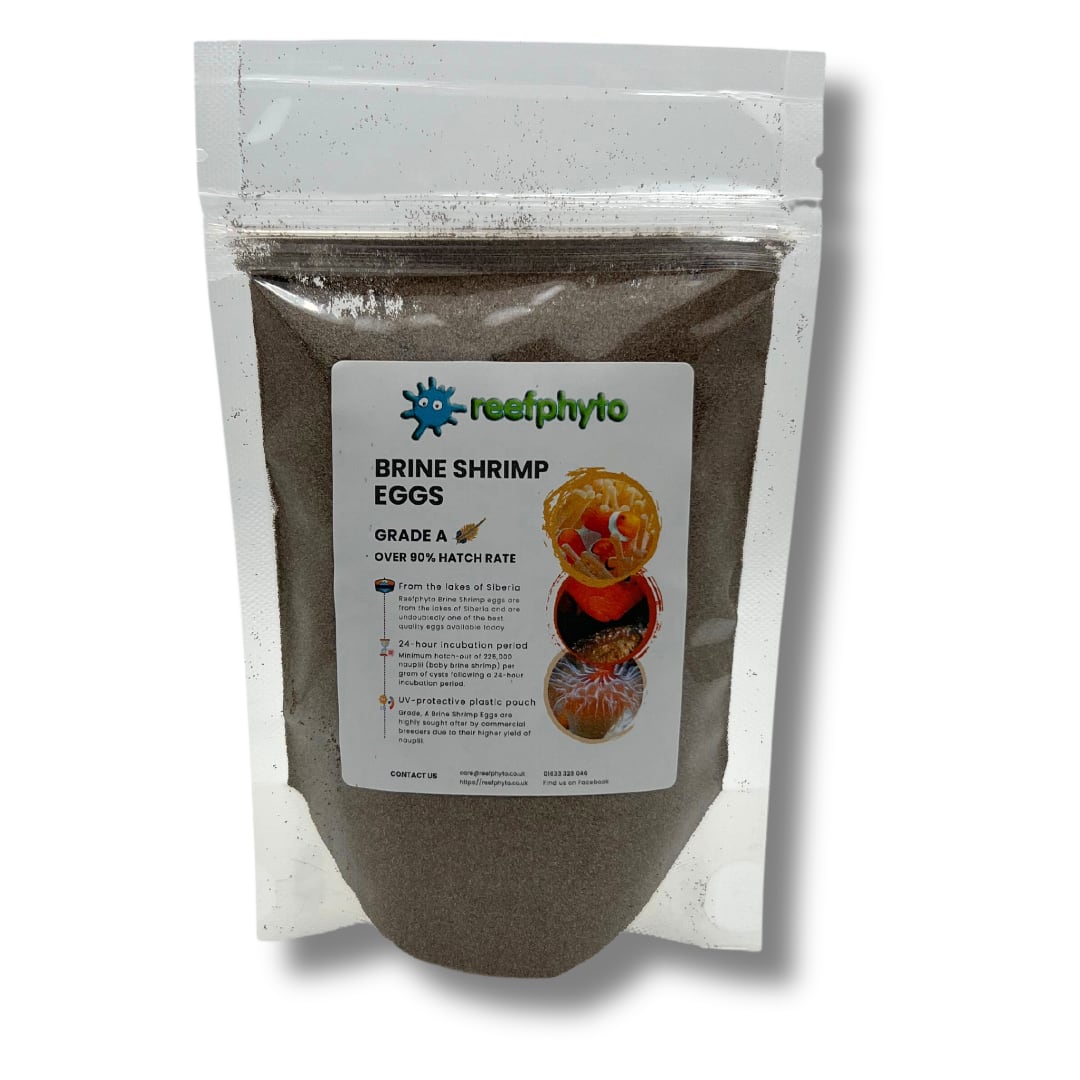
Reefphyto Brine Shrimp Eggs are sourced from Siberian salt lakes and achieve a consistent 90% hatch rate, producing over 225,000 nauplii per gram within 24 hours of hatching. Each nauplius is approximately 400 to 500 microns, rich in protein, amino acids, and essential fatty acids, and moves in exactly the way that triggers a feeding response in fish that will ignore everything else. Available in 30g, 60g, 90g, and 120g sizes to suit occasional hatches and regular breeding programmes alike.
Within a day of your first hatch, you will have a dense, wriggling cloud of nauplii ready to feed. Fry that were hovering at the surface begin to hunt. Seahorse juveniles that refused enriched frozen food take nauplii without hesitation. Marine larvae that require live prey in their first week get exactly what they need. The hatch is reliable, the yield is consistent, and the routine becomes straightforward once established.
Reefphyto has been supplying live and hatchable marine nutrition for 18+ years. These eggs are packed in UV-protective pouches to preserve viability and stored correctly will remain hatchable for months. If you need guidance on hatching technique or feed rates for your specific species, contact us directly. Darren is available personally and has worked with brine shrimp across marine and freshwater breeding programmes for 18+ years.
If the fish you are trying to raise need live food in their first days, this is where to start.
Why Newly Hatched Brine Shrimp Are Irreplaceable in Fish Breeding
There is a window in the early life of most fish larvae during which they will only accept food that moves. It is not a preference. It is biology. The predatory instinct that will eventually make them effective hunters in a reef or freshwater biotope begins as a simple reflex triggered by motion. Feed them something static in that window and many species will ignore it entirely, even if they are starving.
Newly hatched Artemia nauplii, baby brine shrimp, are the most widely used and most reliably effective live food for fish fry across both marine and freshwater species. They hatch within 24 hours, they are the right size for the mouths of most newly hatched larvae, they are nutritionally dense in protein and essential fatty acids, and they move in exactly the way that triggers a feeding response. For breeders and keepers attempting to raise fish from larvae, they are not optional. They are the foundation.
What Makes These Eggs Different
Not all brine shrimp eggs are equal. Hatch rate is the most important variable and the one most often overstated. Eggs that claim high hatch rates but deliver inconsistently waste time, waste money, and, at the critical early stage of a larva's development, waste a feeding opportunity that cannot be recovered.
Reefphyto Brine Shrimp Eggs are sourced from Siberian salt lakes, where the environmental conditions that produce high-viability Artemia cysts are most consistently found. The 90% hatch rate is a verified performance figure, not a marketing claim. Each gram produces over 225,000 nauplii within 24 hours under standard hatching conditions of 28 degrees Celsius, 25 to 35 parts per thousand salinity, and continuous aeration and light. The eggs are packed in UV-protective pouches immediately after processing to preserve the integrity of the cyst membrane, and stored correctly in a cool, dry environment they remain hatchable for months.
Who These Eggs Are For
Brine shrimp eggs are used across a wide range of marine and freshwater breeding and feeding applications. Understanding which scenario applies to you helps determine the quantity and hatching frequency that suits your setup.
Marine fish breeders raising clownfish, dottybacks, gobies, or any broadcast-spawning species that produce larvae requiring live first-feed will hatch nauplii continuously through the larval period, typically the first ten to twenty days post-hatch depending on species. A reliable, high-hatch-rate egg is essential to this programme because any shortfall in nauplii availability during the larval window directly impacts survival rates.
Seahorse and pipefish keepers are among the most regular users of newly hatched brine shrimp nauplii. Seahorse fry are notoriously difficult to raise on anything other than live prey in their first weeks, and nauplii at the right size are one of the few foods small enough and active enough to elicit a reliable feeding response from juveniles that are still developing their hunting capability.
Freshwater fish breeders raising cichlids, bettas, discus, killifish, and many other species that produce fry too small for standard dried foods rely on brine shrimp nauplii as a first and early feed. The universality of the nauplius as a first-feed food source across tropical freshwater species makes brine shrimp eggs one of the most used products in ornamental fish breeding regardless of whether the keeper's primary interest is marine or freshwater.
Reef keepers who do not breed fish also use freshly hatched nauplii as a supplemental live food for corals, filter feeders, and finicky marine fish. Newly hatched nauplii are within the size range consumed by many filter-feeding invertebrates, fan corals, and NPS corals, and their live energy and movement make them a more stimulating food source than frozen or dried alternatives for difficult feeders like seahorses, pipefish, and mandarins between copepod feeds.
How to Hatch Brine Shrimp Eggs
The hatching process is straightforward and requires minimal equipment. A plastic bottle or purpose-built hatching cone, an air pump and airline, a light source, and salt water are all that is needed to begin.
Fill your hatching vessel with water at 28 degrees Celsius and 25 to 35 parts per thousand salinity. Add eggs at approximately one gram per litre of water. Provide continuous aeration to keep the eggs suspended and ensure adequate oxygenation. Illuminate the vessel with a lamp positioned close to the hatching cone as light accelerates hatching and helps attract the nauplii after hatching is complete.
Within 18 to 24 hours at 28 degrees, the majority of viable eggs will have hatched. To harvest, turn off the aeration and allow the contents to settle for five to ten minutes. The empty shells will float to the surface, the unhatched eggs will sink, and the nauplii will congregate in the middle of the water column, attracted to the light source. Siphon the nauplii from the centre of the vessel, pass them through a fine mesh sieve to remove excess salt water, and rinse briefly with fresh water before feeding.
For a full step-by-step walkthrough including troubleshooting for low hatch rates and advice on hatching equipment, see the Reefphyto Brine Shrimp Hatching Guide on our website.
Enrichment and Nutritional Considerations
Newly hatched Artemia nauplii at the time of hatching are rich in protein and provide excellent first-feed nutrition. However, their fatty acid profile at hatch, while adequate for freshwater species and as a short-term marine feed, is lower in the marine-specific omega-3 fatty acids EPA and DHA that marine fish larvae require for optimal development.
For marine fish breeding programmes where nauplii will be fed beyond the first day or two, enriching the nauplii before feeding improves their nutritional profile significantly. This involves feeding the nauplii a concentrated emulsion of marine lipids for several hours before harvesting, which gut-loads the nauplii and passes the additional fatty acids directly to the larvae that consume them. The Reefphyto Rotifer and Artemia Enrichment product is designed for this purpose and pairs directly with these eggs for marine breeders who want to optimise their larval nutrition programme.
For freshwater breeders and reef keepers using nauplii as a supplemental feed rather than a primary larval diet, enrichment is beneficial but not essential. Nauplii fed directly after hatching remain a nutritious and highly effective food source for the species and applications described above.
Frequently Asked Questions
How long do the nauplii remain viable after hatching?
Newly hatched nauplii should ideally be fed within a few hours of harvesting for maximum nutritional value, as they begin to metabolise their own yolk sac reserves quickly after hatching. If you need to hold them for longer, transfer the harvested nauplii to clean saltwater in a well-aerated container in a cool location. They can be held for up to 24 hours this way, though nutritional quality declines over time. For breeding programmes requiring continuous nauplii supply, staggering hatches every 12 to 24 hours ensures a consistent supply of freshly hatched nauplii.
How long do unhatched eggs keep?
Stored in a sealed container in a cool, dry environment away from light, these eggs will remain hatchable for up to 18 months from the date of packaging. Once opened, reseal tightly and refrigerate for best results. The UV-protective pouches they are supplied in are designed to maintain cyst viability through the storage period.
What salinity should I use for hatching?
25 to 35 parts per thousand is the effective range. A practical starting point is 25 grams of marine or non-iodised salt per litre of water, which falls at the lower end of the optimal range and is sufficient for consistent results. Avoid using iodised table salt as iodine inhibits hatching.
Can I use these eggs in a dedicated brine shrimp hatchery?
Yes. These eggs are compatible with all standard brine shrimp hatching equipment including cone hatcheries, bottle hatcheries, and purpose-built Artemia incubators. The 90% hatch rate is verified under standard hatching conditions and is consistent across equipment types when temperature, salinity, aeration, and light are maintained correctly.
Are these eggs suitable for marine coral feeding?
Newly hatched nauplii are within the size range consumed by many filter-feeding corals and invertebrates, particularly NPS corals, fan corals, and soft filter feeders. They are not a substitute for a regular phytoplankton or zooplankton dosing programme but can be used as a supplemental live feed particularly for target-feeding corals that respond well to larger planktonic particles.
Reefphyto: Live and Hatchable Marine Nutrition for 18+ Years
Reefphyto has been supplying live marine nutrition to reef keepers, marine fish breeders, and public aquariums across the UK for 18+ years. Brine shrimp eggs sit alongside our live copepod, phytoplankton, rotifer, and zooplankton range as part of a complete approach to live feeding across the full spectrum of marine and freshwater aquarium keeping. If you have questions about hatching, enrichment, or how to build a live feeding programme around your specific species, contact us directly. Darren responds personally to every enquiry.

 Roll over image to zoom in


 Darren Wordley
18 years culturing live phytoplankton in Wales
Darren Wordley
18 years culturing live phytoplankton in Wales
 Cultured in Wales, shipped live.