
Quick Navigation
- Why reef tanks overheat faster than you think
- The warning signs your reef tank is getting too hot
- What temperature a reef tank should actually run at
- How to keep your reef tank cool, step by step
- The mistakes that kill more reef tanks than the heat
- Watch your salinity, not just your temperature
- Why a well-fed reef survives the heat better
- Topping up fish that have stopped eating in the heat
- Receiving live food safely during a heatwave
- Your heatwave action plan
- FAQs
When the temperature on the wall climbs and your tank thermometer starts creeping past 27 degrees, the question that matters is a simple one: how do you keep your reef tank cool before the heat does real damage? A heatwave can turn a stable, thriving system into a stressed one within hours, and the livestock you have spent months building up are suddenly fighting for oxygen and riding out swings they were never built to handle.
I am Darren, and I have run Reefphyto from Wales since 2008. In 18+ years of culturing and dispatching live marine food through British summers, I have talked hundreds of reef keepers through hot spells, failed-heater scares and the gut-drop of finding a tank sitting at 31 degrees on a Tuesday morning. This guide walks you through exactly how to keep your reef tank cool, what to do first, what you must never do, and why a well-fed reef rides out the heat far better than a hungry one.
Why reef tanks overheat faster than you think
A reef aquarium is a small, closed box of water sitting in a warm room, and it has very little thermal buffer compared with the ocean it is trying to imitate. To keep your reef tank cool you have to work with that disadvantage, not against it. The sea barely shifts a degree across a summer afternoon. Your display can climb three or four degrees in the same window, especially a nano tank with a high ratio of equipment to water volume.
The heat does not only come through the glass. Your return pump, powerheads, protein skimmer and lights all pour energy into the water as a by-product of running. On a normal day your heater and the room balance that out. During a heatwave the room is already warmer than your target, so every watt your equipment burns is added heat with nowhere to go. A tank that holds a perfect 25 degrees in March can run away from you in July without a single thing changing inside the cabinet.
Marine systems also punish you harder than freshwater for the same temperature rise. Corals, and small polyp stony corals in particular, do not tolerate swings well and will bleach or recede when the water sits too warm for too long. Invertebrates are sensitive too. This is why learning how to keep your reef tank cool is less about chasing a number and more about protecting the stability your livestock depend on.
The warning signs your reef tank is getting too hot
The first thing to do in any hot spell is stop guessing and start reading. A cheap stick-on thermometer is not enough when degrees matter. A digital thermometer with a probe, ideally one with an alarm, tells you the truth and tells you early. Check it morning and evening, because the danger window is often late afternoon when the room has been baking for hours.
Your fish will tell you too. Rapid gilling, hanging near the surface or crowding around the return flow where oxygen is highest are all signs that the water is too warm and oxygen is running short. Corals will look less open than usual, polyps pulling in, and the brightest small polyp stony pieces may start to pale at the tips. None of this means disaster yet, but it means you act now rather than after work, because the sooner you move to keep your reef tank cool, the smaller the swing your livestock have to absorb.
The real killer is oxygen, not just the temperature
This is the part most guides skip, and it is the part that wipes tanks out overnight. Warm water physically holds less dissolved oxygen than cool water. At the same time, the heat speeds up the metabolism of your fish, your corals and the beneficial bacteria in your rock and sand, so everything in the tank is breathing harder and demanding more oxygen exactly when there is less of it available. The nitrifying bacteria that keep your water safe are among the hungriest, and they will compete with your fish for what little oxygen remains.
That is the trap. A fish does not usually die because the water hit 30 degrees. It dies because the water hit 30 degrees and suffocated. So when you set out to keep your reef tank cool, you are really fighting two problems at once, and oxygen is the one that kills first. Almost everything in this guide helps with both.
What temperature a reef tank should actually run at
Most reef keepers aim for a steady 25 degrees, around 77 Fahrenheit, and the key word is steady. A tank that holds 26 degrees all summer is far healthier than one that swings between 24 and 29. The table below gives you a realistic read on where you stand once the heat arrives.
| Water temperature | What it means for your reef | What to do |
|---|---|---|
| 24 to 26°C | The healthy target range. Corals and fish settled and stable. | Maintain. Keep monitoring through the day. |
| 27 to 28°C | Warm. Tolerable short term but oxygen is starting to drop. | Begin active cooling and boost aeration now. |
| 29 to 30°C | Stressful. Corals stressing, fish breathing hard. | Cool urgently but gradually. Maximise oxygen. |
| 31°C and above | Dangerous. Real risk of livestock loss within hours. | Emergency cooling, full aeration, do not panic-shock the tank. |
The reason gradual matters so much is that a sudden drop is its own danger. Cooling a reef tank by more than two or three degrees in a few hours can shock the same livestock you are trying to save and can trigger disease outbreaks. The goal is always a controlled, steady descent back to your normal range, never a cold-water rescue that does more harm than the heat. Patience is the rule whenever you keep your reef tank cool.
How to keep your reef tank cool, step by step
You do not need expensive kit to get a reef tank through a British heatwave. The most effective approach is to stack several simple methods together rather than relying on any single one. Here is how to keep your reef tank cool using what most of us already have to hand, working from the cheapest and fastest up to the permanent solutions.
Open the lid and get the air moving
The single quickest thing you can do is take the lid or cover glass off and let heat escape from the surface. A closed hood traps warm, humid air right above the water and stops it cooling. Opening it up lets that heat lift away and lets fresh air reach the surface. The only caution is jumpers. If you keep wrasse, gobies or anything prone to leaping, lay a mesh screen over the open top so you gain the cooling without losing a fish to the floor.
Cooling fans and evaporative cooling
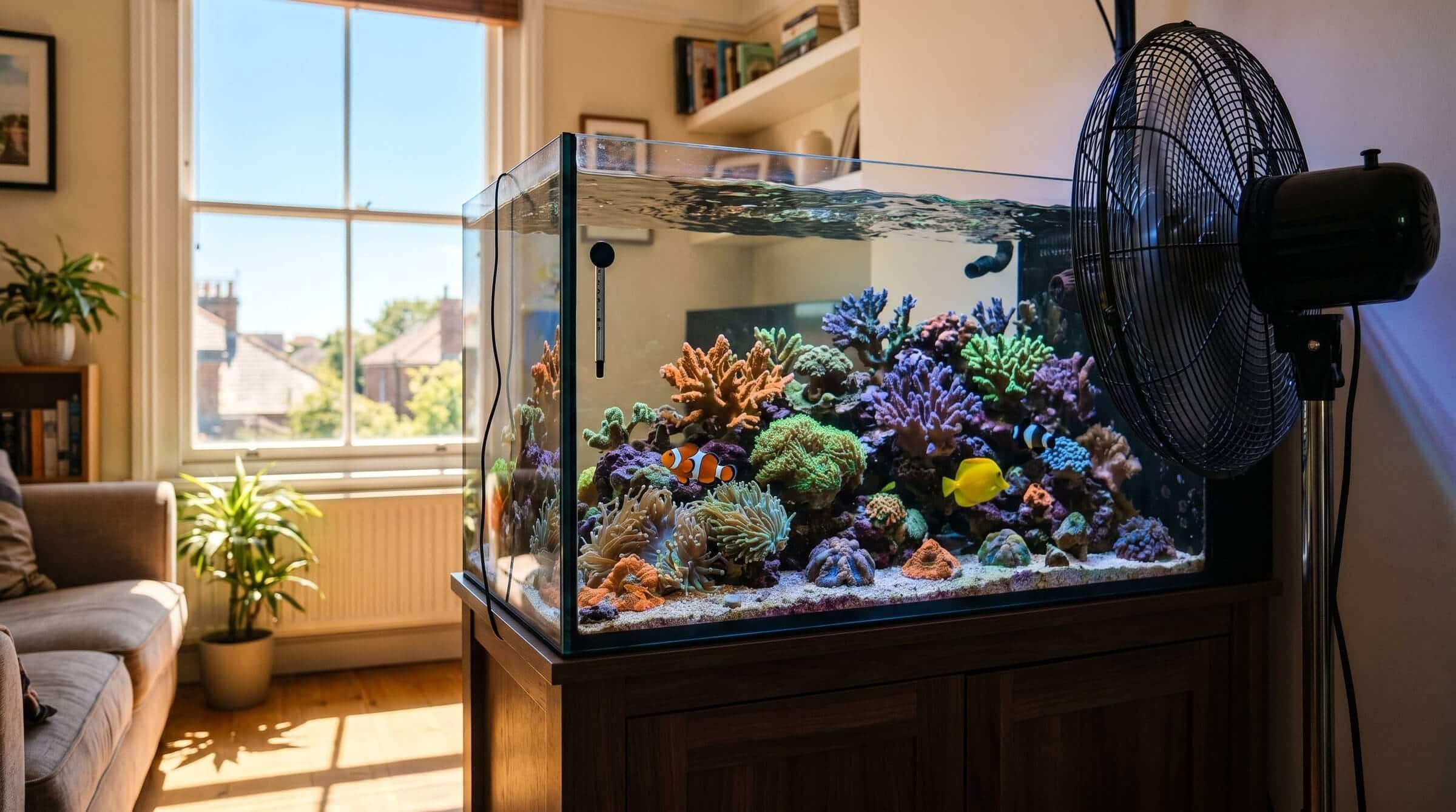
A fan blowing across the water surface is the most cost-effective way to drop temperature there is, and it is exactly how purpose-built aquarium coolers work. As air moves over the water, evaporation pulls heat out with it, and a decent clip-on or desk fan angled across the surface can take two to four degrees off in a hot room. Clip-on aquarium fans are made for the job and sit neatly on the rim, but an ordinary household fan works just as well as long as it is fixed securely and kept clear of the water. This is the method I lean on most to keep your reef tank cool day to day, because it is quiet, cheap and genuinely effective.
The frozen bottle method, done properly
Freeze a few plastic bottles of fresh water, then float one in your sump in an area of good flow, or in your top-up reservoir. As it thaws it pulls heat from the water gradually and safely. Rotate a fresh bottle in as each one thaws and you have a rolling cold source that costs nothing. Two rules keep this safe. Do not overfill the bottles before freezing or they split, and never tip loose ice cubes or cold water straight into the display. Direct ice causes exactly the kind of sudden swing that shocks livestock. Keep the cold contained in the bottle and let it work slowly, and it becomes one of the safest ways to keep your reef tank cool in an emergency.
Manage your lighting without crashing your corals
Your lights are one of the biggest heat sources in the system, so trimming the photoperiod helps. Older metal halide and T5 units run especially hot, and even modern LEDs add warmth. Shortening the lit hours or running at reduced intensity during the worst of the afternoon takes real heat out of the equation. The reef-specific catch, and one the generic guides get wrong, is that you cannot simply plunge the tank into darkness for days. Corals rely on stable, consistent light for photosynthesis, and a sudden blackout stresses them on top of the heat. Reduce and shorten, do not switch off entirely, and your corals stay happier while you keep your reef tank cool.
Increase oxygen and surface flow
Because oxygen is the real threat, getting more of it into the water is non-negotiable in a heatwave. Add an air pump and air stone, or angle a powerhead so it ripples the surface hard. That surface agitation is where gas exchange happens, pulling oxygen in and driving carbon dioxide out. An air pump running through good airline is cheap insurance and the first thing I tell anyone to switch on at the first sign of a hot spell. It will not cool the water much on its own, but it keeps your livestock breathing while the other methods you are using to keep your reef tank cool bring the temperature down.
Cool the room, not just the tank
Sometimes the smartest move is to fight the heat before it ever reaches the glass. Close the curtains or blinds on the tank during the day, especially if any direct sunlight falls across it, because a beam of sun heats not just the water but the rock and substrate, which then sit there radiating warmth all afternoon. Open windows at night to flush the hot air out, and keep the tank away from doorways and sunny walls. If you have air conditioning in the fish room, that single step does more to keep your reef tank cool than anything else on this list, set and forget.
Chillers, temperature controllers and the permanent fix
If you live somewhere that bakes every summer, or you run a high-value coral system you cannot risk, a dedicated chiller is the reliable long-term answer. It plumbs in like a filter and holds your chosen temperature regardless of the weather. Pair it, or pair your fans, with a temperature controller such as an Inkbird unit. These have a probe and two sockets, so you plug your heater into one and your cooling fan or chiller into the other, set your upper and lower limits, and the controller switches each on automatically. That takes the worry off your shoulders entirely and means the tank looks after itself while you are at work.
The mistakes that kill more reef tanks than the heat
Over 18+ years I have seen the heat itself cause fewer losses than the panic responses to it. When a tank is sitting too warm and you are anxious, the instinct is to do something drastic, and drastic is usually what does the damage. Keep these clear in your head before you reach for anything.
| Do | Do not |
|---|---|
| Leave the heater plugged in and at its normal setting. | Unplug the heater. It will not fire while the water is warm, but if you forget to plug it back in, the tank can cold-shock overnight. |
| Cool gradually, two to three degrees over several hours. | Drop the temperature suddenly. Fast swings shock livestock and trigger disease. |
| Float frozen bottles in the sump. | Tip ice cubes or cold water straight into the display. |
| Do small water changes with temperature-matched water if needed. | Do large cold water changes to crash the temperature down. |
| Boost aeration the moment a hot spell starts. | Wait until fish are gasping before adding oxygen. |
The water change point is worth dwelling on. A large change with cold water feels like a fast fix, but it is one of the most dangerous things you can do to a reef. If you genuinely must change water to bring a runaway tank down, keep it small, no more than around 20 percent, and aim only to take the edge off, not to reset the whole system in one go. Patience is what keeps your reef tank cool without trading one emergency for another.
Watch your salinity, not just your temperature
Heat brings a second problem that quietly catches people out: evaporation. When the water is warm and you have got fans running and the lid off, evaporation rockets. Water leaves, salt stays behind, and your salinity climbs day by day. A reef that started the week at a perfect 1.025 can drift uncomfortably high by the weekend if nobody is topping up.
If you run an automatic top-up system, check it is keeping pace and that the reservoir does not run dry, because demand in a heatwave can be far higher than usual. If you top up by hand, do it more often than you think you need to, always with fresh RO water rather than saltwater, and check your salinity daily. Keeping salinity stable is part of the same job as keeping temperature stable, and both matter when you are working to keep your reef tank cool through a long hot stretch.
Why a well-fed reef survives the heat better
Here is the part nobody else writing about cooling will tell you, and it is the part that comes from culturing live food rather than selling equipment. A heatwave is a stress event, and a reef that is well-nourished going into it copes and recovers far better than one running on the edge. Stress tolerance is built long before the hot weather arrives, at every feeding.
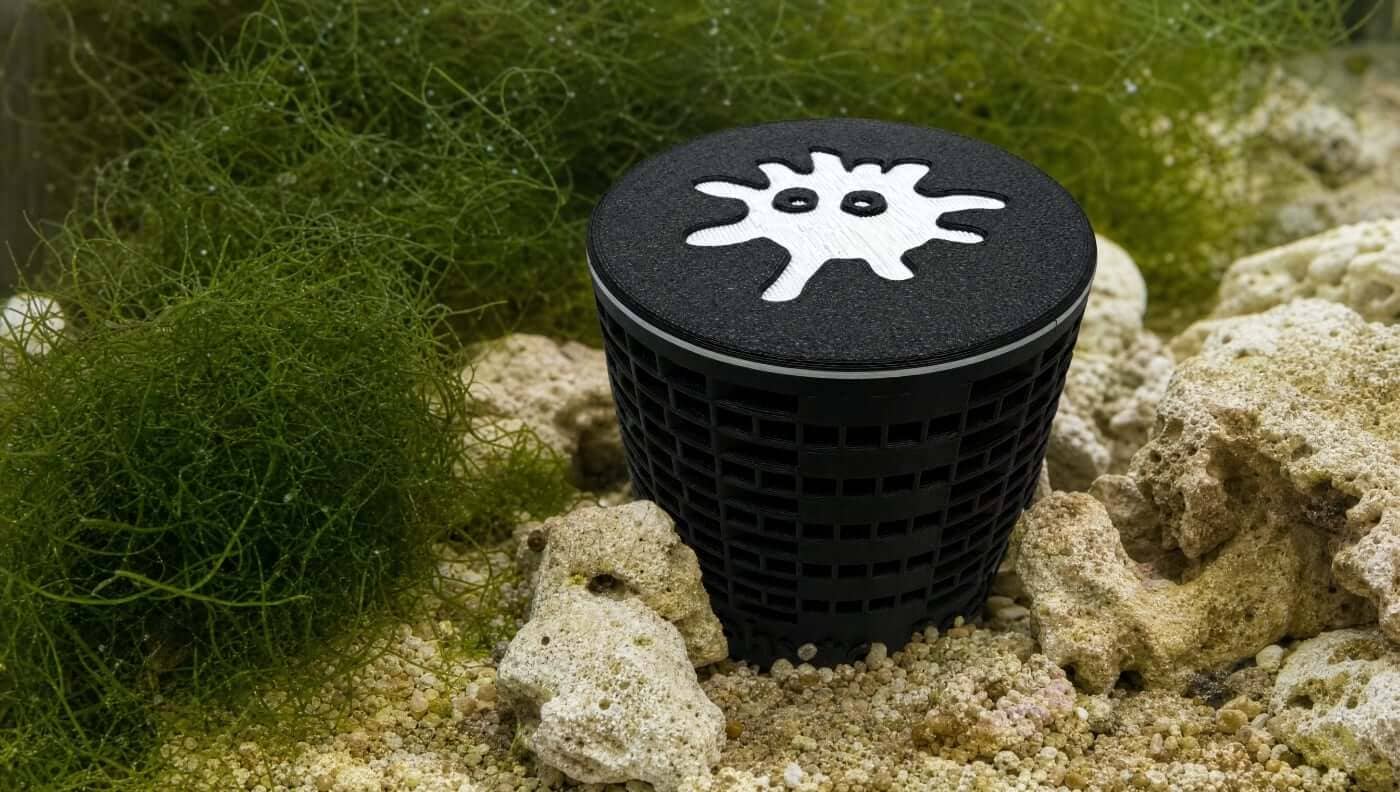
Fish carrying good condition and strong fat reserves have something to draw on when their metabolism spikes in the heat and they go off their food for a few days. A mandarin or a wrasse that has been grazing on a healthy population of live copepods is in a stronger place than one that has been scraping by. Those copepods, Tigriopus californicus, carry the EPA, DHA and astaxanthin that underpin a fish's resilience, and an established refugium population, fed on a quality copepod feed, means there is always something for them to pick at even on the days they refuse prepared food. A PodHide shelter helps that population hold and rebuild rather than getting wiped out.
Corals are the same story. Photosynthesis alone does not carry a coral through a heat-stress event, and the energy reserves that help it hold its colour and recover come from feeding. Regular dosing of 5 Species Phytoplankton feeds the filter feeders, the pods and the wider food web, and the dosing is simple to keep up even in a busy hot week: 1ml per 27 litres for a lightly stocked tank, 1ml per 18 litres for a medium system, and 1ml per 9 litres for a heavily stocked reef, daily. If you would rather a single richer blend, Reef Juice doses at the same 1ml per 27 litres light, 1ml per 18 litres medium and 1ml per 9 litres heavy, every day. For coral feeders specifically, Live Reef Flourish at 1 to 4 drops per 80 litres daily keeps the smallest mouths fed. A reef feeding well is one that is easier to keep your reef tank cool through, because nothing in it is already running on empty.
None of this stops a heatwave. What it does is give your livestock the reserves to ride one out. A reef built on a living food web, copepods, phytoplankton and the broad-spectrum mix of a live zooplankton blend, is simply more robust than one fed on dried food alone. That robustness is invisible right up until the day it matters, and a heatwave is exactly that day. Feeding well all year is one of the quietest, most underrated ways to keep your reef tank cool-headed under pressure.
Reef Juice - Live Phytoplankton Blend

£9.99
Something has shifted in your tank. Brown film creeps across the sand bed in the mornings, corals look less extended than they should, and nothing in your water chemistry quite explains it. You have probably checked your nitrate and phosphate,… read more
Topping up fish that have stopped eating in the heat
It is normal for fish to go off prepared food when they are warm and stressed, and live food often gets eaten when nothing else will. A live, moving target triggers a feeding response that a lifeless pellet does not. If your fish are picking at the surface and ignoring their usual food, a top-up of live prey can keep them fed and keep their strength up through the worst days.
This is where the ready-to-use pouches earn their place. Pod-Shot is concentrated live copepods you can pour straight in with no preparation, perfect for tempting a reluctant fish today rather than waiting for a refugium to deliver. For broader coverage, Zoo-Shot gives you live zooplankton on demand for coral feeding without any setup. Keeping a couple of these in reserve through summer means you always have something a stressed fish will actually take. For mandarin keepers, a Mandarin Food Pack subscription keeps a steady live supply arriving without you having to remember to reorder.
Receiving live food safely during a heatwave
A question I am asked every summer is whether it is safe to order live food when the weather is hot, and the honest answer is yes, with a little timing on our side. Live marine cultures are tougher in transit than people assume, and we have packed and posted them through 18+ British summers. We choose dispatch around the cooler conditions that give your livestock the best possible journey, and everything is packed to hold steady on the way to you.
Your part is simple. Open and acclimatise your order as soon as it arrives rather than leaving the parcel sitting in a warm porch or car. Float and temperature-match as you normally would, and if your tank is running warm, acclimatise a touch more slowly so the new arrivals are not dropped into a swing. Treated that way, a fresh culture of live food settles in happily even in summer, and topping the tank up with fresh nutrition while you keep your reef tank cool is one of the better things you can do for stressed livestock.
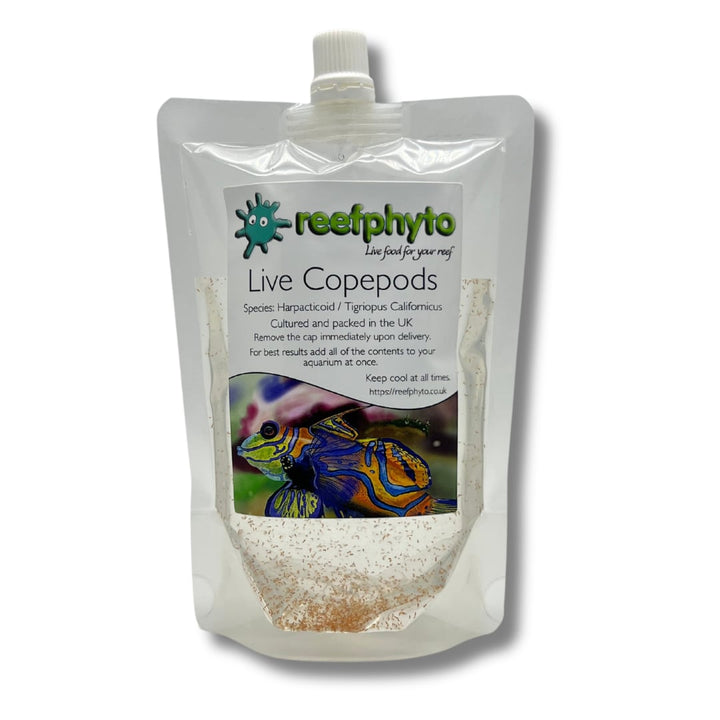
Live Copepods
£11.99
Live Copepods UK: Tigriopus californicus, Cultured Fresh in Wales by Reefphyto Your reef looks right on paper. Clean water, stable parameters, good equipment. But something is still off. Your fish are pale, your mandarin is wasting, your corals are feeding… read more
Your heatwave action plan
When the forecast turns hot, you do not need to overthink it. Get an accurate digital thermometer reading first so you know exactly where you stand. Lift the lid, get a fan moving air across the surface, and switch on extra aeration straight away, because oxygen is the first thing to protect. Float a frozen bottle in the sump if you are climbing toward 29 degrees, trim your lighting hours without blacking the tank out, and close the curtains on any sun hitting the glass. Top up evaporation with fresh RO water and watch your salinity daily. Above all, cool gradually and leave the heater plugged in, because the panic moves cause more losses than the heat ever does.
Do those things and you will keep your reef tank cool through the worst a British summer can throw at it, with your corals holding their colour and your fish breathing easy. If you have kept your reef well-fed all year, you have already done the most important part long before the thermometer started to rise.
For more on building that resilience, my guides on coral feeding, why live copepods benefit your reef tank and how phytoplankton impacts your reef are good next reads, and the refugium setup guide shows you how to build the live food web that carries a tank through the hard weeks.
If you have questions about getting your reef through a heatwave, get in touch. I answer every message personally.
Darren
Founder, Reefphyto Ltd - Wales, UK - Est. 2008