Live Copepods & PodHide Bundle
You keep adding copepods to your tank and they disappear within days. Your mandarin is still hunting, your wrasses are still patrolling, and the population never seems to get ahead of the predation. You are restocking constantly and the refugium still feels empty.
The problem is not the quality of the copepods. It is that they have nowhere safe to hide, breed, and establish before being eaten. Live copepods introduced into a tank with active predators face immediate pressure, and without a protected space to reproduce, the population never has a chance to grow beyond what you add manually.
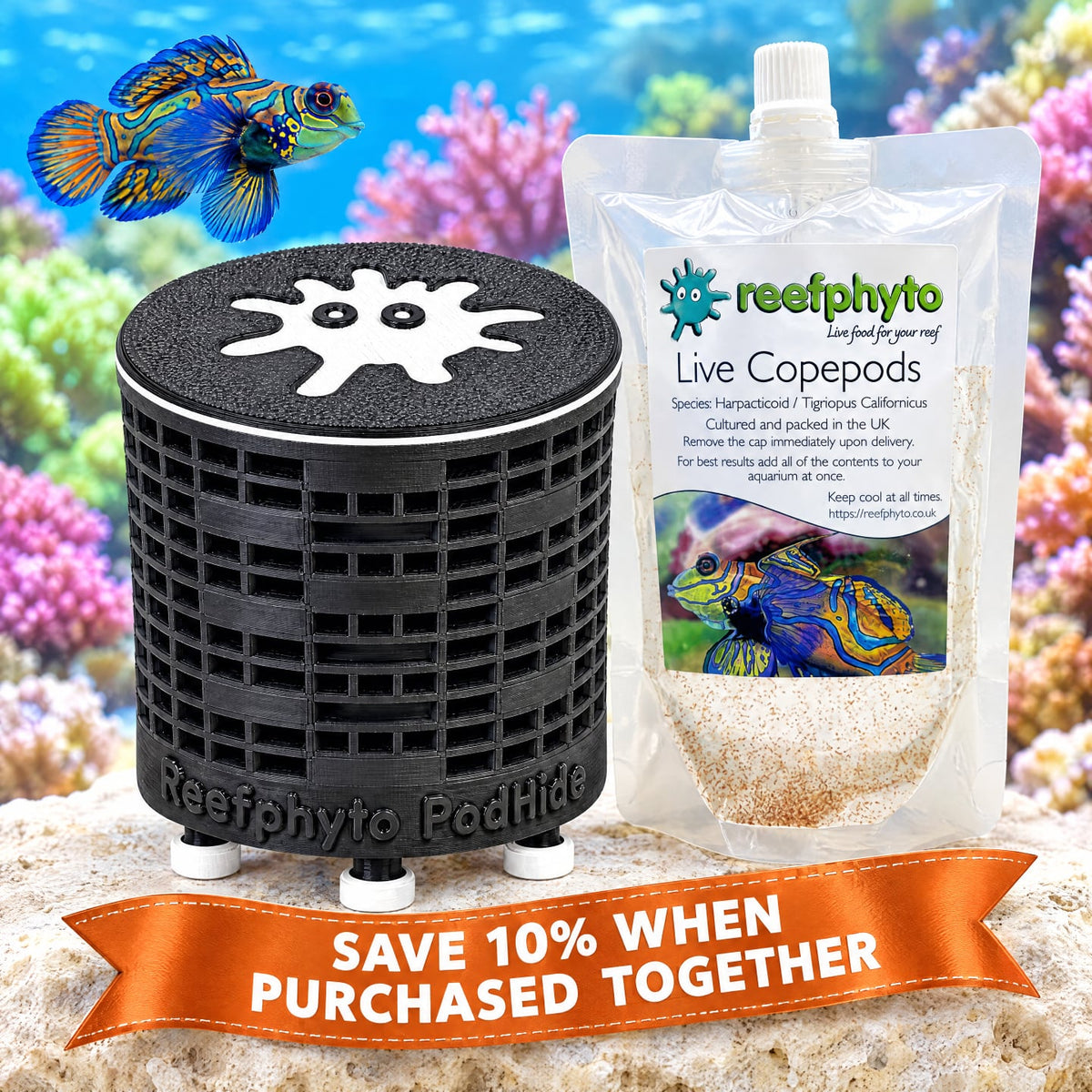
The Reefphyto PodHide and Copepod Bundle pairs freshly cultured Tigriopus californicus copepods with the PodHide, a reef-safe 3D-printed breeding shelter measuring 85mm in height and 80mm in width, with a stable four-foot base and a multi-hole textured interior designed to give copepods a protected structure where they can colonise, reproduce, and gradually migrate into the display tank on their own terms. It sits equally at home in a sump, refugium, or low-flow area of the display tank.
With a PodHide in place, the dynamic shifts. Copepods establish in the shelter, breed without predation pressure, and begin seeding the tank with a continuous, self-renewing population. Fish that were consuming pods faster than you could replace them start encountering a steady supply rather than an occasional flush of food.
Reefphyto has been culturing live copepods from our specialist facility in Wales since 2008, and the PodHide was designed in-house by Darren to solve exactly the problem that most pod keepers encounter. If you have questions about placement or stocking density for your specific setup, he is happy to help personally.
Stop restocking and start sustaining. This bundle gives your copepod population the foundation it needs to thrive.
Adding live copepods to a reef tank is straightforward. Keeping them alive long enough to make a difference is where most keepers struggle. The Reefphyto PodHide and Copepod Bundle solves both parts of the problem at once, combining freshly cultured Tigriopus californicus copepods with a purpose-built breeding shelter that protects the population from predation and gives it the structure it needs to establish, reproduce, and sustain itself long-term. Both components are available at a 10% saving when purchased together.
If your copepods keep disappearing before they can establish a population, adding structure and fresh copepods together is the right decision.
Why Copepods Disappear So Quickly in Reef Tanks
This is one of the most common frustrations in the reef hobby. A keeper adds a generous volume of live copepods, watches their mandarin feed eagerly for a day or two, and then finds the population has vanished. They restock. The same thing happens. The cycle repeats, the cost accumulates, and the refugium never reaches the population density needed to support demanding fish long-term.
The reason is simple. In a tank with active copepod predators such as mandarin dragonets, scooter blennies, leopard wrasses, and anthias, the predation rate outpaces the reproduction rate. Copepods introduced directly into the water column are exposed immediately. They are consumed before they have the opportunity to find substrate, settle, and begin reproducing. Without a protected space to breed, the population can never get ahead of the pressure placed on it.
This is not a problem with the copepods. It is a structural problem with the environment they are being added to. The PodHide addresses that structure directly.
What Is the Reefphyto PodHide?
The PodHide is a copepod shelter and breeding station designed and manufactured in-house by Reefphyto. It is 3D printed in reef-safe PETG material and features a multi-hole design with textured internal surfaces that provide copepods with the physical structure they need to colonise, hide, and reproduce away from predation pressure.
Measuring 85mm in height and 80mm in width, the PodHide has a stable four-foot base suitable for placement on sand or glass. It is available in four colour options: Black and White, Black and Blue, Black and Orange, Black and Red and Translucent. It is designed to be unobtrusive in any sump, refugium, or low-flow area of the display tank.
The concept behind the PodHide is straightforward. In the wild, copepods are not evenly distributed in the water column. They colonise structure, live rock surfaces, rubble, algae, and substrate where they can graze, breed, and shelter from predators. The PodHide replicates this habitat in a compact, purpose-designed unit that can be placed anywhere in the system.
Once copepods colonise the PodHide, they breed within the protected structure and migrate naturally into the surrounding water and eventually into the display tank. This creates a continuous, self-replenishing supply of live prey rather than the boom-and-bust cycle that results from periodic manual additions to an unprotected tank.
How the PodHide and Live Copepods Work Together
The two components of this bundle are designed to complement each other at every stage of the process.
The live Tigriopus californicus copepods provide the seeding population. Freshly cultured at Reefphyto's specialist facility in Wales on the day of dispatch, they arrive active and ready to establish. Rather than being added directly to the display tank where they face immediate predation, they are introduced to the PodHide by gently squirting them into the shelter holes using the delivery packaging, where they can settle and begin colonising the textured interior surfaces.
The PodHide then does the work of protecting that founding population. Copepods that establish within the shelter breed in relative safety, and the growing population begins to overflow into the wider system naturally over time. The result is a copepod population that builds from the bottom up, rather than being repeatedly consumed and replaced.
For tanks with a refugium, the PodHide placed in the refugium provides the most effective setup, combining the protection of the shelter with the protection of the refugium environment. For tanks without a refugium, placing the PodHide in a low-flow area of the sump or in a sheltered section of the display tank still produces significantly better outcomes than adding copepods to open water.
Which Fish and Reef Animals Benefit Most
Mandarin Dragonets
The mandarin dragonet is the fish most commonly associated with copepod dependence, and for good reason. Mandarins are obligate live feeders that spend their entire day hunting copepods across their territory. A tank that cannot sustain a live copepod population cannot sustain a mandarin long-term. The PodHide and Copepod Bundle is the most practical starting point for any keeper planning to keep a mandarin, providing both the live food and the infrastructure needed to make the population self-sustaining.
Scooter Blennies and Dragonets
Like mandarins, scooter blennies and other dragonet species are adapted to hunt live benthic prey. They patrol substrate and structure looking for copepods and other small organisms. A PodHide placed in or near the display tank provides exactly the kind of structured habitat these fish naturally hunt around, and a colonised shelter gives them a reliable hunting ground rather than a depleted open substrate.
Leopard Wrasses and Planktivorous Wrasses
Many wrasse species are highly efficient copepod hunters that can deplete a tank's pod population faster than almost any other fish. For keepers who want to maintain both wrasses and a healthy copepod community, the PodHide provides a critical buffer, ensuring the population always has a protected breeding core that the wrasses cannot fully access.
Corals and Filter Feeders
As the copepod population establishes and begins reproducing within the PodHide, nauplii and juvenile copepods migrate into the water column continuously. These microscopic early-stage copepods are ideal food for coral polyps, NPS corals, and filter-feeding invertebrates that benefit from a consistent supply of small live particles rather than periodic large additions.
Setting Up Your PodHide
Rinse the PodHide thoroughly with tank water before placing it in your system. Choose a location with low to moderate flow, enough to carry food particles to the shelter and transport copepods and nauplii away from it, but not so strong that it prevents settlement. A refugium is ideal. A shaded area of the sump or a sheltered corner of the display tank work well.
To seed the PodHide, gently squirt the live copepod culture directly into the holes of the shelter using the delivery packaging or a pipette. This places the copepods inside the structure immediately rather than releasing them to open water. Add any remaining copepods to the surrounding area.
Alternatively, add copepods to the tank normally and allow natural colonisation of the PodHide over time. This is a slower process but works well in systems with lower predation pressure.
To support the growing population, add live phytoplankton to the tank regularly. Our 5 Species Live Phytoplankton Blend provides the microalgae diet that Tigriopus californicus grazes on, ensuring the PodHide colony has the food it needs to reproduce consistently.
Frequently Asked Questions
Can the PodHide be used without a refugium?
Yes. The PodHide is specifically designed for tanks without a dedicated refugium as well as those with one. Placed in a low-flow area of a sump or display tank, it provides the protected breeding habitat that a refugium would otherwise offer. Results are best in the sump or a sheltered area away from the most active predators.
How long does it take for the PodHide to become colonised?
With direct seeding into the shelter holes, copepods begin establishing within the first few days. A meaningful breeding population within the PodHide typically develops over two to four weeks, with copepod migration into the display tank becoming visible within four to six weeks. Regular top-ups of live copepods during this establishment phase accelerate the process.
Do I need to keep buying copepods once the PodHide is established?
The goal of the PodHide is to reduce or eliminate the need for frequent restocking once the colony is established. In practice, tanks with heavy copepod predation from mandarins, wrasses, or anthias benefit from periodic top-ups every four to six weeks to maintain numbers and refresh the breeding population. Tanks with lower predation pressure often reach genuine self-sufficiency, with the PodHide colony sustaining itself indefinitely with phytoplankton feeding alone.
Complete Your Copepod System
For the best long-term results, pair this bundle with our 5 Species Live Phytoplankton Blend to feed the PodHide colony and sustain population growth. Our standalone Live Copepods are available for periodic top-ups once your PodHide is established. For broader reef nutrition, our Live Zooplankton blend adds Brachionus plicatilis rotifers alongside copepods to feed corals and filter feeders across the full particle size range.



 Roll over image to zoom in



 Darren Wordley
18 years culturing live phytoplankton in Wales
Darren Wordley
18 years culturing live phytoplankton in Wales
 Cultured in Wales, shipped live.