Live Rotifers: Brachionus plicatilis
You've watched your fish larvae appear healthy at hatching, only to fade and disappear within the first few days. The water is clean, the temperature is stable, and you've done everything the guides suggest. But they're still not making it.
The problem is particle size and prey movement. Newly hatched marine fish and juvenile seahorses have mouths too small for most available foods, and they are hardwired to pursue live, moving prey. Without something small enough to catch and nutritionally complete enough to sustain them, fry starve silently in the first critical days of life. That window, once lost, cannot be recovered.
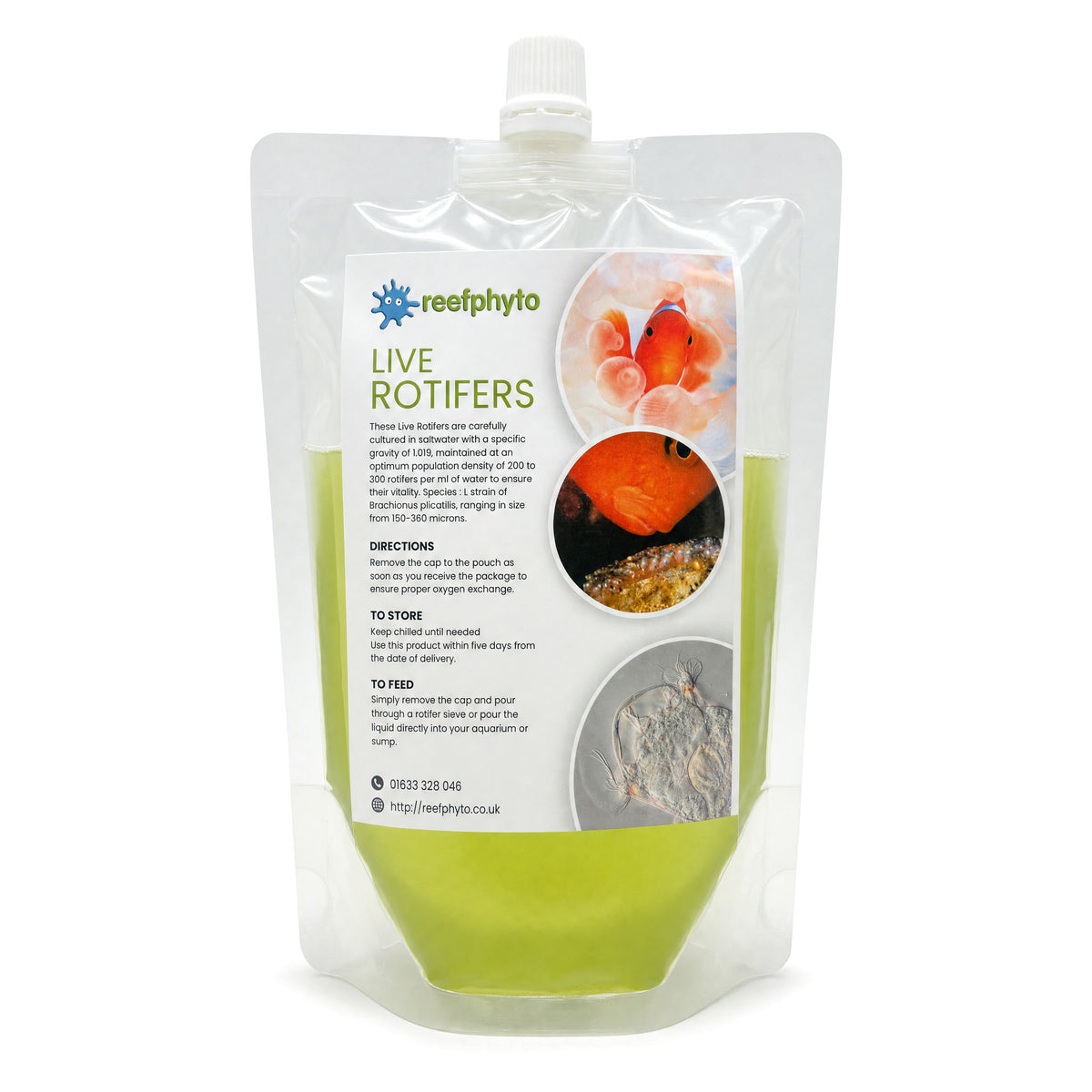
Live Rotifers (Brachionus plicatilis) are microscopic marine invertebrates measuring 90 to 360 microns, making them the ideal first-feed for marine fish larvae, juvenile pipe fish, and young seahorses. Ours are cultured on live phytoplankton rather than yeast, which means they carry genuine omega-3 fatty acids and the same nutritional profile as the rotifers your animals would encounter in the wild.
Once live rotifers are introduced, the difference is immediate and tangible. Larvae that showed no interest in paste begin striking at prey. Juvenile seahorses settle and feed with visible intent. Fish that seemed fragile start to gain strength and hold condition through the most vulnerable stage of their lives.
Reefphyto has been producing live marine cultures from our specialist facility in Wales since 2008. Darren has over 18 years of hands-on aquaculture experience and prepared your culture fresh before it was dispatched. If you have questions about feeding rates, enrichment, or your specific species, he answers personally.
Give your larvae the live prey they need to make it through the first days and beyond.
If you are raising fry, keeping seahorses, or feeding filter feeders that need prey smaller than copepods, starting with live rotifers is the right decision.
What Are Live Rotifers?
Rotifers are microscopic aquatic invertebrates found throughout the world's oceans. In marine aquaculture and reef keeping, Brachionus plicatilis the L-type rotifer is the species most widely used as a live food source. Measuring between 90 and 360 microns across the full size distribution of a healthy culture, from freshly hatched juveniles up to gravid adults carrying eggs, they sit in a size range that makes them accessible to animals from the smallest newly hatched larvae through to juvenile fish and filter feeders.
Their soft bodies, slow swimming movement, and high nutritional density make them uniquely suited to the job. When fed on live phytoplankton, rotifers bio-accumulate omega-3 fatty acids, EPA, DHA, and essential amino acids, passing that nutritional value directly to whatever consumes them. This is why wild marine larvae thrive on rotifers in the ocean, and why captive animals struggle without them.
Why Marine Fish Larvae Need Live Rotifers to Survive
The first days of a marine fish larva's life are the most critical and the most often misunderstood. Newly hatched clownfish fry, seahorse juveniles, and the larvae of most reef fish species share two characteristics that make standard aquarium foods completely unsuitable as a first feed.
First, their mouths are extraordinarily small. Most enriched paste foods, frozen preparations, and even newly hatched brine shrimp are simply too large for larvae in the first days post-hatch to consume. Second, they are hardwired to respond to movement. A stationary or sinking food particle will not trigger a feeding response in most marine larvae, no matter how nutritious it is.
Live Brachionus plicatilis satisfy both requirements. A healthy culture contains rotifers across the full 90 to 360 micron range, with the smallest newly hatched juveniles fitting within the gape of even the tiniest newly hatched marine larvae and the larger adults providing more substantial prey for juvenile fish and filter feeders. Their slow, rotating swimming motion triggered by their corona of cilia creates exactly the prey movement that stimulates a feeding response. The result is larvae that strike, pursue, and consume from the very first days of life.
Without this, the outcome is predictable. Larvae may appear healthy for the first 24 to 48 hours, sustained by their yolk sac reserves. Once those reserves are exhausted, starvation follows quickly and silently. This is the most common cause of failure in marine fish breeding projects, and it is almost entirely preventable with the right live food.
What Makes Reefphyto Live Rotifers Different
Not all live rotifers are equal. The nutritional value of a rotifer culture depends entirely on what those rotifers have been fed before dispatch. Rotifers cultured on yeast or low-quality algae concentrates carry a fraction of the fatty acid content of rotifers raised on live phytoplankton.
At Reefphyto, our Brachionus plicatilis are cultured on live phytoplankton, not yeast. This gut-loading process ensures that every rotifer your animals consume is carrying genuine EPA, DHA, and the micronutrient profile that wild rotifers derive from their natural diet. We enrich our cultures before dispatch to maximise nutritional density at the point of arrival.
Every culture is prepared fresh at our specialist facility in Wales on the day of dispatch. We do not hold stock for extended periods or import from overseas suppliers. What you receive is alive, active, and nutritionally complete on arrival.
What Are Live Rotifers Used For in a Reef Tank?
First Feed for Marine Fish Larvae
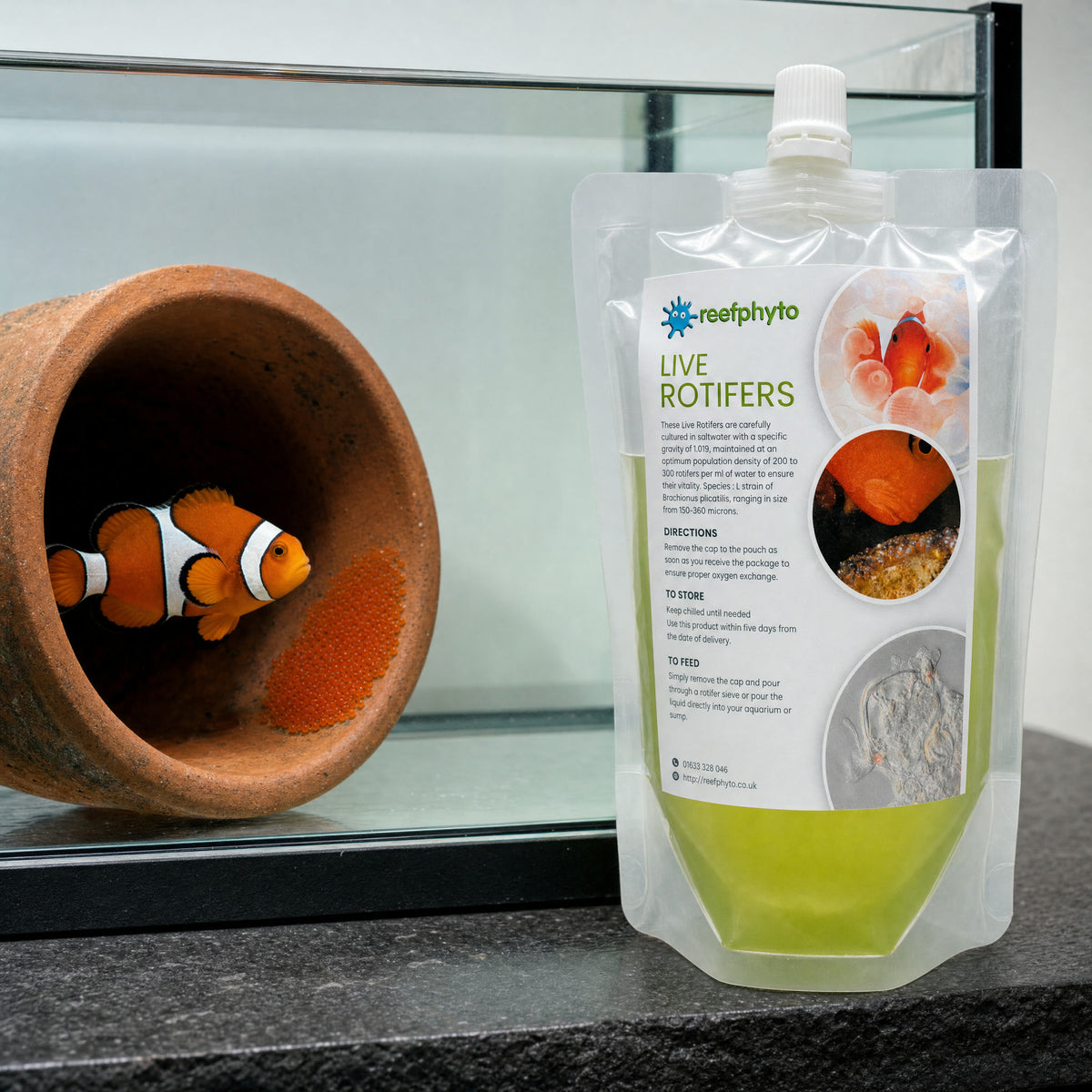
Live rotifers are the standard first-feed in commercial marine aquaculture worldwide for good reason. Clownfish, dottybacks, gobies, seahorses, pipefish, and the larvae of most reef fish species all benefit from live rotifers as their first food source. For serious marine breeders in the UK, a reliable supply of freshly cultured Brachionus plicatilis is not a luxury, it is a requirement.
Feeding Seahorses and Pipefish
Juvenile seahorses and pipefish present one of the most challenging feeding scenarios in the reef hobby. Their small size, delicate constitution, and instinct to pursue live moving prey makes the early weeks of their lives precarious without the right food source. Live rotifers provide the particle size and movement stimulus that juvenile syngnathids need to feed consistently and build condition through their most vulnerable growth stage.
Feeding Corals and Filter Feeders
Rotifers are not only for breeders. SPS and LPS corals, fan corals, feather duster worms, tube worms, bivalves, and a wide range of filter-feeding invertebrates all respond positively to live rotifers in the water column. Their small size makes them accessible to coral polyps that cannot capture larger zooplankton, and their movement triggers a feeding response that frozen or dried alternatives simply do not produce.
Supporting Microfauna and Reef Biodiversity
A healthy reef tank is not just fish and coral. It is a functioning microfauna community: copepods, amphipods, worms, and microscopic organisms that collectively maintain balance in the system. Introducing live rotifers supports this broader community, adds nutritional diversity to the water column, and contributes to the kind of ecological balance that distinguishes a thriving reef from a merely maintained one.
How to Use Live Rotifers in Your Reef Tank
When your culture arrives, turn off mechanical filtration and skimmer for 30 minutes before adding rotifers to your tank or breeding vessel. This prevents the animals from being removed from the water column before your fish or corals have had the opportunity to feed.
For marine fish larvae, dose into the rearing vessel at a density appropriate to the species and larval age. For reef tanks and filter feeders, add directly to the display tank or sump in the evening when coral feeding activity is naturally higher.
You do not need to add the full pack on the day of arrival. Many reef keepers prefer to split a culture across smaller daily doses over five days, keeping the unused portion refrigerated between feeds. This spreads the nutritional benefit across the week and gives corals and filter feeders a steady supply of live prey rather than a single large pulse.
Store any unused culture in the refrigerator with the cap slightly loose to allow gas exchange. Use within five days of delivery for best results. If you plan to maintain a longer-term rotifer culture, our rotifer feed concentrate and rotifer enrichment are available to keep your culture healthy and nutritionally dense between top-ups. Our rotifer culture guide walks you through setup, feeding, and maintenance step by step.
Frequently Asked Questions About Live Rotifers
How many rotifers do I need for marine fish larvae?
For most marine fish larvae, a density of 5 to 10 rotifers per millilitre in the rearing vessel is a good starting point. Species with smaller mouths or slower development may require higher densities initially. Darren is happy to advise on specific species. Contact us directly before your spawn if you want guidance tailored to your setup.
Are live rotifers safe to add directly to a reef tank?
Yes. Rotifers are a natural component of the marine food web and are entirely safe to add to a healthy reef system. They will not introduce pests or disease and will be consumed quickly by fish, corals, and filter feeders. Our cultures are maintained under controlled aquaculture conditions and are dispatched free from cross-contamination.
What is the difference between rotifers and copepods?
Rotifers and copepods serve different but complementary roles in a live food system. Rotifers are smaller and slower, making them the right choice for larvae, juvenile seahorses, and corals. Copepods are larger, more energetic prey that are better suited to established fish, mandarin dragonets, and refugium stocking. For a complete live food system, both are valuable. See our live copepods page for more detail.
Complete Your Live Food System
Live rotifers work best as part of a broader live nutrition programme. For reef keepers looking to build a complete system:
Our live phytoplankton feeds and sustains your rotifer culture, and provides direct nutrition for corals and filter feeders. Our live copepods complement rotifers by providing larger live prey for established fish and a self-sustaining refugium population. Our live zooplankton blend combines copepods and rotifers in a single culture for reef keepers who want broad-spectrum live nutrition in one addition.



 Roll over image to zoom in



 Darren Wordley
18 years culturing live phytoplankton in Wales
Darren Wordley
18 years culturing live phytoplankton in Wales
 Cultured in Wales, shipped live.