Quick Navigation
- What the scientists actually found
- Why live phytoplankton for reef tank keepers is the foundation of everything
- Who is eating live phytoplankton for reef tank feeding
- Why cell size and species mix matter more than volume
- Live phytoplankton for reef tank use versus preserved: what "live" really means
- What a failed bloom looks like in a reef tank
- How to be the bloom: a practical live phytoplankton for reef tank routine
- Signs live phytoplankton for reef tank dosing is working, and signs you are overdoing it
- The bigger picture
- FAQs
A study published this week by scientists at the University of Colorado Boulder described phytoplankton as "the foundation that everything else eats" in the ocean. It is a simple line, but it explains a great deal about why live phytoplankton for reef tank keeping matters so much, and why so many tanks quietly struggle without it. If you have ever wondered why your copepod population faded a few weeks after you added them, why your feather dusters shrank, or why a mandarin that looked plump in the shop slowly thinned out in your care, the answer often sits at the very bottom of the food chain.
I have been culturing live marine foods here in Wales for more than 18 years, and phytoplankton is where every one of my cultures starts. The copepods, the rotifers, the zooplankton blends, all of them are built on a steady supply of living algae grown in-house. So when I read a piece of ocean science that says the whole system rests on these tiny cells, I recognise it immediately, because I watch the same thing happen in my culture room every single day. This post is about what that study found, what it means for the water in your living room, and how to make sure your tank has the bloom it needs.
What the scientists actually found
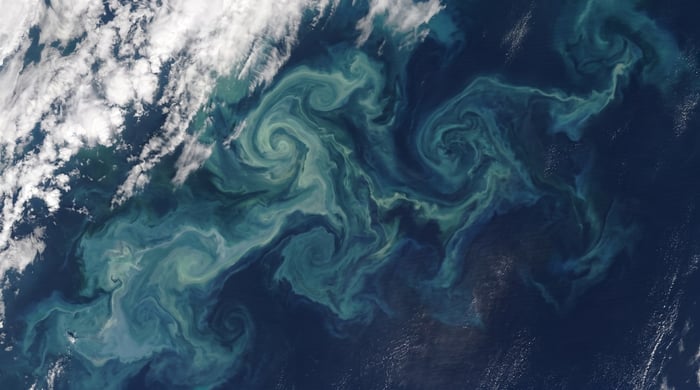
The research, published in Geophysical Research Letters by Nicole Lovenduski, Genevieve Clow, Samuel Mogen and colleagues at CU Boulder and the National Center for Atmospheric Research, was not about aquariums. It was about how well satellites can see phytoplankton from space. Satellites measure the green of chlorophyll at the sea surface, and for decades that has been our main window onto how much phytoplankton the ocean is producing.
The team built a satellite emulator, a computer model that mimics what an orbiting sensor can and cannot see, and compared it with what a full ocean model says is really happening. The result was striking. Globally, satellites detect only around 10 percent of the days when phytoplankton hits a low extreme, and around 19 percent of the days when it hits a high extreme. Cloud cover, sea ice and low sun angles hide the rest. In other words, most of the time the ocean's productivity spikes or collapses, we do not see it happen.
The part that stopped me was their explanation of why the low extremes matter. When a bloom fails to occur, marine life in that region that relies on phytoplankton for its diet can be severely affected. Zooplankton have nothing to graze. Larval fish that hatched expecting a soup of food find clear water. The effect ripples upward through everything from anchovies to whales. Phytoplankton is the base, and when the base is missing, the whole structure above it goes hungry.
Why live phytoplankton for reef tank keepers is the foundation of everything
It is worth pausing on how the ocean's food web is built, because the reef in your tank is a miniature version of the same thing, with one enormous difference.
Reef Juice - Live Phytoplankton Blend

£9.99
Something has shifted in your tank. Brown film creeps across the sand bed in the mornings, corals look less extended than they should, and nothing in your water chemistry quite explains it. You have probably checked your nitrate and phosphate,… read more
How the ocean feeds itself
Phytoplankton are single-celled algae, most of them between two and twenty microns across, which is far smaller than anything you can see with the naked eye. They use chlorophyll to turn sunlight, water and carbon dioxide into sugars, fats and proteins, and they do it in staggering quantities. Roughly half of all the photosynthesis on Earth happens in these cells. Everything in the sea that does not photosynthesise is, at some remove, eating phytoplankton. Copepods graze it directly. Larval fish eat the copepods. Bigger fish eat the larvae. Sponges, clams, feather dusters and many corals filter the cells straight out of the water column.
On a natural reef, that supply never really stops. Currents sweep plankton over the reef crest day and night, and a reef in good health is effectively bathed in a constant thin broth of living cells and the animals that eat them. Reef biologists have measured coral reefs consuming huge amounts of plankton from the water passing over them. The reef is a wall of mouths, and the ocean keeps delivering.
Why your tank is a bloom that never comes
Now think about a reef aquarium. It is a sealed box of water with a light on top. There is no current bringing new plankton in from the open sea. There is no spring bloom. Your skimmer and filter socks remove suspended particles. Your mechanical filtration is designed, quite deliberately, to keep the water crystal clear, which is another way of saying free of the very thing the ocean runs on.
So the situation the CU Boulder team describes as a rare and damaging extreme, a region where the bloom simply does not happen, is the everyday condition of most reef tanks. The animals that need phytoplankton are living in a permanent low. That is the reason live phytoplankton for reef tank feeding is not a luxury or an optional extra. In a closed system, you are the only source of the bloom. If you do not add it, it does not exist.
Who is eating live phytoplankton for reef tank feeding
People sometimes tell me they have no filter feeders, so they do not need phytoplankton. Almost every reef tank has more phytoplankton eaters in it than the owner realises, and the case for live phytoplankton for reef tank feeding gets stronger the closer you look at the rock.
Copepods, rotifers and the microfauna
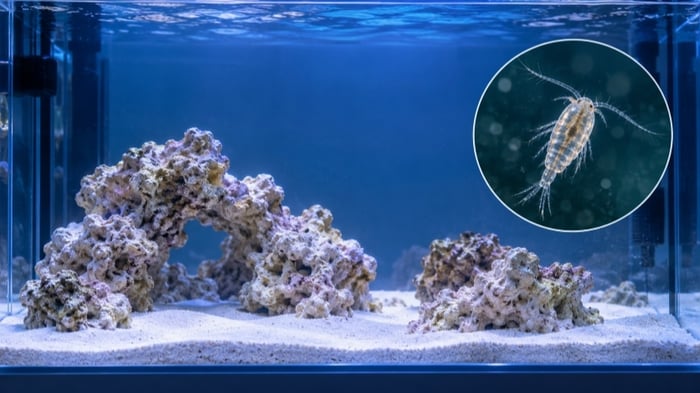
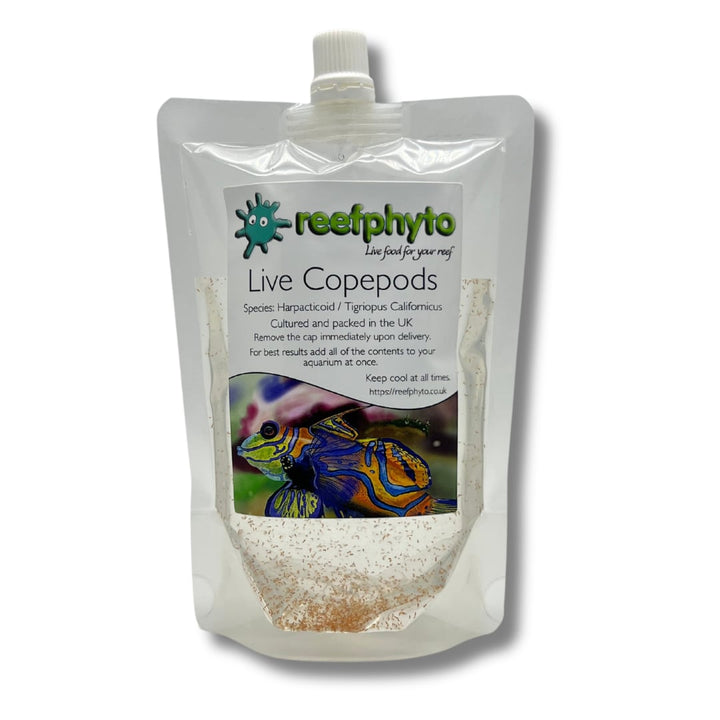
Copepods are the most obvious. My live copepods are Tigriopus californicus, a harpacticoid species that grazes on algae and detritus across the rock, sand and glass. Adults are fairly forgiving eaters, but their nauplii, the tiny larval stages, depend heavily on suspended microalgae. If you add a bag of pods to a tank with no phytoplankton, the adults will survive for a while and breed, but each successive generation of nauplii has less to eat, and the population slowly declines. That is why I have always been clear that pods and live phytoplankton for reef tank use go together. Adding live zooplankton without feeding it is a bit like introducing sheep to a car park.
Rotifers are even more dependent. Brachionus plicatilis can double its population in under a day when it has enough Nannochloropsis to graze, and it crashes just as fast without it. I have written about culturing these in my copepod culture guide, and the single most common reason a home culture fails is not temperature or salinity but simply running out of food.
Live Copepods
£11.99
Live Copepods UK: Tigriopus californicus, Cultured Fresh in Wales by Reefphyto Your reef looks right on paper. Clean water, stable parameters, good equipment. But something is still off. Your fish are pale, your mandarin is wasting, your corals are feeding… read more
The filter feeders you forgot you had
Then there are the animals that do not move. Feather duster worms, Christmas tree worms, tunicates, sponges, clams, scallops, and the small encrusting sponges and bryozoans that colonise live rock. All of these are pulling particles out of the water, and most of them are built to capture cells in the two to twenty micron range, which is exactly where phytoplankton sits. A tank with a healthy sponge and worm population on the rock is quietly consuming live phytoplankton for reef tank health all day, and if there is none available, those populations shrink. Many reef keepers have watched a beautiful feather duster drop its crown and assumed it was water quality when it was simply starving.
Corals, directly and indirectly
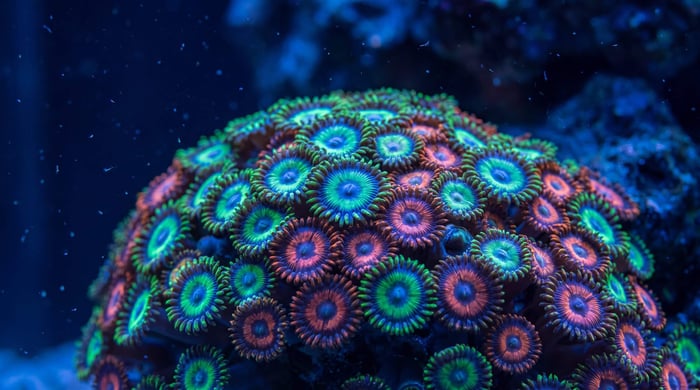
Corals are a more nuanced case. Most reef corals get much of their energy from their symbiotic algae, but they also capture food from the water, and studies have shown a range of stony corals ingesting phytoplankton directly. Some soft corals, gorgonians and the non-photosynthetic species like Dendronephthya rely almost entirely on captured plankton. Even for corals that do not eat phytoplankton cells themselves, the effect is indirect but real: the copepods, rotifers and other zooplankton that corals do capture at night are themselves fed on phytoplankton. Feed the base, and everything above it has more to eat. I cover the practical side in my coral feeding guide.
Why cell size and species mix matter more than volume
The CU Boulder researchers were counting phytoplankton biomass as a single number, but anyone who works with these algae knows that not all phytoplankton is the same. Different species have different cell sizes, different fatty acid profiles and different nutritional value, and the animals in your tank have different preferences. This is the reason I culture a blend rather than a single species, and it is the reason I think a mixed live phytoplankton for reef tank use gives more consistent results than any single strain.
| Species | Typical cell size | Notable nutrition | Who it suits |
|---|---|---|---|
| Nannochloropsis oculata | 2 to 4 microns | Very high EPA, robust cell wall | Rotifers, copepod nauplii, sponges |
| Nannochloropsis gaditana | 2 to 5 microns | High EPA, fast growing | Rotifers, copepods, general water column feeding |
| Tetraselmis suecica | 10 to 14 microns | Balanced amino acids, vitamins, some EPA | Copepods, clams, feather dusters, larger filter feeders |
| Pavlova | 4 to 6 microns | Rich in DHA and sterols | Copepods, bivalves, larval fish via enrichment |
| Thalassiosira weissflogii | 5 to 20 microns | Diatom, silica frustule, good EPA and DHA | Corals, clams, sponges, larger copepods |
Those five make up my 5 Species Phytoplankton Blend, and the point of the mix is coverage. A rotifer cannot handle a 20 micron diatom, and a clam gets little from a diet of nothing but two micron cells. Between them, the five species cover the size range and provide both EPA and DHA, the two omega-3 fatty acids that show up in every serious study of larval fish and copepod nutrition. Choosing a blended live phytoplankton for reef tank feeding is the difference between a varied diet and a monotonous one. Feeding a single species is like feeding a family nothing but rice. It keeps them alive, but it does not make them thrive.
If you want a simpler single-species option, Nannochloropsis gaditana is what I use as the workhorse in my own rotifer cultures, and the Phyto Shot is a convenient concentrated pouch of the same for smaller tanks.
Live phytoplankton for reef tank use versus preserved: what "live" really means
This is the part where I have to be careful, because I obviously have a commercial interest, so let me lay out what I know rather than what I sell.
A living phytoplankton cell is doing several things at once. It is photosynthesising, it is holding its fatty acids and vitamins inside an intact membrane, and it is buoyant, meaning it stays suspended in the water column where filter feeders can reach it. It is also, quietly, taking up nitrate and phosphate as it grows. Once a cell dies, all of that stops. The membrane starts to break down, the fats begin to oxidise, and the cell sinks. A dead cell is still food of a sort, but it is closer to a flake than to a living organism, and it is contributing to your nutrient load rather than drawing from it.
Preserved and bottled phytoplankton products have their place, particularly for people who cannot get regular deliveries, and I am not going to pretend they are useless. But there is a real difference between a culture harvested at its peak and shipped within days, and a product that has sat on a warehouse shelf for months. When I say live phytoplankton for reef tank feeding, I mean cells that are still dividing when they reach you. That is the whole reason I built this business around culturing in-house rather than importing, and it is why the bottles you get from me are a deep green that changes slightly through the seasons rather than a uniform colour that never varies.
If you have ever opened a bottle and noticed a strong smell, I wrote a post on why phytoplankton has a strong odour that explains what is normal and what is not.
What a failed bloom looks like in a reef tank
The scientists described the consequences of a missing bloom in the ocean. Here is what the same thing looks like in a tank, because once you know the signs you will start seeing them everywhere.
The first sign that a tank is missing live phytoplankton for reef tank stability is usually the pods. You add a good population, you see them on the glass at night for a couple of weeks, and then they thin out and disappear. People assume the fish ate them all, and fish certainly take a share, but a fed population on a tank with decent rockwork can outbreed a wrasse. An unfed one cannot.
The second sign is in the filter feeders. Feather dusters shed their crowns and regrow smaller ones. Sponges that were bright and firm turn pale and shrink back into the rock. Clams gape more and respond less. None of this happens overnight, which is why it is so easy to miss and so easy to blame on something else.
The third is the fish that hunt microfauna. A mandarin dragonet, a scooter blenny, a leopard wrasse, a pipefish. These fish eat constantly through the day, picking tiny crustaceans off the rock, and they depend on a self-sustaining pod population. When the pods fade because there is no phytoplankton, the fish go hungry, and because they are shy about prepared foods, it can take weeks before you notice they have lost condition. My guide on keeping a mandarin alive long term goes into this in detail, but the short version is that the mandarin's food supply starts with algae you cannot see.
The fourth is a subtle one. Tanks with a consistent live phytoplankton for reef tank routine tend to have a more stable and diverse population of small life on the rock, and that in turn seems to make them more resilient when something goes wrong. I cannot give you a peer-reviewed paper on that specific claim in aquariums, but I have watched it in enough customers' tanks and enough of my own systems over 18 years that I am confident saying it.
How to be the bloom: a practical live phytoplankton for reef tank routine
The good news is that providing live phytoplankton for reef tank feeding is not complicated. It just has to be consistent, because the ocean's supply is constant and the animals are built to expect it.
Starting out
For most tanks, the 5 Species Phytoplankton Blend is the place to start. Dose 1ml per 27 litres for a light feed, 1ml per 18 litres for a medium feed, or 1ml per 9 litres for a heavy feed, and do it daily if you can. Little and often is the rule for live phytoplankton for reef tank dosing, and it beats a big weekly dose, for the same reason that a steady drizzle does more for a garden than a monthly downpour. Turn the skimmer off for twenty to thirty minutes after dosing if it is practical, so the cells have a chance to circulate before the skimmer starts pulling them out.
If you would rather use a concentrate, Live Reef Flourish is dosed at 1 to 4 drops per 80 litres daily, and the Reef Flourish Super Concentrate at 1 to 4 drops per 265 litres daily, which makes it very economical on larger systems. For a weekly boost, Reef Juice is dosed at 5ml per 100 litres, one to two times a week.
Tanks with pods and pod-eating fish
If you are keeping a mandarin or building a refugium, pair the phytoplankton with a proper seed population of copepods and keep feeding the base. My Pod-Shot pouch is an easy way to top up, and the PodHide gives the pods somewhere to breed out of reach of the fish. The Mandarin Food Pack subscription was built for exactly this situation, delivering pods and phyto on a schedule so the food chain never breaks. If you are setting up a refugium, my refugium setup guide covers the layout.
Culturing your own
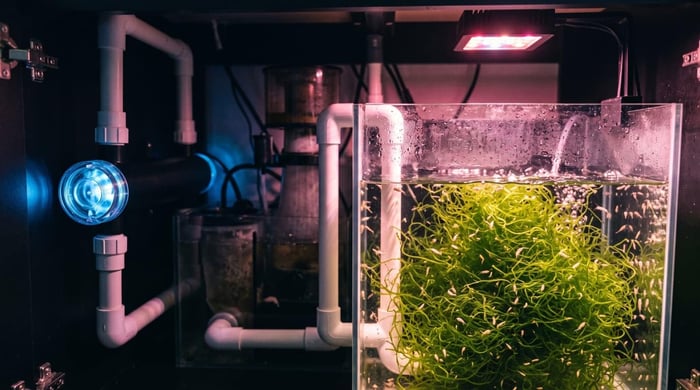
Some people want to go a step further and culture their own live phytoplankton for reef tank use, which is a satisfying project and a good way to understand what the ocean is doing on a much bigger scale. The Phytoplankton Culture Kit gives you a starter culture of Nannochloropsis oculata along with Guillard's f/2 nutrient, and with a bottle, a light and an air pump you can keep a rolling culture going indefinitely. The main thing people get wrong is harvesting too late, after the culture has peaked and begun to crash. A healthy culture is a clean, bright green. When it goes olive or brown, it has passed its best.
Phytoplankton Culture Kit - Nannochloropsis Oculata

£33.99
Phytoplankton Culture Kit, Nannochloropsis Oculata: Boost Your Aquatic Ecosystem You want to grow your own phytoplankton. You understand the value, a continuous, self-sustaining supply of live Nannochloropsis to feed your copepods, rotifers, and reef tank without the ongoing cost of… read more
Signs live phytoplankton for reef tank dosing is working, and signs you are overdoing it
Within two to four weeks of a consistent live phytoplankton for reef tank routine, you should see more pods on the glass after lights out, feather dusters with fuller crowns, and sponges that look plump rather than pale. Mandarins and wrasses spend more time hunting and less time hovering. The water may have a very faint tint immediately after dosing, which should clear within a few hours as the cells are consumed and circulated.
If the water stays green for a day or more, you are adding more than the tank can eat, and the surplus is dying and adding to your nutrient load. Cut the dose in half and build back up. If nitrate or phosphate creeps upward after you start dosing, the same applies. The aim is a thin, constant supply, not a thick soup. A properly fed tank looks clear and smells of nothing at all, because the phytoplankton is going into animals rather than sitting in the water.
For nano and pico tanks, where a millilitre is a big dose, I would start at the light rate or lower and watch. My nano and pico reef guide has more on scaling everything down.
The bigger picture
What I took from the CU Boulder study was not really the satellite science, interesting as it is. It was the reminder of how completely everything in the sea depends on something too small to see. The researchers worry about warming, oxygen loss and acidification hitting phytoplankton because they know that if the base weakens, the whole web weakens with it.
In our tanks, live phytoplankton for reef tank feeding is the bloom, and we do not have to worry about satellites missing it. We have to worry about the bloom never arriving in the first place. Providing it is one of the few things in this hobby that is genuinely simple: a few millilitres a day, consistently, and the food chain that the ocean built over millions of years starts to work in a glass box in your living room. The pods breed, the sponges grow, the mandarin eats, and the tank starts to look after itself a little more each month.
The ocean runs on phytoplankton. So does your tank. The only difference is who has to provide it.
If you have questions about live phytoplankton for reef tank feeding, or about anything in this post, get in touch. I answer every message personally.
Darren
Founder, Reefphyto Ltd - Wales, UK - Est. 2008