Nannochloropsis gaditana – Live Phytoplankton for Reef Tanks
You are running copepods in your refugium but the population never quite reaches the density you want. Or your rotifers are reproducing slowly, your clams are partially retracted, and your fine filter feeders seem to be getting by rather than thriving. The tank is maintained. Something at the base of it is still missing.
In most cases that something is a consistent, reliable supply of the right phytoplankton. Copepods, rotifers, clams, feather dusters, sponges, and fine filter feeders all depend on microalgae as either a direct food source or the nutritional foundation of everything they eat. Without it, populations stall, filter feeders underperform, and the biological richness that makes a reef feel genuinely alive never fully develops.
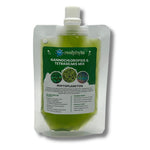
Nannochloropsis gaditana is a pure single-species live phytoplankton culture, cells measuring 2 to 5 microns, supplied as a high-density live culture from our specialist facility in Wales. Its exceptional EPA content makes it one of the most nutritionally significant microalgae species in marine aquaculture, valued both as a direct feed for fine filter feeders and as the primary enrichment algae for copepod, rotifer, and brine shrimp cultures. Dose 1ml per 27 litres for lightly stocked tanks, 1ml per 18 litres for medium stocking, and 1ml per 9 litres for heavily stocked systems with lots of filter feeders. Store refrigerated and use within six weeks of delivery.
Start dosing consistently and the changes accumulate at every level of the system. Copepod populations in the refugium stabilise and grow. Rotifers in culture produce healthier, more nutritious progeny. Clams, feather dusters, and fan corals become more visibly extended and active. Nitrate and phosphate levels begin to track downward as the culture absorbs dissolved nutrients from the water column. The tank settles into a biological rhythm that no amount of water changes alone can create.
Not sure how much to dose for your tank size? Our live food dosing calculator works it out for you. Enter your total water volume, select your product, and get the exact daily dose in seconds. No guesswork, no searching through instructions.
Reefphyto has been culturing Nannochloropsis and other live microalgae at professional scale in Wales since 2008. Every batch is produced fresh and dispatched at peak cell density. If you are running a copepod or rotifer culture programme and want advice on feed rates and culture management, contact us directly. Darren has been culturing with Nannochloropsis for over 18 years and responds personally.
If the base of your reef's food chain has been running on empty, this is where it starts again.
Why Nannochloropsis Gaditana Is the Most Widely Used Phytoplankton in Marine Aquaculture
Of the hundreds of microalgae species studied for use in marine aquaculture, Nannochloropsis gaditana has become one of the most consistently used across the widest range of applications. It is not an accident. At 2 to 5 microns, it sits within the feeding range of the smallest filter feeders and the finest coral polyps. Its EPA content is among the highest of any commercially cultured microalgae species. It is robust in culture, resistant to contamination, and tolerant of a range of temperature and salinity conditions that make it practical to maintain at both professional and hobbyist scale. And it absorbs dissolved inorganic nutrients including ammonia, nitrite, nitrate, and phosphate from the water column as it photosynthesises, providing a measurable water quality benefit alongside its nutritional role.
In short, it does more useful things per millilitre than almost any other phytoplankton species available, which is why it is the species most commonly recommended as the first phytoplankton a reef keeper or live culture operator should run.
The Two Roles Nannochloropsis Gaditana Plays in a Reef System
Nannochloropsis gaditana serves two distinct functions in a reef or live culture programme, and understanding both helps you dose and apply it correctly.
The first is as a direct food source for the reef tank itself. Dosed into the water column, the cells are consumed by fine filter feeders including sponges, tunicates, clams, feather duster worms, Christmas tree worms, fan corals, and the smallest coral polyps. At 2 to 5 microns, Nannochloropsis gaditana is accessible to organisms that cannot process larger microalgae cells, making it one of the few phytoplankton species that genuinely feeds the full filter feeding community in a mixed reef rather than only the largest and most robust feeders.
The second is as a culture feed for live zooplankton. Nannochloropsis gaditana is the primary food source for Brachionus plicatilis rotifers in commercial and hobbyist marine aquaculture. Rotifers fed on Nannochloropsis produce progeny with a significantly better fatty acid profile than those fed on yeast or inferior algae products, and the gut-loading effect means that fish larvae consuming those rotifers receive the EPA content of the Nannochloropsis indirectly. The same principle applies to copepod cultures. Tigriopus californicus and other harpacticoid copepods fed consistently on Nannochloropsis-rich water carry a better nutritional profile into the animals that consume them. For brine shrimp enrichment, Nannochloropsis gaditana is one of the most effective and widely used algae for gut-loading nauplii before feeding to marine larvae.
For keepers running a complete live food programme combining a copepod refugium, a rotifer culture, and regular brine shrimp hatches, a single consistent supply of Nannochloropsis gaditana feeds every part of the system simultaneously.
Nannochloropsis Gaditana Versus the Five-Species Blend: Choosing the Right Product
Reefphyto's phytoplankton range includes both single-species and multi-species products. Understanding the practical difference helps you choose the right product for your application.
Nannochloropsis gaditana as a single species is the correct choice when you are running a live culture programme, feeding rotifers, copepods, or brine shrimp and need a reliable, consistent single-species algae with a known nutritional profile. It is also the right choice for keepers who want the nutrient export benefits of Nannochloropsis specifically, or who are targeting fine filter feeders and sponges that respond particularly well to its cell size range.
The five-species blends, the 5 Species Phytoplankton, Live Reef Flourish, and Reef Flourish Super Concentrate, cover a broader particle size range from 1 to 20 microns and provide a wider fatty acid and pigment profile in a single dose. They are better suited to mixed reef tanks where the goal is broad-spectrum nutrition across the full filter feeding and coral community simultaneously. Many keepers use Nannochloropsis gaditana to feed their live cultures and dose a five-species blend into the display tank, getting the precision of single-species culture feeding alongside the breadth of multi-species reef nutrition.
How to Dose Nannochloropsis Gaditana
Dose at the rate that matches your tank's stocking level. For lightly stocked tanks with soft corals and few filter feeders, dose 1ml per 27 litres of system volume daily. For medium-stocked mixed reefs running LPS and soft corals, dose 1ml per 18 litres daily. For heavily stocked systems with SPS, clams, and high filter feeder loads, dose 1ml per 9 litres daily. A 200-litre medium-stocked reef will therefore receive around 11ml per day.
Start at the lighter end of the range and increase gradually over two weeks based on your tank's response. Polyp extension, clam gape, copepod population density, and filter feeder activity are all useful indicators that the rate is right. If the water stays slightly green for more than an hour or two after dosing, reduce the rate until the filter feeding community grows to match the input.
Add the dose to a high-flow area of your sump or display tank to ensure even distribution throughout the water column. Turn off your protein skimmer, UV steriliser, and any ozone equipment for 30 to 60 minutes after dosing. These systems will remove or destroy live phytoplankton cells before they can be consumed if left running. Resume normal operation after this period.
Dosing in the evening under reduced lighting extends the time the cells remain viable in the water column before the tank's circulation processes them. For systems with heavy filter feeder populations that clear phytoplankton quickly, dosing can be split into two smaller additions morning and evening to maintain more consistent cell availability throughout the day.
For live culture feeding, add Nannochloropsis gaditana directly to your rotifer or copepod culture vessel at a rate that maintains a visible green tint in the culture water. A pale green colour indicates adequate cell availability. Clear water indicates the culture has consumed the available algae and requires topping up.
Water Quality Benefits of Regular Nannochloropsis Dosing
One of the less discussed but practically significant benefits of regular Nannochloropsis gaditana dosing is its effect on dissolved nutrient levels. As a photosynthetic microalgae, Nannochloropsis actively absorbs ammonia, nitrite, nitrate, and phosphate from the water column as it grows and multiplies. In a reef tank dosed consistently, this nutrient uptake contributes to the natural export of dissolved inorganic nutrients without the need for additional chemical interventions.
The effect is most visible over weeks of consistent dosing. Nitrate and phosphate levels that have been stable or slowly creeping upward begin to track downward as the phytoplankton cells absorb nutrients and are subsequently consumed by filter feeders, exported through the protein skimmer, or physically removed from the system. Keepers who combine regular phytoplankton dosing with a healthy refugium and copepod population often find that their water quality management becomes progressively easier over time as the biological processes that handle nutrient export become more robust.
Storage and Handling
Nannochloropsis gaditana is a living culture and requires appropriate storage to maintain cell viability. Refrigerate at 4 to 10 degrees Celsius from the moment of delivery. Do not freeze. Shake gently before each use to redistribute settled cells. Use within six weeks of delivery for best results, though cell viability begins to decline gradually after this point rather than dropping off suddenly.
The product is supplied as a high-density live culture. Cell density is maintained at the point of dispatch from our Wales facility, and the cold chain from dispatch to delivery is managed to preserve viability as closely as possible on arrival.
Frequently Asked Questions
Can I use this to feed both my reef tank and my copepod culture?
Yes, and this is one of the most common applications. A single bottle of Nannochloropsis gaditana can be used to dose the reef tank daily and top up a copepod or rotifer culture simultaneously. Size your order based on the combined daily volume required for both applications.
How does this differ from the five-species phytoplankton blend?
Nannochloropsis gaditana is a single species with a specific cell size range of 2 to 5 microns and a particularly high EPA content. The five-species blend covers a broader size range from 1 to 20 microns and provides a wider range of fatty acids and pigments in a single dose. Single-species Nannochloropsis is better suited to live culture feeding and targeted fine filter feeder nutrition. The five-species blend is better suited to broad-spectrum reef tank dosing. Many keepers use both.
Will this affect my water clarity?
At the recommended dosing rates, a slight green tint may be visible immediately after dosing in smaller systems. This typically clears within one to two hours as the cells are consumed or processed. In larger systems with heavy filter feeder populations the clearing is often faster. If clarity does not return within a few hours, reduce the dose slightly until the filter feeding community grows to match the input.
Can I use this to enrich brine shrimp before feeding to marine larvae?
Yes. Nannochloropsis gaditana is one of the most effective and widely used algae for brine shrimp enrichment in marine fish breeding programmes. Add freshly hatched nauplii to a vessel containing a dense Nannochloropsis culture and allow them to feed for two to four hours before harvesting and feeding to larvae. This gut-loading process significantly improves the EPA content delivered to the larvae.
Is this suitable for feeding clams and tridacna?
Yes. Tridacna clams and other bivalves are among the primary beneficiaries of regular Nannochloropsis dosing. The cell size is within the optimal feeding range for bivalve filter feeding, and the high EPA content directly supports the health and growth of the zooxanthellae that give tridacna their distinctive colouration.
Reefphyto: Live Phytoplankton Cultured in Wales Since 2008
Reefphyto has been producing and supplying live microalgae to reef keepers, marine fish breeders, public aquariums, and live culture operators across the UK since 2008. Every batch of Nannochloropsis gaditana is cultured fresh at our specialist facility in Wales and dispatched at peak cell density. If you have questions about dosing, culture feeding rates, or how to integrate Nannochloropsis gaditana into a complete live food programme, contact us directly. Darren responds personally to every enquiry.

 Roll over image to zoom in



 Darren Wordley
18 years culturing live phytoplankton in Wales
Darren Wordley
18 years culturing live phytoplankton in Wales
 Cultured in Wales, shipped live.