
Quick Navigation
- The Real Question Behind the Comparison
- Nutrition: What Freezing Actually Does to a Copepod
- Feeding Response: Movement Matters More Than You Think
- Tank Ecology: One Feeds, the Other Pollutes
- Cost and Convenience: The Honest Trade-Off
- Live vs Frozen Copepods: The Verdict.
- When Frozen Copepods Make Sense
- When Live Copepods Are the Only Real Option
- FAQ: Live vs Frozen Copepods
- Key Takeaways
- FAQs
Quick Answer: Choosing between live vs frozen copepods comes down to what you need from them. Live copepods deliver superior nutrition, trigger natural hunting behaviour, and can establish self-sustaining populations in your tank. Frozen copepods are convenient and have a long shelf life, but they lose key nutritional compounds during processing and add to your nutrient load rather than reducing it. For most UK reef keepers, live copepods are the better investment, especially if you keep mandarins, seahorses, or other specialist feeders.
The Real Question Behind the Comparison
If you are reading this, you have probably already decided that your reef needs copepods. The real live vs frozen copepods question is about what you are actually trying to achieve with them.
If your goal is a quick, occasional supplemental feed alongside frozen mysis and pellets, frozen copepods can do a job. But if you are trying to sustain a mandarin dragonet, build a functioning refugium population, support coral health through a natural food web, or replicate anything close to what your animals experience in the wild, the comparison tilts heavily toward live.
This is not about one option being bad. It is about understanding what each one actually delivers once it hits your water.
Nutrition: What Freezing Actually Does to a Copepod
A live copepod cultured on high-quality phytoplankton is a nutrient-dense package. Copepods typically contain 44 to 52% protein by dry weight, with high levels of the essential fatty acids EPA and DHA that drive colour, immune function, and reproductive health in reef fish. They also carry astaxanthin, the carotenoid pigment responsible for much of the red and orange colouration you see in healthy marine animals.
Crucially, a live copepod that has been gut-loaded on phytoplankton is delivering two layers of nutrition at once. Your fish eats the copepod and simultaneously receives the concentrated microalgae inside it. This is how marine food webs work in the ocean, and it is impossible to replicate with a frozen product.
Freezing disrupts cell membranes and degrades enzymatic activity. The moment a copepod is frozen, it begins losing nutritional integrity. Sensitive compounds like certain HUFAs (highly unsaturated fatty acids), digestive enzymes, and water-soluble vitamins break down during the freeze-thaw cycle. The copepod still has caloric value, but it is no longer the same nutritional package it was when alive.
This matters most for fish with high metabolic demands or specialist feeding requirements. Mandarins, seahorses, and pipefish did not evolve to eat dead food. They evolved to hunt live, moving prey that is nutritionally complete at the moment of capture.
Feeding Response: Movement Matters More Than You Think
This is the factor that most reef keepers underestimate when weighing live vs frozen copepods. A frozen copepod sinks or drifts. A live copepod moves erratically through the water column and across surfaces, triggering the predatory instincts that many reef fish rely on.
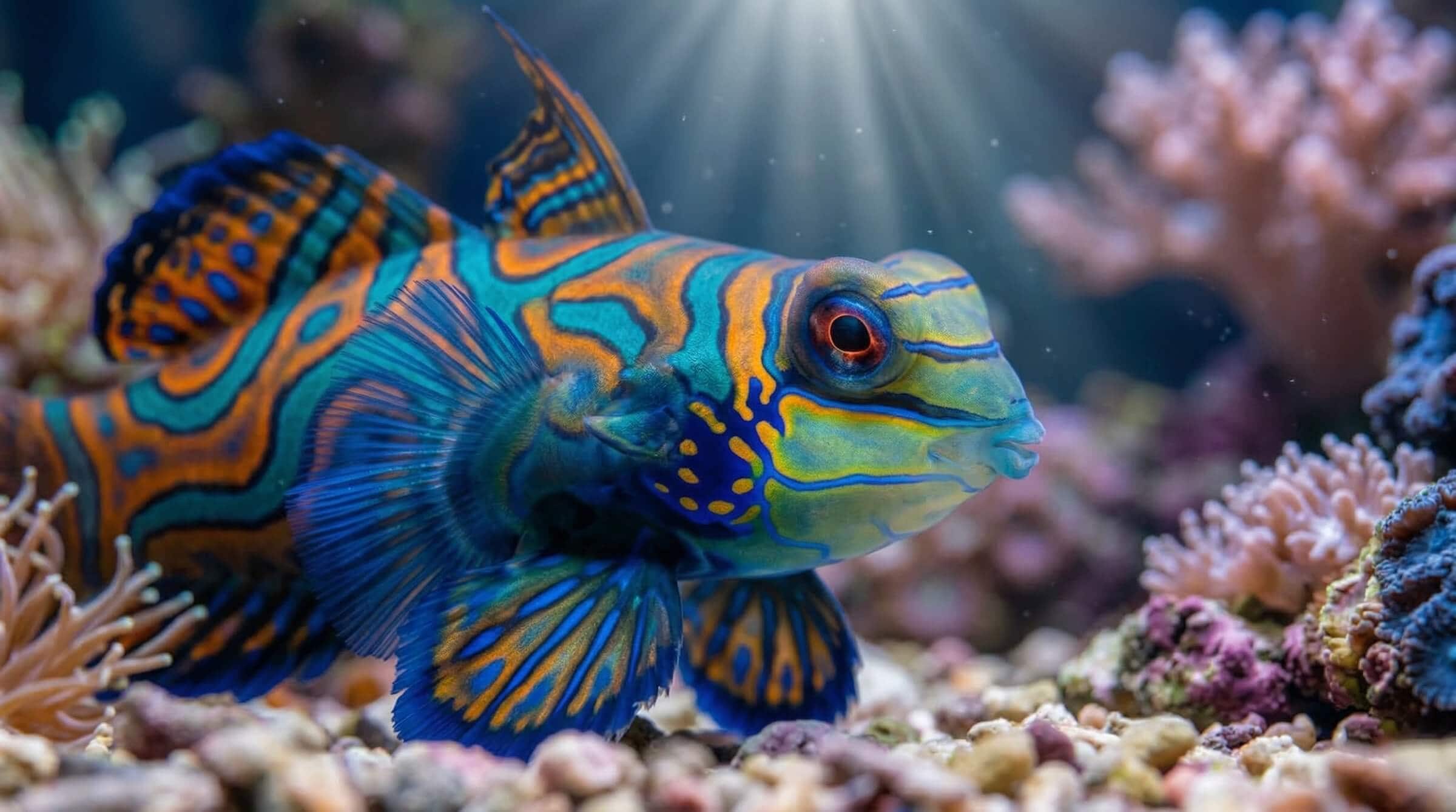
Mandarin dragonets are a perfect example. They are obligate live feeders that hunt by sight and movement. A mandarin will track a live copepod across the rockwork with focused, deliberate pecking behaviour. Drop frozen copepods into the same tank and the mandarin will largely ignore them. Not because it is being difficult, but because its feeding behaviour is hardwired to respond to movement, not to the presence of inert food particles.
Seahorses and pipefish behave similarly. They are ambush predators that rely on movement to trigger their strike. Without that stimulus, they simply will not feed consistently, regardless of how nutritious the food sitting in front of them might be.
Even fish that readily accept frozen food, like wrasses and anthias, show noticeably different behaviour when live copepods are present. The hunting response is more active, more sustained, and more closely resembles how these fish feed on a natural reef.
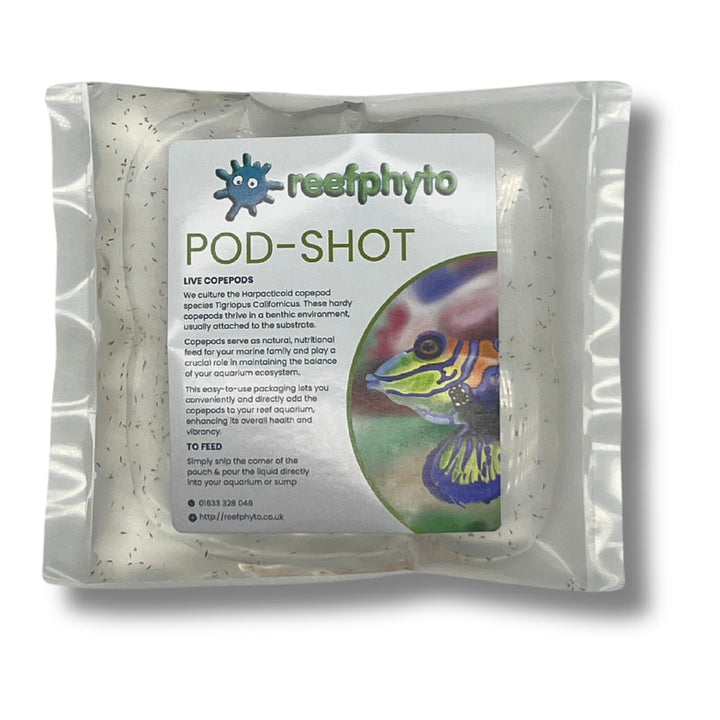
Pod-Shot - Live Copepods
£5.99
Pod-Shot: Live Copepods The moment you added a mandarin to your tank, the feeding pressure on your copepod population changed. What was a healthy refugium culture a month ago is now visibly thinner, and your mandarin is spending more time… read more
Tank Ecology: One Feeds, the Other Pollutes
Here is where the live vs frozen copepods comparison becomes most stark. Live copepods are not just food. They are a functioning part of your reef ecosystem.
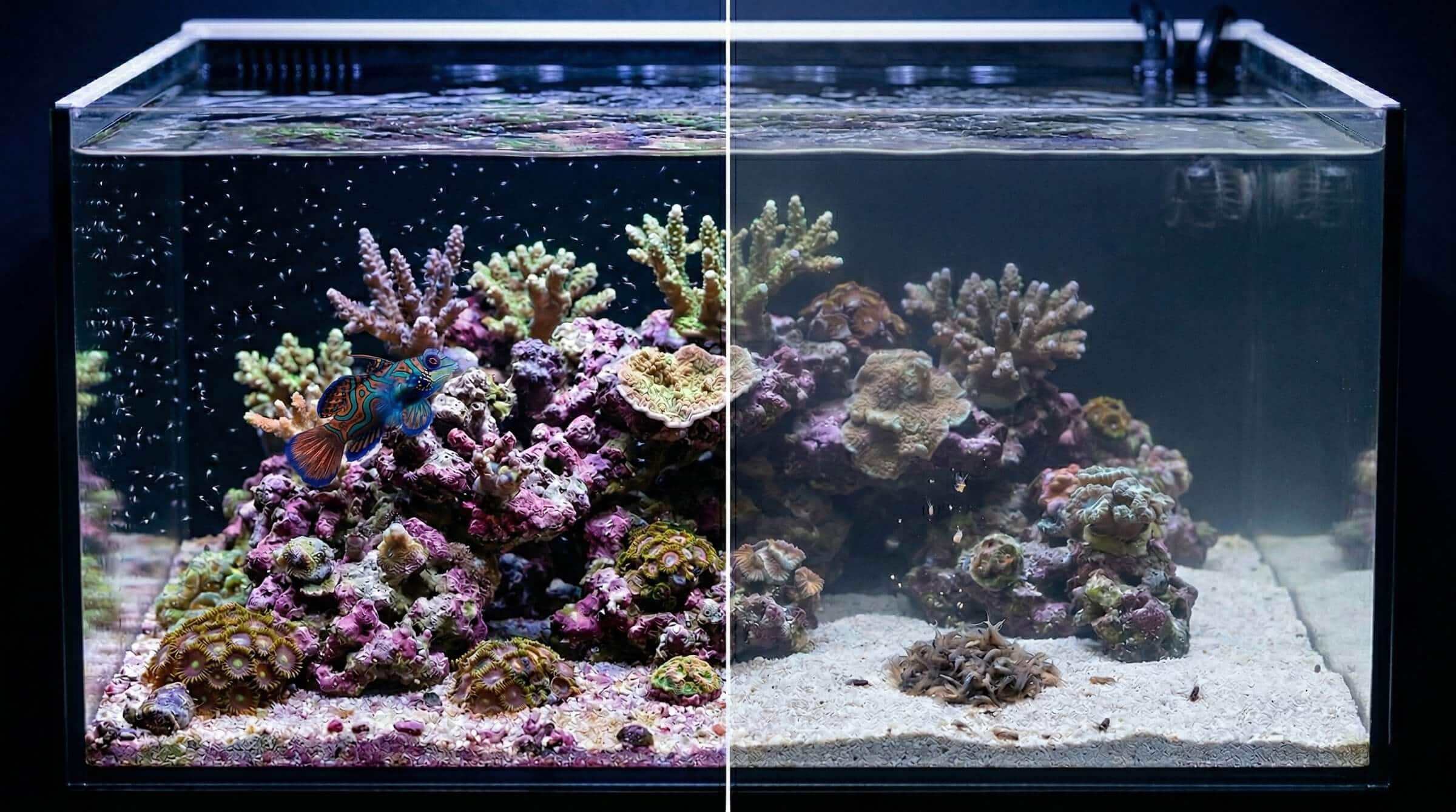
Once introduced, live copepods graze on detritus, film algae, and organic waste across your rockwork, sandbed, and glass. They consume uneaten food and break down organic material before it has a chance to decompose and spike your nutrient levels. In a tank with a refugium, they reproduce and create a self-sustaining population that continuously migrates into the display, providing a round-the-clock food source for your fish and corals.
Frozen copepods do the opposite. Every frozen copepod that lands in your tank and is not immediately eaten becomes organic waste. It settles into dead spots, decomposes, and contributes to your nitrate and phosphate load. You are adding nutrients rather than cycling them. For tanks that are already battling elevated nutrients or nuisance algae, this is a meaningful difference.
A healthy live copepod population effectively works as part of your biological filtration. A bag of frozen copepods is just another input that your filtration system has to process.
Cost and Convenience: The Honest Trade-Off
Frozen copepods win on convenience. They store in your freezer for months, require no acclimation, and can be added in seconds. You can keep them on hand without worrying about viability or timing your order around dispatch days.
Live copepods require more thought. They need to be ordered, received promptly, and ideally added to the tank the same day they arrive. They are a perishable product with a limited window of peak viability. For some keepers, that logistics overhead is a genuine barrier.
On cost, the picture is more nuanced than it first appears. A bag of frozen copepods from your local fish shop might cost less per unit than a bottle of live copepods. But frozen copepods are a consumable. Every bag is gone the moment it hits the water.
Live copepods, added to a refugium or a tank with adequate habitat, can reproduce and sustain a population that feeds your reef for weeks or months between additions. Over a six-month period, a reef keeper who seeds live copepods into a refugium and supports them with phytoplankton will typically spend significantly less than one who buys frozen copepods every week.
For keepers who want to eliminate the ongoing cost entirely, a Copepod Culture Kit provides everything needed to maintain a permanent home culture. The kit typically pays for itself within two to three months compared to regular frozen or bottled purchases.
Live vs Frozen Copepods: The Verdict.
Nutrition: Live wins. Full EPA, DHA, and astaxanthin, plus gut-loaded phytoplankton. Frozen loses nutritional integrity during the freeze-thaw cycle.
Feeding response: Live wins. Triggers natural hunting in mandarins, seahorses, and wrasses. Frozen sinks or drifts and is ignored by obligate live feeders.
Tank ecology: Live wins. Grazes waste, reproduces, and self-sustains. Frozen adds to your nutrient load and decomposes if uneaten.
Shelf life: Frozen wins. Stores for months in the freezer. Live copepods are perishable and should be added on arrival day.
Long-term cost: Live wins. The population reproduces between additions. Frozen is a one-time consumable every time you buy.
Convenience: Frozen wins. Grab from freezer, thaw, and add. Live requires planning around dispatch and delivery.
Best for live: Mandarins, seahorses, pipefish, refugium seeding, breeding, and ecosystem building.
Best for frozen: Coral target feeding, emergency backup, and community tank enrichment.
When Frozen Copepods Make Sense
Frozen copepods are not worthless. There are specific situations where they are a reasonable choice.
If you keep a community reef with no specialist feeders and you simply want an occasional enrichment alongside your regular frozen food rotation, frozen copepods are a practical addition. They are also useful as an emergency backup if your live copepod delivery is delayed and your fish need feeding today.
For coral target feeding, frozen copepods can work well. Corals do not require live movement to trigger a feeding response in the same way fish do. LPS corals in particular will capture and consume thawed copepods placed near their tentacles.
If you travel frequently and need a reef sitter to feed your tank without the complexity of handling live cultures, frozen copepods stored in the freezer are simpler to manage.
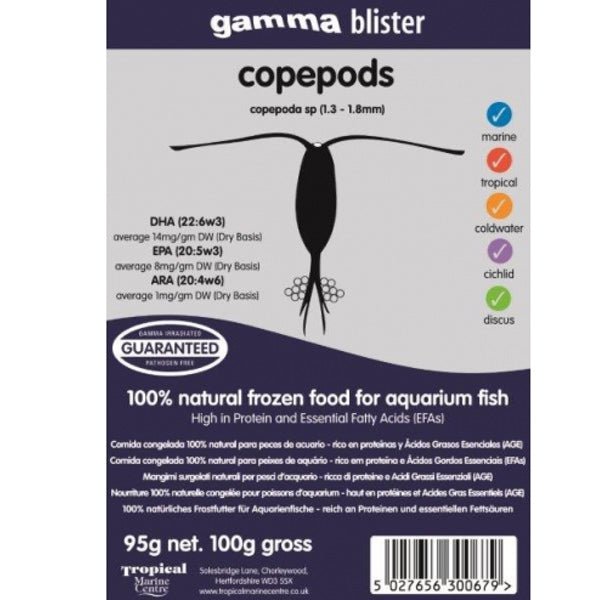
Frozen Gamma Copepods - Pathogen-Free Marine Nutrition - 5 Pack
£17.45
Frozen Gamma Copepods – Pathogen-Free Marine Nutrition for Reef Fish and Corals - 5 X 100g blister packs. Some of the most rewarding fish to keep in a reef tank are also the most nutritionally demanding. Mandarin dragonets, seahorses, pipefish,… read more
When Live Copepods Are the Only Real Option
For certain species and certain goals, the comparison is not really a debate.
If you keep a mandarin dragonet, scooter blenny, or ruby red dragonet, live copepods are essential. These fish will not sustain themselves on frozen food alone. They need a reproducing population of live copepods in the system, ideally supported by a refugium, to meet their daily feeding requirements.
If you keep seahorses or pipefish, live copepods and live rotifers are the foundation of a viable feeding programme. Frozen alternatives simply do not trigger the feeding response these animals depend on.
If your goal is to build a natural, self-sustaining reef ecosystem with healthy microfauna, a functioning food web, and minimal reliance on manual feeding, live copepods are the starting point. Combined with regular phytoplankton dosing to feed the copepod population, this approach creates a system that increasingly takes care of itself.
And if you are breeding marine fish, live copepods (alongside live rotifers for first-feed larvae) are not optional. They are the standard in commercial aquaculture for good reason: nothing else delivers the nutritional profile and feeding stimulus that larval fish require to survive their first critical days.
For keepers who need a quick live copepod top-up between larger orders, our Pod-Shot pouches are designed exactly for this. Pour directly into the tank or refugium with no preparation needed, available in 50ml, 100ml, and 250ml sizes.
FAQ: Live vs Frozen Copepods
Q: Can I use frozen copepods to feed a mandarin dragonet?
A: As a sole food source, no. Mandarins are obligate live feeders that rely on movement to trigger their hunting response. Frozen copepods will mostly be ignored. You need a reproducing live copepod population in the tank, ideally established through a refugium seeded with live copepods. Our full guide on how to feed a mandarin dragonet covers this in detail.
Q: Do frozen copepods still contain EPA and DHA?
A: They retain some, but levels degrade during the freeze-thaw process. More importantly, frozen copepods lack the gut-loaded phytoplankton content that makes live copepods so nutritionally complete. A live copepod freshly cultured on microalgae delivers both its own fatty acid profile and the concentrated nutrition of the phytoplankton inside it.
Q: How long do live copepods survive once added to my tank?
A: Indefinitely, if conditions are right. Unlike frozen copepods, which are consumed or decompose within hours, live copepods reproduce. In a tank with refugium habitat, rockwork, and a phytoplankton food source, a single introduction can establish a population that sustains itself for months. Our guide on why live copepods benefit your reef tank explains the long-term value in more detail.
Q: Is it worth using both live and frozen copepods together?
A: It can be. Some keepers maintain a live copepod population in the refugium for their specialist feeders while occasionally target-feeding frozen copepods to corals. The two serve different purposes and can complement each other. Just be mindful that frozen copepods add to your nutrient load, so dose them carefully in smaller tanks.
Q: What is the most cost-effective way to maintain a live copepod supply?
A: Culturing your own. A Copepod Culture Kit gives you a permanent, self-sustaining supply that you harvest as needed. For keepers who prefer not to culture, our subscription options provide regular deliveries at a reduced cost, and Pod-Shot pouches offer affordable top-ups between larger orders.
Key Takeaways
- Live copepods deliver superior nutrition, including gut-loaded phytoplankton that frozen products cannot replicate.
- Movement triggers natural feeding behaviour in specialist fish like mandarins, seahorses, and pipefish, making live copepods essential for these species.
- Live copepods actively reduce waste and nuisance algae in your tank. Frozen copepods add to your nutrient load.
- Over time, live copepods are more cost-effective because they reproduce. Frozen copepods are a one-time consumable.
- Frozen copepods have a role for coral target feeding, emergency backup, and general community tank enrichment, but they cannot replace live copepods for specialist feeders or ecosystem building.
Your reef evolved on live food. Give it what it was built for. Shop Live Copepods →
Questions about which option is right for your specific tank? Call Darren on 01267 611533 or email care@reefphyto.co.uk. Free shipping on orders over £65.