
Quick Navigation
- Understanding Mandarin Dragonet Feeding Behaviour
- Natural Diet of Mandarin Dragonets in the Wild
- Why Standard Aquarium Foods Don't Work
- Live Copepods: The Foundation of Mandarin Dragonet Nutrition
- Establishing a Copepod Population in Your Reef Tank
- Supplementing with Live Copepod Cultures
- Beyond Copepods: Supporting Live Foods
- Live Rotifers for Juvenile and Smaller Mandarins
- Live Brine Shrimp and Mysis Shrimp
- Training Mandarin Dragonets to Accept Frozen Food
- Step-by-Step Frozen Food Training Strategy
- Best Frozen Foods for Mandarin Dragonets
- Creating a Sustainable Mandarin Dragonet Feeding Strategy
- What Happens If You Get This Wrong
- FAQs
How to Feed a Mandarin Dragonet: Building a Sustainable Diet That Actually Works
If you've ever watched a mandarin dragonet slowly lose condition despite everything you're doing right, you'll know the particular frustration that comes with keeping one of the reef hobby's most beautiful fish. The water is pristine. The tank is mature. But the mandarin is wasting away and you don't know why.
The problem is almost never husbandry. It's feeding biology. Mandarin dragonets are one of the most commonly starved fish in home aquariums, not because they're fragile, but because their nutritional needs are fundamentally different to every other reef fish. Understanding that difference is the key to keeping them long-term.
I've been working with live marine foods for over 18 years, and mandarins are the fish I get asked about more than any other. This guide covers how mandarins actually feed, why most aquarium foods fail, and how to build a layered feeding strategy that gives your fish the best possible chance of thriving.
- Darren, Reefphyto
Understanding Mandarin Dragonet Feeding Behaviour
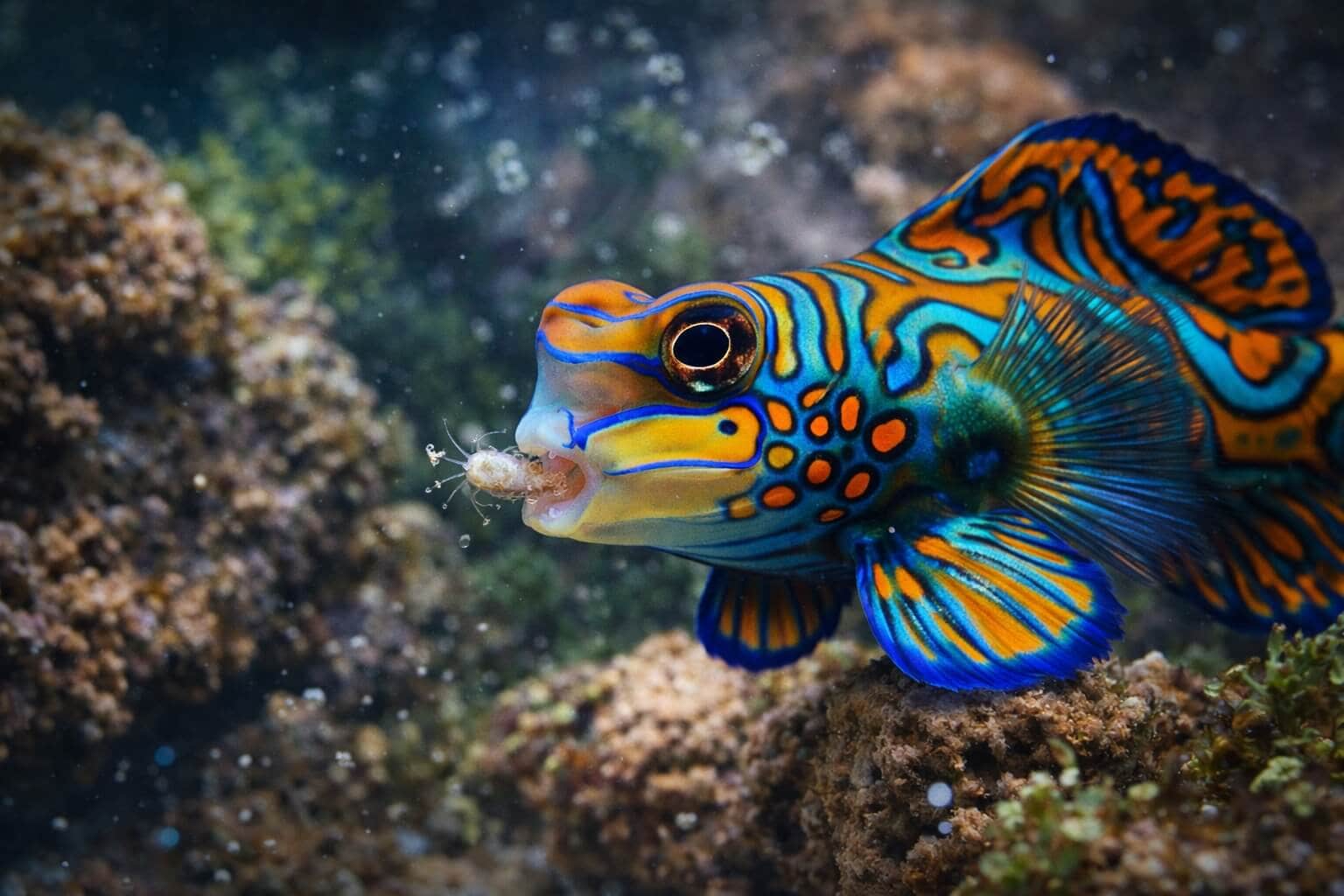
Mandarin dragonets are continuous micro-grazers, not meal-based feeders. This single fact explains most of the problems keepers run into.
Rather than eating once or twice a day like most reef fish, mandarins spend nearly all daylight hours picking at live prey across rockwork and substrate. Their small, highly specialised mouths are designed for tiny, moving food items not static flakes, not sinking pellets, not frozen cubes drifting past in the current.
In practice this means that if live prey isn't available throughout the day, a mandarin will slowly starve even while appearing active and alert. The decline is gradual enough that many keepers don't notice until significant condition has been lost. By then, recovery is difficult.
The four feeding traits that define mandarin husbandry are constant foraging behaviour, a strong preference for live moving prey, a poor competitive response at feeding time compared to other fish, and a slow but continuous daily intake requirement. A tank setup that accounts for all four of these gives a mandarin the environment it needs to genuinely thrive.
Natural Diet of Mandarin Dragonets in the Wild
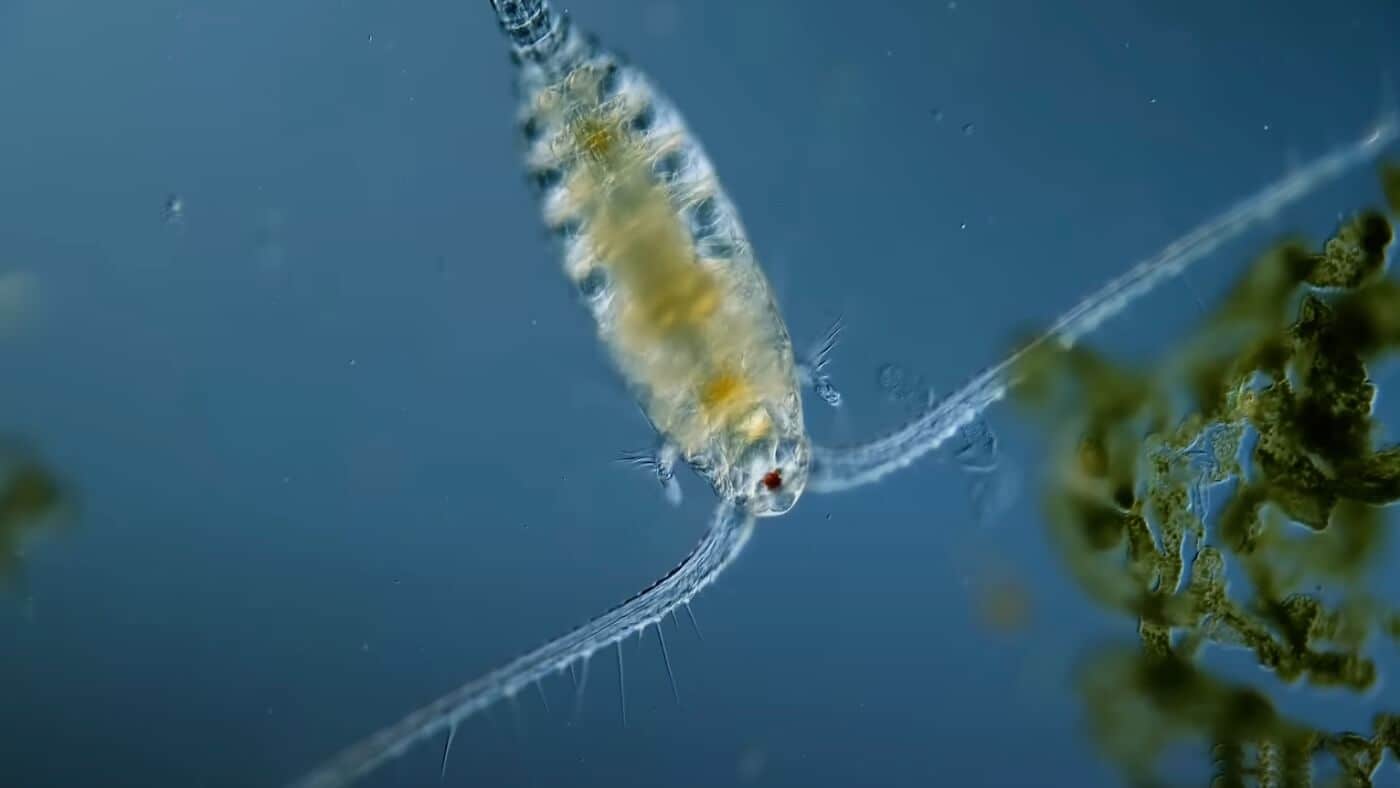
In natural reef environments, mandarins live among rubble zones rich in microfauna. Their diet consists primarily of harpacticoid copepods, small amphipods, ostracods and micro-crustaceans, and larval invertebrates. These prey items are available constantly across the substrate which is why mandarins feed hundreds of times per day in the wild.
Replicating this in captivity isn't about recreating the ocean. It's about ensuring that when your mandarin goes looking for food, which it will do all day, every day, it finds something. That means maintaining a live prey population in the tank, not just adding food at feeding time.
Live Copepods
£11.99
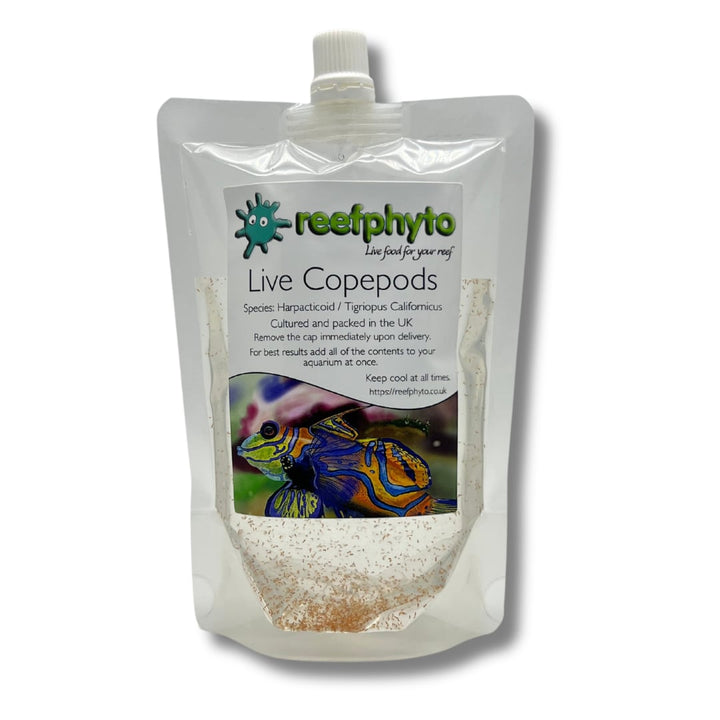
Live Copepods UK: Tigriopus californicus, Cultured Fresh in Wales by Reefphyto Your reef looks right on paper. Clean water, stable parameters, good equipment. But something is still off. Your fish are pale, your mandarin is wasting, your corals are feeding… read more
Why Standard Aquarium Foods Don't Work
Most dry and frozen aquarium foods fail mandarins for two reasons, and understanding both helps you avoid the mistake of assuming a mandarin is "eating" just because food is being added to the tank.
The first is behavioural mismatch. Mandarins do not instinctively recognise non-moving food as prey. Their hunting is triggered by movement, a copepod scuttling across rockwork, a rotifer tumbling in the current. Even when frozen food is placed directly in front of them, many mandarins will ignore it entirely. The food doesn't register as food.
The second is nutritional mismatch. Even in the cases where a mandarin can be trained to accept frozen food, flakes and standard pellets are too large and dense for their small mouths, poorly digested, and lacking the essential fatty acid profile particularly EPA and DHA that mandarins rely on from live prey. The result is a fish that appears to be eating but is slowly losing the nutritional foundation it needs.
Live Copepods: The Foundation of Mandarin Dragonet Nutrition
Live copepods are not optional for mandarin dragonets they are the primary food source, and everything else in a mandarin feeding strategy is built around them.
Copepods work for mandarins for several reasons. They are the right prey size, matching what mandarins evolved to hunt. They trigger natural hunting behaviour through movement. They are exceptionally high in essential fatty acids including EPA and DHA, which support colouration, immune function, and long-term condition. And critically, harpacticoid species like Tigriopus californicus will reproduce directly in a reef system, establishing a self-sustaining prey population if conditions are right.
A healthy mandarin should be able to find copepods at any point during the day, not just in the hour after you've dosed a culture. This is why building and maintaining a resident copepod population is the single most important thing you can do for a mandarin's long-term welfare.
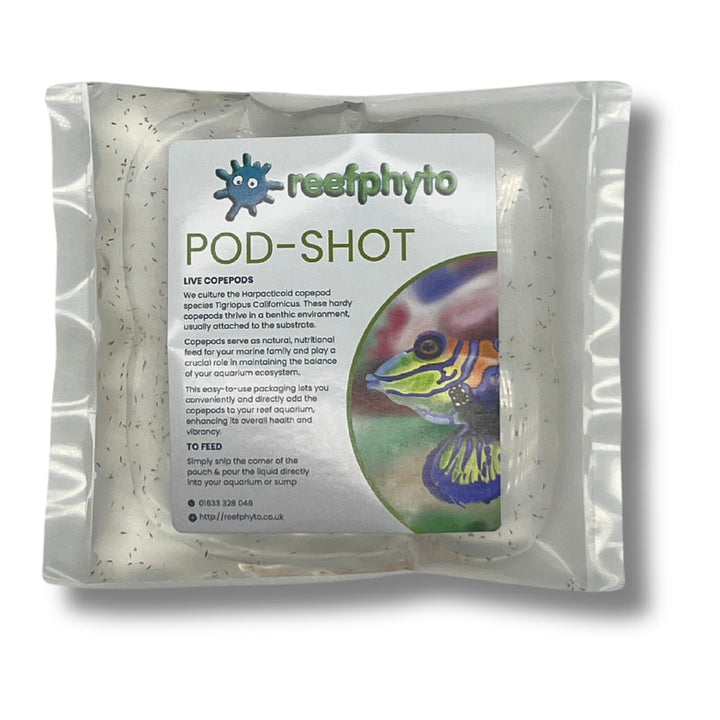
Pod-Shot - Live Copepods
£5.99
Pod-Shot: Live Copepods The moment you added a mandarin to your tank, the feeding pressure on your copepod population changed. What was a healthy refugium culture a month ago is now visibly thinner, and your mandarin is spending more time… read more
Establishing a Copepod Population in Your Reef Tank
Before adding a mandarin, your system must already support a strong copepod population, ideally an established one that's been running for several months. Introducing a mandarin into a newly set-up tank, or one with an immature copepod population, is one of the most common reasons these fish fail in captivity.
The general requirements for a tank that can sustain a mandarin are a mature aquarium of at least six months, adequate live rock surface area for copepods to shelter and reproduce, limited pod-eating tankmates such as wrasses or dragonets, and stable parameters that support a healthy microfauna community. Larger tanks are more forgiving, a 300-litre system with a refugium gives you significantly more margin than a 100-litre display, but even smaller systems can succeed with consistent copepod supplementation.
A refugium is worth its weight in gold for mandarin keeping. A lit section of sump planted with macroalgae and seeded with copepods creates a protected breeding zone that continuously replenishes your display tank with live prey. If you're serious about keeping a mandarin long-term, I'd consider a refugium close to essential rather than optional.
Supplementing with Live Copepod Cultures
Even well-established tanks benefit from ongoing copepod additions. Mandarin predation is constant and heavy, a single fish can consume several hundred copepods per day and in most systems, natural reproduction alone isn't enough to keep pace with demand indefinitely.
Regular dosing of live copepod cultures prevents population crashes, compensates for predation pressure, maintains nutritional consistency, and significantly reduces the risk of slow starvation. Many successful mandarin keepers add fresh live copepods weekly or bi-weekly as a routine part of their maintenance schedule, treating it the same way they'd treat a water change, not an occasional intervention, but a regular habit.
At Reefphyto, we culture Tigriopus californicus fresh in our Welsh facility and ship live to your door. If you notice your mandarin spending more time near the surface or showing less active foraging behaviour, a declining pod population is often the first thing to investigate.
Live Copepods
£11.99
Live Copepods UK: Tigriopus californicus, Cultured Fresh in Wales by Reefphyto Your reef looks right on paper. Clean water, stable parameters, good equipment. But something is still off. Your fish are pale, your mandarin is wasting, your corals are feeding… read more
Beyond Copepods: Supporting Live Foods
While copepods form the backbone of the mandarin's diet, additional live foods add resilience, variety, and nutritional breadth particularly during the establishment phase or when a mandarin is recovering condition.
Live rotifers, enriched live brine shrimp, and live mysis where available all have a role to play. These foods should support copepods rather than replace them, but used thoughtfully they make a meaningful difference to a mandarin's overall condition and the range of nutritional inputs it receives.
Live Rotifers for Juvenile and Smaller Mandarins
Live rotifers are particularly valuable for juvenile mandarins, smaller individuals, and newly introduced fish that may be stressed or underweight. At 90–360 microns, Brachionus plicatilis are small enough for even a juvenile mandarin to consume easily, and their constant movement in the water column triggers the same hunting response as copepods.
Rotifers work as an excellent bridge food while a copepod population is establishing, providing live prey immediately while your harpacticoid culture takes hold. They can also supplement adult mandarins during periods of conditioning or recovery, adding live prey volume to the system without competing with your copepod population for resources.
Live Rotifers

£5.99
Live Rotifers: Brachionus plicatilis You've watched your fish larvae appear healthy at hatching, only to fade and disappear within the first few days. The water is clean, the temperature is stable, and you've done everything the guides suggest. But they're… read more
Live Brine Shrimp and Mysis Shrimp
When properly enriched, live brine shrimp and mysis can trigger strong feeding responses, provide additional protein, and support food training efforts. Their larger size makes them more visible prey items, which can be useful when introducing a mandarin to a new tank and trying to encourage active hunting behaviour.
That said, brine shrimp have a poor nutritional profile unless enriched with omega-3 supplements before feeding, and neither brine nor mysis should replace copepods as the primary food source. Think of them as useful additions to the feeding rotation rather than staples.
Training Mandarin Dragonets to Accept Frozen Food
Some mandarins can be trained to accept frozen foods but I want to be honest about this, because it's an area where a lot of keepers invest significant effort and end up disappointed. Frozen food acceptance should be treated as backup nutrition, not a replacement for live prey.
Not all mandarins will accept frozen food regardless of the training approach. For those that do, the process typically takes weeks or months of patient, consistent effort, and live food access must continue throughout, you cannot withhold live food to force a mandarin onto frozen alternatives. That approach almost always ends in a fish that declines before it accepts the new food.
If you do want to attempt frozen food training, set realistic expectations from the start. A mandarin that takes frozen food occasionally is a bonus. One that relies on it exclusively is the exception, not the rule.
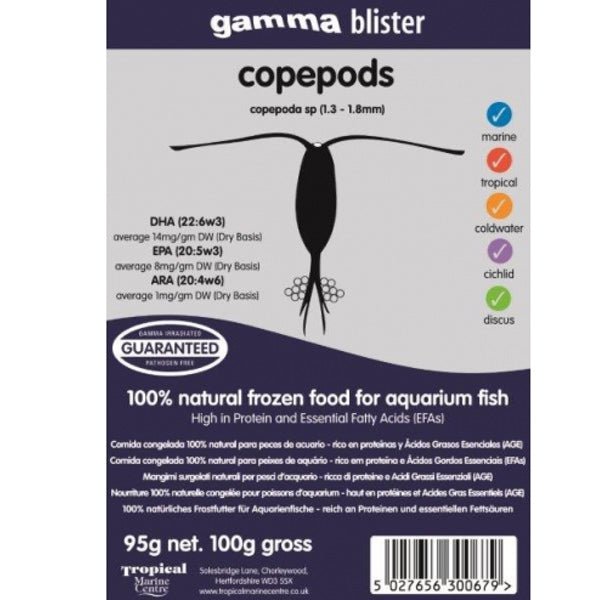
Frozen Gamma Copepods - Pathogen-Free Marine Nutrition - 5 Pack
£17.45
Frozen Gamma Copepods – Pathogen-Free Marine Nutrition for Reef Fish and Corals - 5 X 100g blister packs. Some of the most rewarding fish to keep in a reef tank are also the most nutritionally demanding. Mandarin dragonets, seahorses, pipefish,… read more
Step-by-Step Frozen Food Training Strategy
If you decide to attempt frozen food training, a gradual approach is the only one that has any consistent success rate. Start by offering live food in a small feeding dish so your mandarin gets used to associating that location with prey. Once it's reliably visiting the dish, introduce frozen food mixed with live prey in the same location. Very slowly, over several weeks, reduce the proportion of live food while increasing frozen. Feed small amounts multiple times daily rather than one larger feeding, and maintain your copepod population throughout the entire process.
Abrupt transitions almost always fail. The mandarin has no reason to accept food it doesn't recognise as prey, and stress from food deprivation compounds the problem rather than solving it.
Best Frozen Foods for Mandarin Dragonets
If you're going to use frozen food as a supplement, choosing the right products makes a difference. The options with the highest success rates are frozen copepods, cyclops, Nutramar Ova, and finely chopped enriched mysis. What they have in common is small particle size, soft texture, and a reasonably high palatability compared to standard flake or pellet alternatives. Foods should be thawed fully and rinsed before use, and target-fed as close to the mandarin as possible rather than broadcast into the water column.
Frozen Mysis - 5 Pack

£15.00
Frozen Mysis - Pack of Five If you're looking for a nutritious meal for your fish, fresh frozen mysis shrimp is an excellent choice. With higher natural protein content than most other foods, it's a healthy option that your fish… read more
Creating a Sustainable Mandarin Dragonet Feeding Strategy
Long-term success with mandarin dragonets comes from layered feeding redundancy building multiple overlapping food sources so that if one layer is under pressure, the others take the strain. No single food source, however good, is enough on its own.
A proven strategy combines an established resident copepod population in the display tank and refugium, regular additions of fresh live copepods to prevent population crashes, live rotifer supplementation during establishment or recovery periods, refugium or pod-safe zones that give copepods a breeding space free from predation, and frozen food as emergency backup rather than a primary strategy.
When mandarins have continuous access to live prey, the difference is visible. Better colour saturation. More active, confident foraging. Natural behaviour across the full day rather than short bursts of activity. And the longevity that makes keeping one of these fish genuinely rewarding rather than an exercise in anxiety.
What Happens If You Get This Wrong
It's worth naming this directly, because the decline of a mandarin on an inadequate diet is one of the quieter tragedies in reef keeping. The fish doesn't suddenly stop eating. It grazes less. It becomes slightly less active. Its belly gradually hollows. Its colours slowly lose their intensity. By the time the problem is obvious, the fish has often been slowly starving for weeks or months.
The guilt that comes from losing a fish this way especially one as extraordinary as a mandarin is real and it's common. But it's almost entirely avoidable. These fish don't fail because they're delicate. They fail because their feeding biology is misunderstood and their nutritional needs go unmet.
Getting this right isn't complicated. It just requires building the right foundation before the fish goes in, and maintaining it consistently afterwards.
A Final Note from Darren
Mandarin dragonets are the fish I feel most strongly about in this hobby. I've watched too many decline unnecessarily, and I started Reefphyto in part because I knew the UK reef-keeping community needed reliable access to the live foods that make keeping them possible.
If you're planning to keep a mandarin, or you're currently struggling with one, I'm always happy to talk through your specific setup. Every tank is different, and sometimes a short conversation is worth more than a long guide. Hit the contact button or call us directly on 01267 611533, I read every message personally.
Build your system around live copepods and natural grazing, give your mandarin the continuous access to live prey it needs, and you'll find it becomes one of the most rewarding reef fish you'll ever keep.