Reefphyto Premium Marine Granules 100g UK: Slow Sinking Granules for Marine Fish
You drop food in and the tangs and wrasse take it in seconds, while the gobies, chromis and young clowns chase pieces they cannot swallow.
Most dry foods are made in one size, and it is usually too big for the smaller mouths in the tank. Those fish mouth the food, spit it out and go without. Over a few months they thin out while the bigger fish look fine.
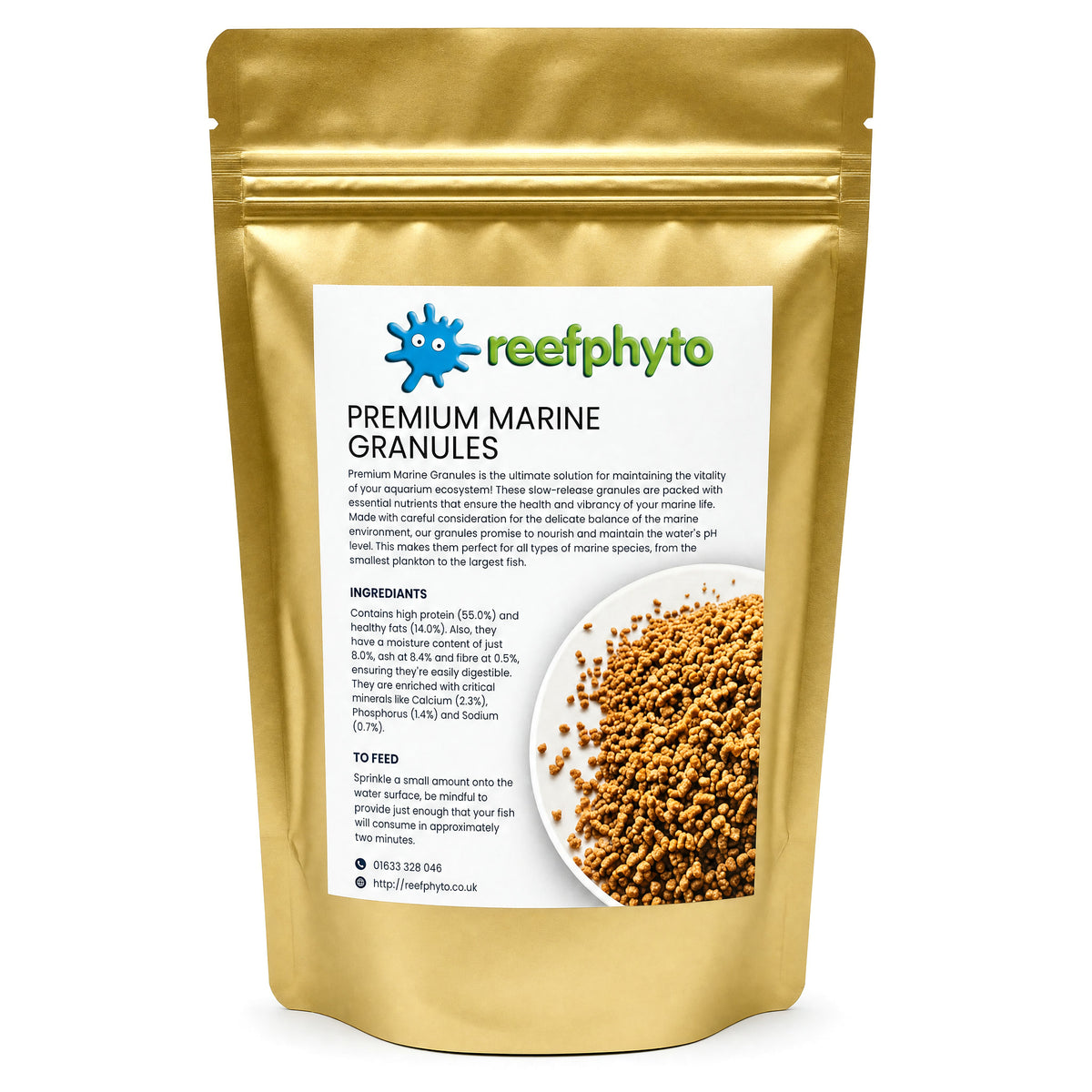
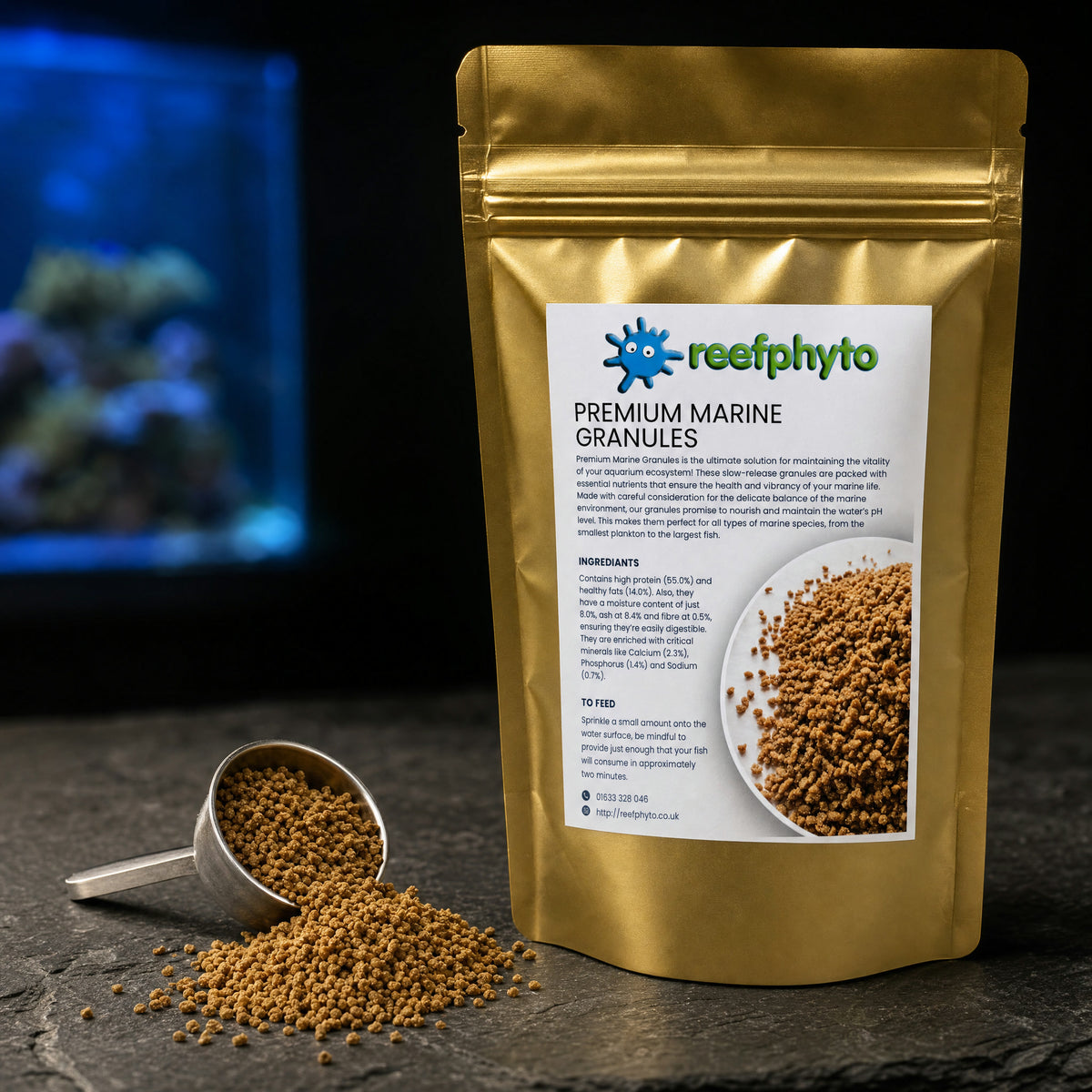
Reefphyto Premium Marine Granules are a slow sinking granule for marine fish, with 55% protein and 14% fat, in two sizes. Small is 0.5 to 0.8mm and Medium is 0.8 to 1.2mm. Feed small portions once or twice a day, only as much as your fish finish within five minutes.
Picture a pinch of granules drifting down through the water, and every fish in the tank, large and small, feeding at its own level.
I have been culturing live marine food in Wales since 2008, with 18+ years in marine aquaculture, and I am happy to advise on which size suits your fish.
Choose the size your smallest fish can swallow, and feed the whole tank.
Premium Marine Granules: What They Are
These are a dry granule food for marine fish, sold in a 100g pot. They are denser and smaller than a pellet and far less messy than flake. Because they sink slowly, they spend time in the upper water, the middle of the tank and near the rockwork before they reach the bottom, so surface feeders, mid-water fish and bottom dwellers all get a turn.
Which Size Do You Need?
Small, at 0.5 to 0.8mm, is for the small mouths. Gobies, firefish, chromis, young clownfish, small wrasse and juvenile fish that are being grown on after their live first foods. If you breed marine fish, this is the size that takes juveniles on from newly hatched brine shrimp to a dry diet.
Medium, at 0.8 to 1.2mm, suits most adult reef community fish. Clownfish, damsels, anthias, dwarf angels, wrasse and similar sized fish take it comfortably. If your tank is a mix of small and medium fish, many keepers use Small on its own, because larger fish will still eat a smaller granule but small fish cannot manage a larger one.
What Is in Them
The granules are made from fish and fish derivatives, cereals, oils and fats, and yeasts, with added vitamins. The analysis is protein 55.0%, fat 14.0%, fibre 0.5%, ash 8.4% and moisture 8.0%, with calcium at 2.3%, phosphorus at 1.4% and sodium at 0.7%. That is a high protein, low fibre food, which suits carnivorous and omnivorous marine fish.
The colour of the granules can vary a little from the picture, because it changes slightly from batch to batch.
How to Feed
Feed a small pinch once or twice a day and watch what happens. Everything should be eaten within about five minutes. If granules are reaching the sand and staying there, you are feeding too much. Turning the return pump down for a couple of minutes while you feed stops the granules being carried straight to the overflow. Keep the lid on tight and store the pot somewhere cool and dry.
Granules, Pellets or Flake?
We stock three dry foods for marine fish and they do different jobs. Granules are the small, dry, slow sinking option, and the one to pick when mouth size is the problem. Our Premium Marine Pellets are a soft, moist 1mm pellet that fussy feeders often take more readily. Marine Flake is the everyday food for a mixed tank that feeds at the surface. For tangs and other grazers, Premium Spirulina Granules are the plant-based version of this food.
Granules and Live Food
A good dry food is the daily base of a feeding routine, not the whole of it. Granules give your fish reliable protein every day. Live food adds the hunting behaviour and the fresh fatty acids that no dry food can match. Pod-Shot is the quick way to add live copepods at feeding time, and live copepods in the refugium keep a population going between feeds. Fish that are hunting live food will often start taking granules that drift past during the same feed, which is a useful way to wean a new fish onto dry food.
Premium Marine Granules FAQ
Which size should I buy?
Go by your smallest fish. Small is 0.5 to 0.8mm for gobies, chromis and juveniles. Medium is 0.8 to 1.2mm for most adult reef fish.
Do they float or sink?
They sink slowly, so fish at every level of the tank can feed.
How much should I feed?
A small pinch once or twice a day, and only what is eaten within five minutes.
Are they suitable for tangs?
Tangs will eat them, but they need more plant matter than this food provides. Use Premium Spirulina Granules or seaweed as their main food and these as a supplement.
Why are my granules a slightly different colour from the photo?
The colour varies a little between batches. The recipe is the same.
If you are not sure which size or which food suits your fish, get in touch. Darren responds personally.



 Roll over image to zoom in



 Darren Wordley
18 years culturing live phytoplankton in Wales
 Cultured in Wales, shipped live.