Brine shrimp are the most accessible live food in the hobby, easy to hatch, widely available, accepted eagerly by almost every fish that will eat live prey. The problem is not getting them into the tank. It is getting anything useful into them first. A freshly hatched nauplius that goes straight from the hatching cone to the display tank arrives nutritionally empty. The yolk sac that sustained it through hatching is consumed. What replaces it is whatever was in the culture water, which in most cases is very little.
The brine shrimp your fish are hunting are acting as live food without functioning as nutrition. You can see the feeding response. What you cannot see is the near-empty gut of each nauplius, carrying none of the fatty acids your fish and larvae actually need. The behaviour looks right. The outcome is not.
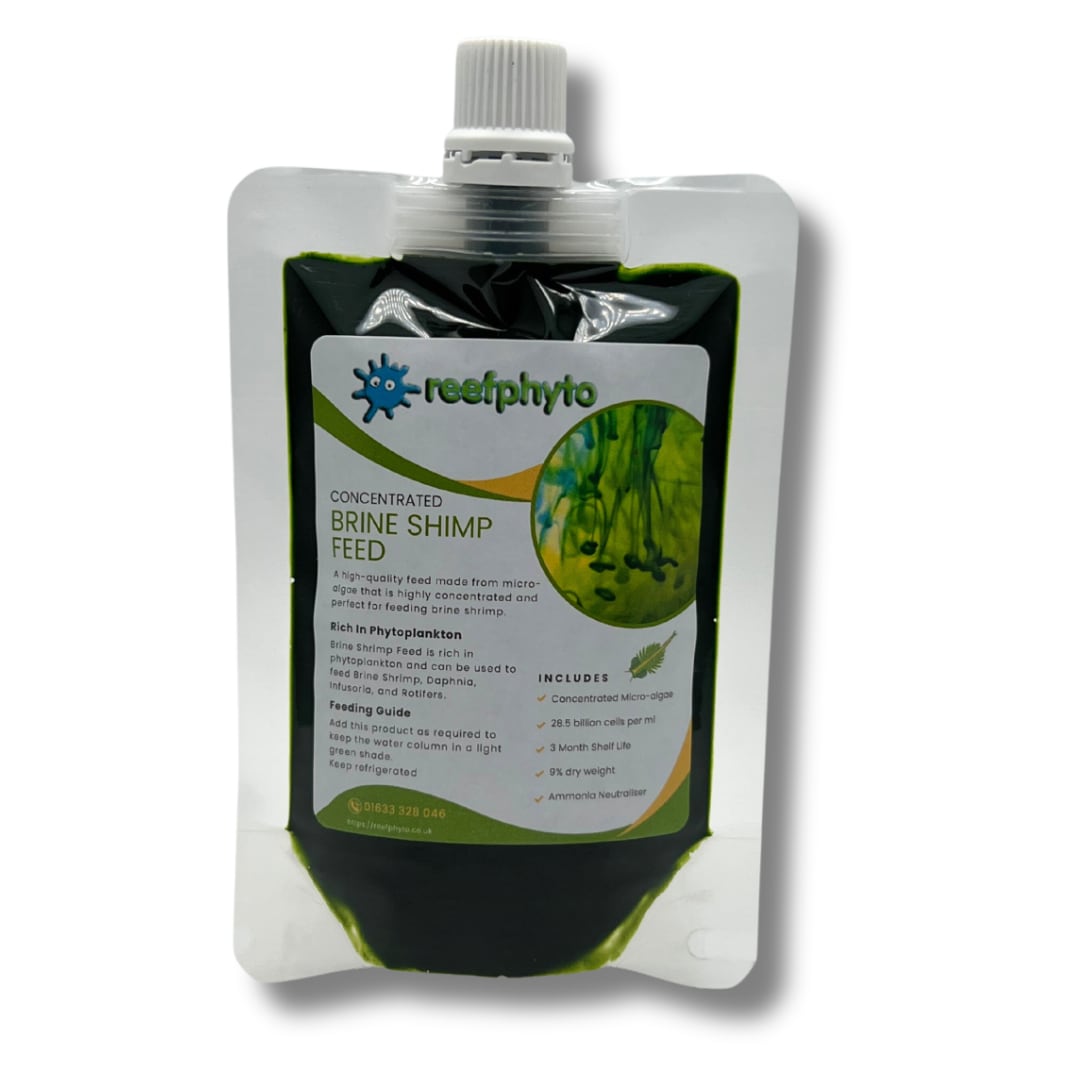
Reefphyto Brine Shrimp Feed is a concentrated microalgae blend at 28.5 billion cells per millilitre and 9 percent dry weight, formulated for both routine Artemia culture feeding and rapid pre-feed gut-loading. Added to the culture vessel it raises nauplii to adulthood in two weeks, providing the sustained microalgae diet that drives juvenile and adult Artemia development. Added one hour before harvesting and feeding to fish or larvae, it gut-loads nauplii rapidly, filling the digestive tract with microalgae cells that transfer directly to whatever consumes them. It also includes an ammonia neutraliser, which helps maintain water quality in brine shrimp culture vessels where organic load builds quickly. Available in 30ml, 50ml, and 100ml, store refrigerated and use within three months of delivery.
The same brine shrimp, fed before they reach the tank rather than after. Fish that were hunting empty vessels are now receiving a nutritional payload with every nauplius they take. Over the following weeks the visible difference accumulates: better colour, stronger feeding drive, and the quieter confidence of knowing the live food you are providing is actually doing what live food is supposed to do.
Reefphyto has been supplying live marine nutrition to reef keepers and fish breeders across the UK since 2008. If you want guidance on gut-loading timing, culture management, or how to integrate brine shrimp into a broader live food programme alongside copepods and rotifers, contact us. Darren responds personally.
Hatch them. Feed them. Then feed your fish something worth eating.
The Nutritional Gap in Brine Shrimp Feeding
Brine shrimp occupy a peculiar position in marine fish keeping. They are the most widely used live food in the hobby, the most reliably accepted by finicky feeders, and the most straightforward to produce at home from inexpensive eggs. And yet, used without enrichment or proper feeding, they are one of the least nutritious live foods available.
The reason is simple. Artemia salina nauplii hatch with a finite yolk sac reserve that is depleted within six to twelve hours of emergence. After that point, their nutritional content is determined entirely by what they have consumed. A nauplius placed in water with no food is nutritionally equivalent to the culture water itself by the time it is fed to fish, alive and moving, but carrying almost no transferable nutrition beyond its own body protein.
This is the junk food problem in brine shrimp feeding. The fish see live prey and respond naturally. The feeding behaviour looks correct. But the outcome, the nutritional transfer that should occur when a fish consumes a live food item, is largely absent if the nauplius was not fed before entering the tank.
Brine Shrimp Feed solves this at both the culture level, where nauplii are raised to adulthood on a consistent microalgae diet, and at the immediate level, where a short pre-feed gut-loading step fills the nauplius digestive tract before it is harvested and fed.
Two Applications in One Product
Brine Shrimp Feed works in two distinct ways depending on how it is used, and understanding both applications helps get the most from the product.
The first application is routine culture feeding. When added daily to a brine shrimp culture vessel, it provides the sustained microalgae diet that juvenile and adult Artemia require to develop normally. Nauplii raised on a consistent microalgae feed accumulate lipids, fatty acids, and proteins over the two weeks from hatching to adulthood that nauplii fed nothing do not. The resulting adult brine shrimp are nutritionally denser, more active, and carry a significantly better fatty acid profile than their unfed equivalents. For breeders or keepers running an ongoing Artemia culture rather than simply hatching and immediately feeding nauplii, daily culture feeding is the foundation of the programme's nutritional output.
The second application is rapid gut-loading before feeding. Adding Brine Shrimp Feed to a vessel of freshly hatched nauplii one hour before feeding to fish or larvae gut-loads the animals quickly. At 28.5 billion cells per millilitre, the cell density in the feed is high enough that nauplii can consume a meaningful quantity of microalgae within an hour, visibly colouring their digestive tract. This coloration is a reliable indicator that gut-loading has been effective and that the nauplii being fed to the tank are carrying live, biologically active cells rather than arriving empty.
The ammonia neutraliser included in the formulation helps manage water quality in the enrichment vessel during the gut-loading period, when the combination of nauplius metabolic output and added microalgae can raise ammonia quickly in a small, closed volume.
Raising Brine Shrimp to Adulthood
Most keepers hatch and immediately feed brine shrimp nauplii without carrying the culture through to the juvenile or adult stage. This is a practical choice for many situations, but adult Artemia offer advantages over nauplii that make growing them through worthwhile for certain applications.
Adult brine shrimp are significantly larger than nauplii, typically 8 to 12 millimetres compared to 500 to 700 microns at hatching, and are appropriate for feeding larger fish that nauplii are too small to satisfy. Fish such as lionfish juveniles, larger wrasse, and triggerfish that are being transitioned from live to prepared food often accept adult Artemia readily as an intermediate step between nauplii and non-live prey.
Adult Artemia that have been maintained on a consistent microalgae diet also contain significantly more accumulated DHA and EPA than nauplii, because they have had days or weeks to absorb and store fatty acids from their feed. For breeders running enrichment programmes alongside larval rearing, adult Artemia fed on Brine Shrimp Feed produce a higher-value enrichment substrate than nauplii gut-loaded for an hour.
Brine Shrimp Feed raises nauplii to adulthood in approximately two weeks under normal culture conditions with adequate aeration, appropriate temperature between 25 and 28 degrees Celsius, and daily feeding at a dose that keeps the culture water lightly but not densely coloured.
How Brine Shrimp Feed Fits Into a Complete Live Food Programme
Brine shrimp are often the first live food a marine keeper or breeder introduces, and for many they remain one component of a broader programme that includes rotifers for first-feeding larvae and copepods for reef fish and refugium populations.
Within that programme, the different live food types serve different roles and different size classes. Rotifers at 90 to 360 microns are the first-feed for most marine fish larvae whose mouths are too small for nauplii. Brine shrimp nauplii at 500 to 700 microns are the second-stage prey, appropriate once larvae have grown enough to capture larger food items. Adult brine shrimp or copepods are appropriate for juveniles and adult fish.
Brine Shrimp Feed supports the brine shrimp stage of this progression, ensuring that nauplii and adults entering the feeding chain are carrying the nutritional content that justifies their place in it. Paired with Rotifer Feed Concentrate for the rotifer stage and the Rotifer and Artemia Enrichment for pre-feed gut-loading of both rotifers and nauplii, it forms part of a complete live food nutrition chain from hatching to harvest.
Frequently Asked Questions
What microalgae species does this contain?
The current product description confirms a concentrated microalgae blend at 28.5 billion cells per millilitre and 9 percent dry weight. For specific species composition details, contact us directly and we will be happy to provide the full specification.
Can I use this for rotifers or Daphnia as well?
Yes. The product works across brine shrimp, Daphnia, Infusoria, and rotifers. For dedicated rotifer culture maintenance feeding, the Rotifer Feed Concentrate is formulated specifically around Brachionus plicatilis feeding biology and is the preferred product for a rotifer-focused programme. Brine Shrimp Feed is the more appropriate choice where brine shrimp are the primary live food being cultured or gut-loaded.
How long should I gut-load before feeding?
Add the feed to the nauplii vessel one hour before harvesting and feeding to fish or larvae. This provides sufficient time for nauplii to consume and visibly accumulate microalgae in their digestive tract. For more intensive enrichment, the Rotifer and Artemia Enrichment product can be added alongside this feed in the gut-loading window to boost DHA and EPA loading further before the nauplii enter the tank.
Does the ammonia neutraliser affect the tank if I add the nauplii without rinsing?
The ammonia neutraliser is present to manage water quality within the culture or enrichment vessel during feeding and gut-loading. Rinsing nauplii through a fine mesh before adding to the tank is good practice regardless, as it removes accumulated metabolic waste and excess phytoplankton from the enrichment water before it enters the display tank or larval rearing vessel.
What size should I order?
The 30ml size suits keepers hatching brine shrimp occasionally or wanting to try gut-loading for the first time. The 50ml size suits regular hatchers using the product for routine gut-loading before each feeding. The 100ml size suits breeders running ongoing Artemia cultures or anyone gut-loading daily across a larval rearing programme.
Reefphyto - Live Marine Nutrition from Wales Since 2008
Reefphyto has been supplying live marine food and culture feeds to reef keepers and marine fish breeders across the UK since 2008. If you want guidance on integrating brine shrimp into a broader live food programme, gut-loading timing, or building a complete larval nutrition chain from rotifers through to adult Artemia, contact us directly. Darren responds personally to every enquiry.
 Roll over image to zoom in


 Darren Wordley
18 years culturing live phytoplankton in Wales
Darren Wordley
18 years culturing live phytoplankton in Wales
 Cultured in Wales, shipped live.