
Quick Navigation
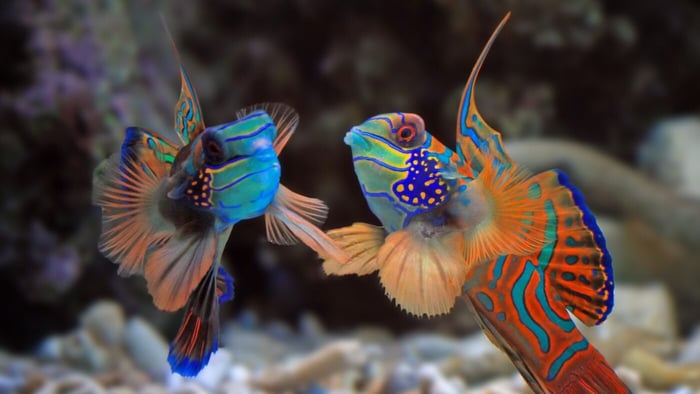
What kind of copepods are good for mandarin fish is one of the most important questions a reef keeper can ask before buying one of the hobby's most visually spectacular fish. The mandarin dragonet is an obligate live feeder. It does not accept dried flakes, pellets, or frozen food with any reliability in the long term. It hunts live prey continuously throughout the day, consuming hundreds of copepods every few hours in the wild. Get the answer to what kind of copepods are good for mandarin fish wrong, and the fish slowly starves regardless of how clean the water is or how much care goes into the rest of the tank.
Darren, Reefphyto
Why Mandarin Fish Are Different
Most marine fish can be transitioned to prepared foods given time and the right approach. Mandarin dragonets are categorically different. Their feeding mechanism is built around live prey detection. They use their eyes to spot moving copepods on the substrate and rockwork, dart forward, and capture them individually. This hunting behaviour is instinctive and highly specific. A mandarin in a tank without a sustainable live prey population will spend its days hunting and finding nothing, gradually losing condition and body weight until it can no longer recover.
The consequence of getting this wrong is not a fish that looks a little thin. It is a fish that dies within weeks to months of purchase, despite every other care parameter being correct. Understanding what kind of copepods are good for mandarin fish, and how to provide them sustainably, is the single most important piece of knowledge for anyone who wants to keep mandarins long-term.
Harpacticoid Copepods: The Right Match for Mandarin Fish
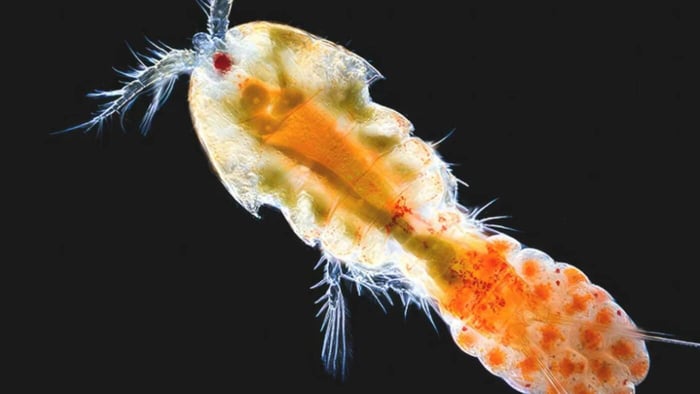
The answer to what kind of copepods are good for mandarin fish is harpacticoid copepods, specifically benthic harpacticoid species that live on and around substrates and rockwork rather than in the open water column. The mandarin's hunting behaviour is substrate-oriented. It picks along the rockwork and sand, hunting prey that is visible against a surface. Pelagic copepod species that live in the water column are not the right match because the mandarin's natural foraging style is not adapted to chasing prey in open water.
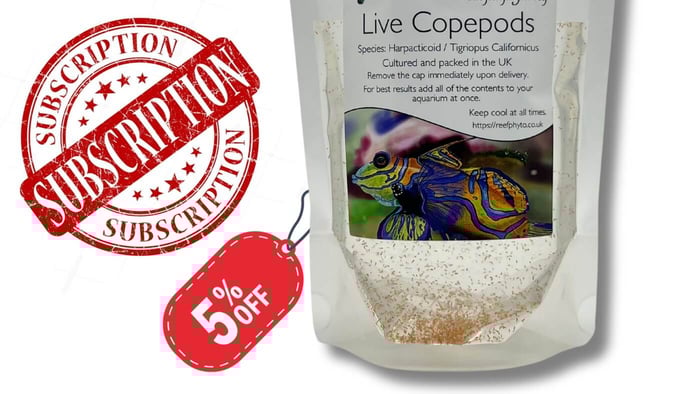
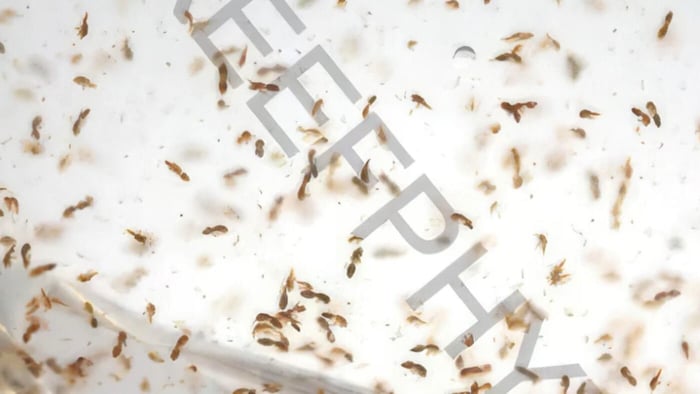
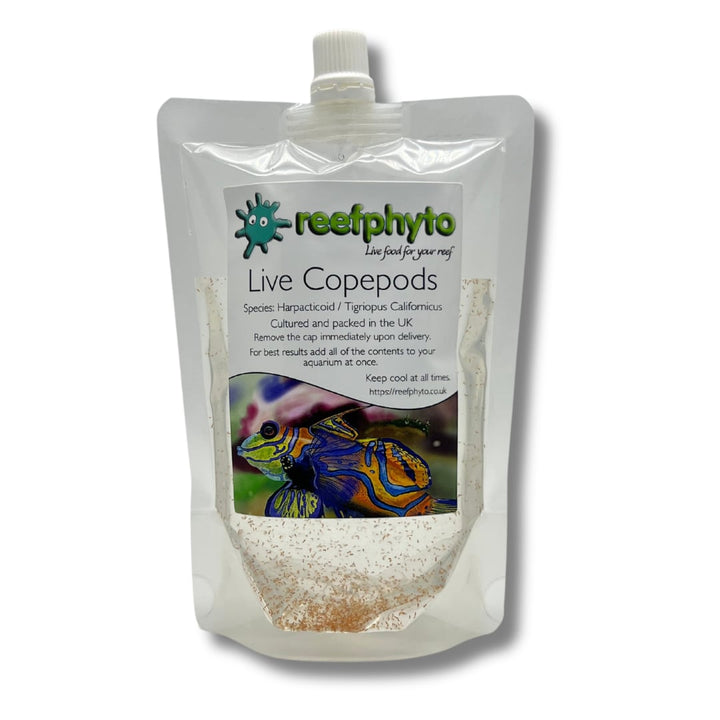
Tigriopus californicus, the harpacticoid species we culture at Reefphyto, is the most commonly used and most reliably available harpacticoid for reef aquaculture in the UK. Tigriopus is a robust, fast-reproducing species that colonises rockwork and refugium surfaces readily, tolerates a wide range of temperature and salinity conditions, and produces nauplii continuously in a productive refugium. It sits at the right size range for mandarin predation, and its nutritional profile, rich in EPA, DHA, and astaxanthin, is exactly what a mandarin dragonet needs to maintain its extraordinary colouration and immune function.
Live Copepods
£11.99
Live Copepods UK - Tigriopus californicus, Cultured Fresh in Wales by Reefphyto Your reef looks right on paper. Clean water, stable parameters, good equipment. But something is still off - your fish are pale, your mandarin is wasting, your corals… read more
A Refugium Is Not Optional for Mandarin Keeping
A single bottle of live copepods added to a display tank will not sustain a mandarin dragonet. The copepods will be consumed within days, and the tank will return to the same state it was in before. What kind of copepods are good for mandarin fish is therefore only half the question. The other half is how to provide them continuously rather than as a one-off addition.
The answer is a productive refugium running a self-sustaining harpacticoid copepod culture. A refugium, typically a separate compartment in the sump below the display tank, provides a protected environment where copepods can reproduce without being immediately predated. Copepod nauplii produced in the refugium migrate into the display tank through the return pump and provide a continuous trickle of live prey throughout the day and night. With a well-established, well-fed refugium, a mandarin can hunt successfully around the clock without ever exhausting the prey population.
Establishing a refugium copepod population takes time. Most reef keepers seed their refugium four to six weeks before introducing a mandarin, dosing with live phytoplankton regularly to feed the copepods and allowing the population to build to a density that can sustain continuous predation from a single fish. The initial population can be seeded with live copepods, which establish quickly on refugium substrate and rockwork and begin reproducing within days under good conditions.
Tank Size, Stocking, and Realistic Expectations
A mandarin dragonet in a tank of less than 200 litres with a small or absent refugium will almost certainly starve, regardless of how frequently copepods are purchased and added. The prey density required to sustain a mandarin is simply not achievable in a small system without a highly productive separate copepod culture supplying the display continuously.
In larger tanks of 300 litres or more with a mature, phytoplankton-fed refugium, a single mandarin can be sustained long-term with occasional copepod top-ups to maintain refugium population density. Two mandarins, which are sometimes kept as a male-female pair, require either a very large system or a particularly productive refugium to prevent one or both gradually losing condition as they compete for the available prey.
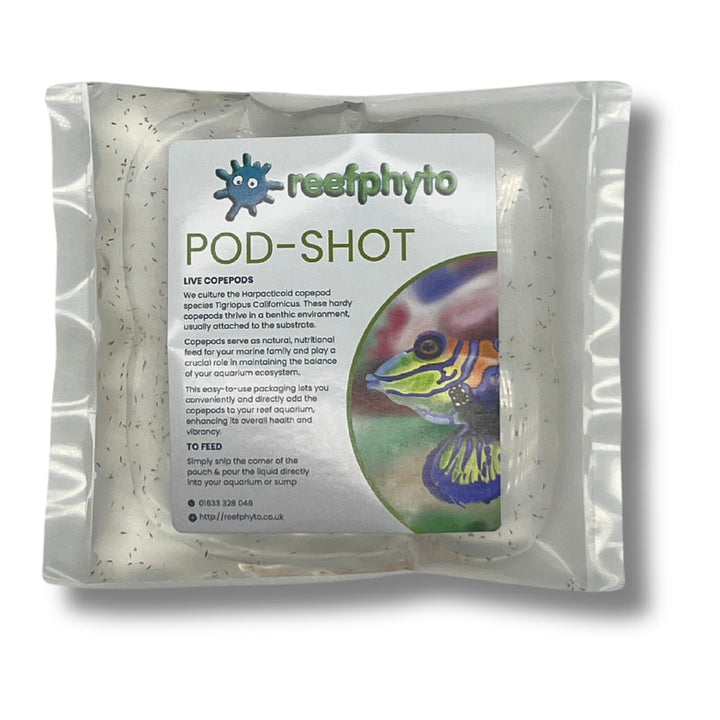
Pod-Shot - Live Copepods
£5.99
Pod-Shot - Live Copepods The moment you added a mandarin to your tank, the feeding pressure on your copepod population changed. What was a healthy refugium culture a month ago is now visibly thinner, and your mandarin is spending more… read more
A Note from Darren
I have been asked what kind of copepods are good for mandarin fish more times than I can count over 16 years. The answer is always harpacticoid copepods in a productive refugium, supported by regular phytoplankton dosing. There is no shortcut around the refugium requirement if you want to keep a mandarin successfully rather than watch it slowly decline. If you want to talk through your specific tank setup and whether it can support a mandarin, call us on 01267 611533 or use the contact page. I would rather help you make the right decision upfront than see a fish lost unnecessarily.